Last Updated on June 23, 2026 by Nucleosystech
The global software industry is currently undergoing a massive paradigm shift. Traditional coding methodologies, which rely entirely on manual programming and long testing cycles, are rapidly evolving. Today, AI software development has emerged as the core driver of this technical revolution. Modern enterprises no longer look at artificial intelligence as an experimental luxury. Instead, it is a fundamental pillar of sustainable digital transformation.
How exactly is artificial intelligence reshaping the custom software landscape? From writing code autonomously to predicting application performance before deployment, artificial intelligence development changes every phase of the traditional Software Development Life Cycle (SDLC).
The impact of AI in Software Development spreads across every single phase of application engineering. This shift is accelerating rapidly; according to data published in the GitHub State of the Open Source Ecosystem, AI-powered tools are fundamentally changing how modern development teams build, test, and deploy software.
By integrating tools like Machine Learning and advanced automated workflows, businesses can build highly tailored, exceptionally scalable, and secure systems in a fraction of the usual timeframe. For modern companies looking to build a definitive competitive advantage, understanding this evolution is essential.
The Evolution: From Traditional Coding to AI Software Development
For several decades, custom software engineering followed a highly linear and strict process. Software engineers manually analyzed client requirements, drafted system architectures, and wrote thousands of lines of code line-by-line. This process required significant time, enormous budgets, and a massive tolerance for human error. Debugging and quality assurance routinely consumed up to half of the total development timeline.
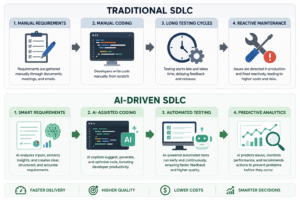
The introduction of modern Artificial Intelligence Development shattered these legacy barriers. AI-driven platforms act as intelligent co-pilots for developers. Instead of replacing human intelligence, these smart systems enhance human capabilities. They eliminate repetitive boilerplate coding, automate syntactic validation, and abstract complex infrastructural logic.
As a result, engineering teams shift their primary focus away from minor syntax details and direct their energy toward high-level business logic, user experience design, and systemic architecture. This evolution significantly lowers the barrier to innovation, allowing organizations of all sizes to launch enterprise-grade platforms rapidly.
Deep Dive: Key AI Technologies Driving Custom Software
To understand how software is transforming, we must look closely at the underlying technical engines powering this change. AI is not a single tool; it is an interconnected ecosystem of sophisticated technologies that work in unison to build robust, future-proof applications.
1. Machine Learning (ML)
At the very heart of smart software lies Machine Learning. Unlike traditional systems governed by hardcoded “if-then” rules, ML algorithms review huge datasets to identify deep conceptual patterns. Once trained, these models make independent, data-driven decisions. In custom applications, machine learning powers highly advanced personalized recommendation engines, autonomous anomaly detection, and sophisticated natural language processing modules.
2. Generative AI
The sudden rise of Generative AI has fundamentally changed how developers approach creation. Powered by vast Large Language Models (LLMs), generative systems write complete code snippets, build comprehensive databases, and automatically generate detailed technical documentation based on plain human language prompts. This rapid generation radically accelerates prototyping, allowing product teams to experiment with multiple architectural configurations in real time.
3. AI Automation
Manual workflows often slow down software engineering. AI Automation fixes this bottleneck by managing complex, repetitive tasks across the entire development cycle. It seamlessly handles software configuration, controls continuous integration and continuous deployment (CI/CD) pipelines, and automates environment setups. By running these background workflows autonomously, development teams experience fewer operational delays and human errors.
4. Predictive Analytics
Building custom software requires long-term planning for scalability and system stability. By embedding Predictive Analytics engines directly into the environment, development teams can analyze historic application performance and precisely project future user behavior. This allows software systems to optimize server resources dynamically, proactively flag potential security vulnerabilities, and fix system bottlenecks before they ever impact an end-user.
Phase by Phase: How AI Rewrites the Software Development Life Cycle (SDLC)
The impact of AI in Software Development spreads across every single phase of application engineering. Let us examine how intelligent algorithms optimize each stage of the lifecycle.
| SDLC Phase | Traditional Approach | AI-Driven Approach | Key Benefit |
| Requirements Gathering | Manual interviews, long documents, and frequent miscommunications. | NLP analysis of market data, user sentiment, and competitive systems. | Highly accurate project scoping and reduced feature creep. |
| System Design & Architecture | Manual blueprint creation based on architect experience. | AI evaluation of thousands of historical system architectures. | Optimized resource allocation, scalability, and performance. |
| Code Generation | Manual typing of code, libraries, and boilerplate structures. | Generative code auto-completion and intelligent refactoring. | Up to 40% faster development timelines. |
| Testing & Quality Assurance | Manual test scripts and basic, surface-level bug hunting. | Autonomous test generation and deep semantic code checking. | Immediate bug discovery and zero human bias in QA. |
| Deployment & Maintenance | Scheduled updates and reactive debugging after system crashes. | Self-healing deployments and proactive system monitoring. | Maximum application uptime and seamless user experience. |
Smarter Requirements Gathering and Conceptualization
Every successful software project begins with clear requirements. Historically, misaligned expectations between clients and developers caused over 70% of project delays. Today, advanced text-mining tools analyze initial client documentation, cross-reference it with industry benchmarks, and instantly highlight logical contradictions or missing requirements. This guarantees a highly accurate software blueprint before writing a single line of code.
Rapid Prototyping and Code Generation
During the development phase, engineering teams utilize advanced AI tools to write clean, syntax-perfect code. Instead of spending hours looking up API documentation or external libraries, a developer can describe a desired feature in plain text. The AI instantly generates the necessary code blocks in frameworks like .NET, Angular, or React. Furthermore, the system analyzes the code as it is being written, actively suggesting structural optimizations and architectural improvements.
Eliminating Bugs with Automated Quality Assurance
Software testing is often tedious and prone to human oversight. AI completely changes this dynamic by automatically scanning codebase updates, predicting where vulnerabilities are most likely to hide, and writing unique test cases to stress-test the environment. These automated systems check for complex logic flaws, data leaks, and edge-case errors, ensuring code is fully verified long before it moves to production.
Strategic Benefits of AI-Driven Custom Software for Enterprises
For modern organizations, adopting AI Development Services is a strategic business decision that delivers measurable financial and operational advantages.
- Drastically Accelerated Time-to-Market: By automating repetitive processes, organizations compress their development cycles from long months into short weeks, allowing them to capture shifting market opportunities faster than competitors.
- Substantial Cost Reduction: Eliminating manual development inefficiencies, minimizing debugging delays, and automating routine infrastructure management drastically lowers total engineering costs.
- Flawless Scalability: Custom platforms built with integrated AI adapt naturally to changing operational demands. They handle sudden traffic spikes smoothly by scaling cloud resources dynamically.
- Hyper-Personalized User Experiences: Businesses can create highly adaptive software interfaces. These systems analyze user behavior profiles in real time to customize layouts, content, and application workflows for each individual user.
- Ironclad Enterprise Security: Modern security systems utilize machine learning models to monitor application traffic continuously. They recognize malicious patterns, block unauthorized access attempts, and isolate suspicious activity instantly.
Real-World Use Cases: AI-Powered Custom Software Across Industries
To appreciate the massive impact of AI Software Development, let us look at how different industries leverage intelligent platforms to redefine their daily operations.
Fintech and Banking
Modern financial institutions deploy custom software built with advanced predictive models to evaluate credit risks instantly. They process thousands of global financial transactions per second, identifying and blocking fraudulent activities through real-time data analysis.
Healthcare and MedTech
In medical ecosystems, custom software solutions connect with machine learning models to analyze patient diagnostic records, predict patient risk factors, and securely manage healthcare records. These applications ensure full compliance with global data privacy regulations like HIPAA, while giving doctors actionable insights.
E-commerce and Retail
E-commerce businesses utilize advanced custom platforms to completely automate supply chain logistics. These systems predict seasonal inventory demands, optimize warehouse storage allocations, and run highly customized pricing models that adjust automatically based on real-time competitor activity and user interest.
Smart Logistics and Fleet Management
Custom enterprise resource planning (ERP) platforms use specialized route-optimization algorithms to manage global fleets. They analyze live traffic updates, weather conditions, and vehicle telemetry data to reduce fuel consumption and ensure on-time deliveries.
Overcoming Key Challenges in AI Software Development
While the business benefits of artificial intelligence are clear, companies must handle specific technical and operational challenges carefully to ensure long-term project success.
Ensuring Data Privacy and Regulatory Compliance
AI models require large amounts of data to learn and function properly. Organizations must ensure that their custom applications follow global data protection laws, including GDPR and CCPA. When building intelligent software, implementing strong data encryption, secure access controls, and strict data-anonymization workflows is essential.
Eliminating Algorithmic Bias
An AI system is only as unbiased as the data used to train it. If training datasets contain historical human bias, the application will repeat those unfair decisions. Mitigating this risk requires using diverse datasets and running continuous algorithmic audits conducted by experienced development partners.
Legacy System Integration
Many established companies rely on older legacy software systems. Integrating modern Enterprise AI Solutions with legacy platforms can create complex technical friction. Overcoming this requires building robust, middle-tier API architectures that allow smooth data exchange between old databases and new AI systems without disrupting core business operations.
Why Partner with a Leading AI Software Development Company?
Trying to design, train, and deploy advanced artificial intelligence systems in-house can overextend your internal IT teams. It requires specialized infrastructure, expensive data pipelines, and hard-to-find technical talent. Partnering with an experienced AI Software Development Company helps you avoid these costly hiring and infrastructural challenges.
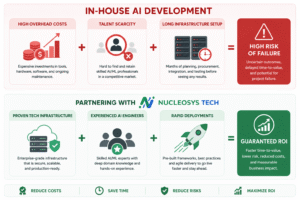
Experienced engineering partners provide the ready-made development frameworks, certified data scientists, and deep industry expertise needed to turn complex concepts into functional software. They help your business select the best technical tools, set up secure cloud integrations, and ensure your system scales smoothly as your company grows.
Drive Business Innovation with Nucleosys Tech
As modern industries continue to evolve, relying on rigid, outdated software architectures will limit your business growth. Staying ahead of the competition requires scalable, highly intelligent tools tailored specifically to your operational workflows.
At Nucleosys Tech, we bridge the gap between complex software engineering and practical business growth. As a premier technology solutions provider with over 13 years of expertise, our team specializes in building custom web applications, advanced .NET environments, and robust enterprise systems. We seamlessly integrate cutting-edge AI Integration Services into your existing architecture, transforming your daily workflows into automated, data-driven powerhouses.
Whether you need to automate complex operational workflows with machine learning or build a scalable SaaS application, we deliver high-performing solutions designed for long-term ROI. Discover how our tailored digital strategies can elevate your business. Explore our full range of services at Nucleosys Tech and let us build the future of your business together.
Frequently Asked Questions (FAQ)
What is the primary difference between traditional software and AI software development?
Traditional software relies on static, human-written rules and code structures that cannot adapt on their own. In contrast, AI software development integrates machine learning models and data-driven algorithms. This allows the application to analyze user behavior, learn from data patterns, and automatically optimize its functionality over time without manual updates.
How does AI automation lower total custom software development costs?
AI automation handles repetitive, time-consuming development tasks like writing boilerplate code, configuring cloud environments, and running continuous quality assurance tests. By automating these background workflows, development teams significantly reduce human errors, shorten overall engineering timelines, and lower total project costs.
Can custom AI solutions integrate safely with our existing legacy databases?
Yes, modern AI integration services are designed to connect with older legacy systems. Experienced development companies build secure API layers and middle-tier architectures that extract, clean, and process data from your legacy databases safely, ensuring your daily business operations continue to run smoothly.
How do you ensure data privacy and security in AI applications?
We implement strict enterprise-grade security protocols, including end-to-end data encryption, multi-factor user authentication, and secure access controls. Additionally, all data processed by the AI models is thoroughly anonymized to ensure full compliance with global regulatory standards like GDPR and HIPAA.
What industries benefit the most from custom AI software solutions?
Almost every industry can leverage AI to improve operational efficiency. Currently, sectors like FinTech, healthcare, e-commerce, logistics, and manufacturing see the highest return on investment. These industries use AI to automate complex workflows, predict market trends, and deliver highly personalized customer experiences.

