
Last Updated on September 18, 2026 by Nucleosystech
AI Search 2026 is changing how people discover information, compare solutions, research businesses, and make decisions online. Google Search is moving beyond the traditional model of entering keywords, scanning blue links, and opening individual websites.
With Google AI Mode, AI Overviews, conversational follow-up questions, multimodal search, and new AI-powered experiences, users can ask longer and more complex questions and receive synthesized answers with links to supporting websites.
For businesses and SEO professionals, this creates a major shift: ranking for a keyword is no longer the only visibility goal.
Brands increasingly need to become visible across traditional search results, AI-generated answers, related queries, conversational search journeys, and other Google discovery surfaces.
Google’s 2026 Search announcements show how quickly this transformation is developing. Google says AI Mode has surpassed one billion monthly users, while AI Overviews have more than 2.5 billion monthly active users. Google has also expanded AI-powered Search with conversational experiences, richer links, multimodal inputs, and AI agents.
So what does this mean for SEO?
Let’s explore how AI Search in 2026 is changing search optimization and what businesses should do to improve their AI visibility.
Table of Contents
- What Is AI Search in 2026?
- What Is Google AI Mode?
- AI Mode vs Traditional Google Search
- How AI Search Is Changing User Search Behavior
- Why AI Search Changes SEO
- AI SEO vs Traditional SEO
- How Google AI Mode Finds and Uses Content
- 10 Ways to Optimize for AI Search in 2026
- The Role of AI Overviews and AI Visibility
- Does AEO or GEO Replace SEO?
- How to Create AI-Search-Friendly Content
- Technical SEO for AI Search
- How to Measure AI Search Performance
- Common AI SEO Mistakes
- The Future of SEO in 2026 and Beyond
- Final Takeaway
- FAQs
What Is AI Search in 2026?
AI Search 2026 refers to the growing use of artificial intelligence within search engines to understand queries, connect information from multiple sources, generate responses, and help users explore a topic conversationally.
Traditional search generally works around a query and a set of ranked results.
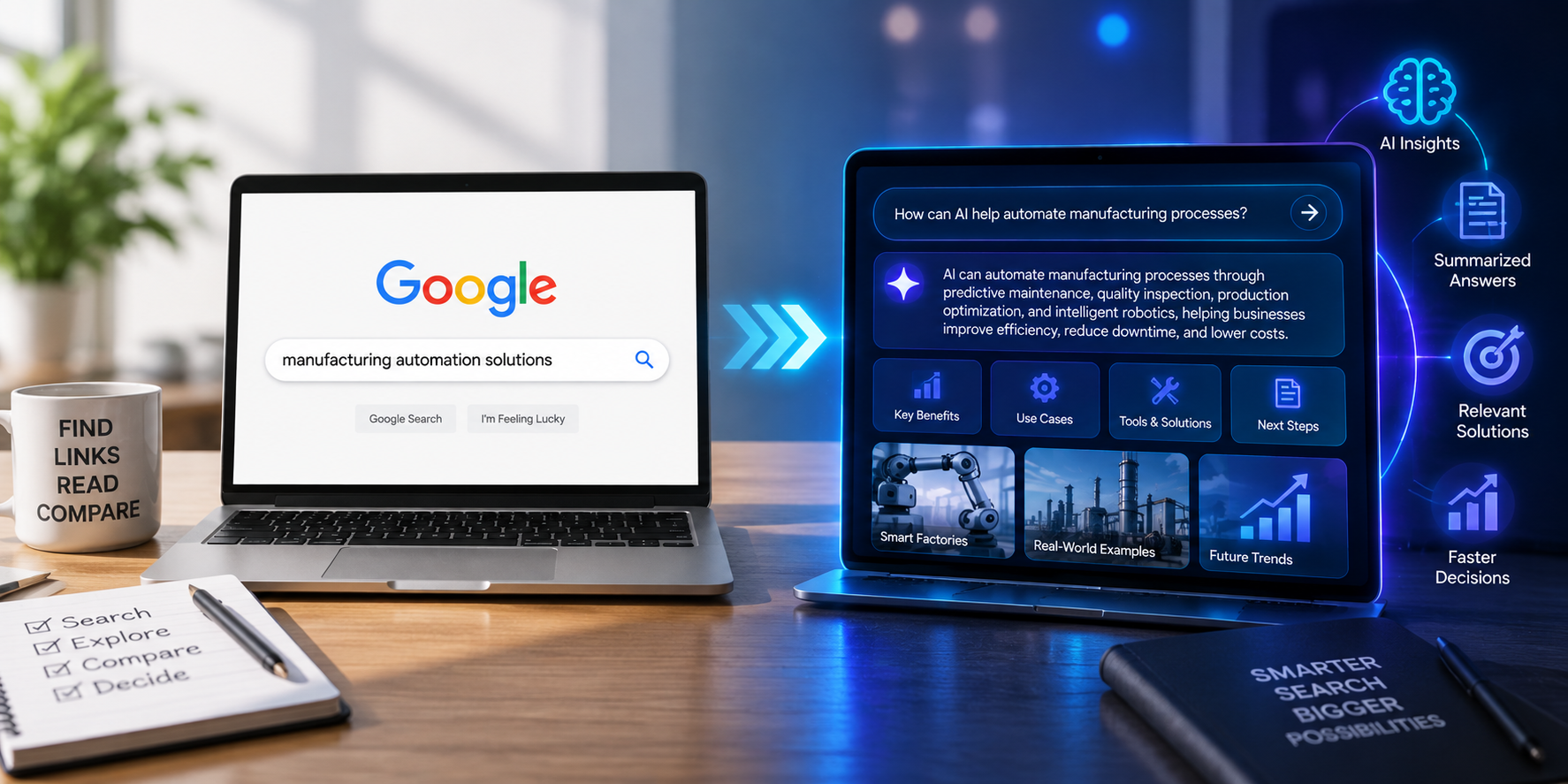
AI-powered search can go further.
A user might search:
“What is the best digital marketing strategy for a manufacturing company that wants more B2B leads?”
Instead of simply returning pages optimized around the exact phrase, an AI-powered search system can understand multiple concepts within the question:
- digital marketing
- manufacturing
- B2B marketing
- lead generation
- buyer intent
- SEO
- paid advertising
- industrial decision-makers
Google’s AI Search systems can use related searches and multiple sources to develop a broader understanding of a complex query.
Google describes query fan-out as a process in which AI generates related searches to explore different aspects of a user’s question before producing a response.
This means content strategy needs to move from simply targeting individual keywords toward covering topics, entities, questions, search intent, and related subtopics comprehensively.
What Is Google AI Mode?
Google AI Mode is an AI-powered Search experience designed for more complex and conversational searches.
Instead of requiring users to perform several separate searches, AI Mode allows them to ask a longer question, receive an AI-generated response, and continue with follow-up questions.
Google introduced AI Mode as a way to handle searches that require deeper reasoning and exploration. In 2026, Google expanded the experience with additional AI capabilities and more conversational interactions.
For example, a traditional search journey might look like:
Search 1: Best SEO strategies for manufacturers
Search 2: Manufacturing SEO keywords
Search 3: How to generate B2B leads
Search 4: Industrial SEO case studies
A conversational AI search journey could combine much of this research into one broader interaction.
That changes the SEO opportunity.
The goal is not only to rank for:
“manufacturing SEO”
but to create authoritative content capable of answering the connected questions a potential buyer may ask next.
AI Mode vs Traditional Google Search
The fundamental purpose of Search remains helping users find useful information, but the interaction is changing.
| Traditional Search | AI-Powered Search |
|---|---|
| Short keyword queries | Longer conversational questions |
| Individual search results | Synthesized responses with supporting links |
| Multiple searches for complex topics | Follow-up conversational searches |
| Primarily text-based | Increasingly multimodal |
| Keyword-focused optimization | Topic and intent-focused optimization |
| SERP ranking | Visibility across AI-generated experiences |
| One query at a time | Related queries and query fan-out |
Google has emphasized that AI Overviews and AI Mode continue to surface links to websites and are designed to help users explore information across the web. Google has also increased the use of links and website previews within AI experiences.
For publishers and businesses, that means organic visibility is not disappearing—it is becoming more distributed across the search experience.
How AI Search Is Changing User Search Behavior
One of the most important changes in AI Search 2026 is the way users formulate questions.
People can now ask more detailed questions without worrying about constructing the perfect keyword phrase.
For example:
Old-style search:
“SEO agency Pune”
More conversational search:
“What should a manufacturing company in Pune look for when choosing an SEO agency to generate qualified B2B leads?”
The second query contains significantly more context.
AI-powered search can interpret:
- location
- industry
- service
- business objective
- audience
- purchase intent
- desired outcome
Google reported that users of AI Mode ask longer questions and use the experience for more complex exploratory searches.
For SEO professionals, this reinforces the importance of search intent and semantic relevance.
Why AI Search Changes SEO
The biggest mistake businesses can make in 2026 is assuming that AI Search means traditional SEO is no longer important.
Google’s own guidance says the opposite.
Google states that existing SEO fundamentals remain relevant for AI features such as AI Overviews and AI Mode. Pages need to be technically eligible for Search, indexable, crawlable, useful, and supported by strong content and page experience.
The change is therefore not:
SEO → AI SEO
It is closer to:
Traditional SEO + stronger topical relevance + useful original content + broader search visibility.
This creates a new optimization objective:
From keyword rankings to search visibility.
A brand may be discovered through:
- traditional organic results
- AI Overviews
- Google AI Mode
- featured snippets
- related questions
- images
- videos
- Discover
- branded searches
- conversational follow-ups
Your SEO strategy should consider the complete journey.
AI SEO vs Traditional SEO
AI SEO is commonly used to describe strategies designed to improve visibility in AI-powered search experiences.
However, Google says there are no special technical requirements or special schema markup required specifically for AI Overviews or AI Mode. The foundational SEO requirements still matter.
The practical difference is mainly strategic.
Traditional SEO focuses heavily on:
- keyword targeting
- rankings
- backlinks
- technical SEO
- on-page optimization
- search intent
AI search optimization adds greater emphasis on:
- comprehensive topic coverage
- conversational questions
- original insights
- clear entities and relationships
- first-hand experience
- concise answers
- contextual relevance
- supporting evidence
- structured content
- brand/entity recognition
This is why AI visibility should be treated as an extension of an established SEO strategy rather than a completely separate discipline.
How Google AI Mode Finds and Uses Content
Understanding this is important for anyone working on AI search optimization.
Google’s generative AI Search features use information from Google’s Search systems to help generate responses. Google describes techniques including retrieval-augmented generation (RAG) and query fan-out as part of how generative AI features can retrieve relevant information.
In practical terms, this means your content still needs to be discoverable and understandable by Search.
Your page should have:
- crawlable content
- clear headings
- descriptive titles
- strong internal links
- useful supporting information
- relevant entities
- original information
- good page experience
- accurate structured data
- accessible text content
AI Search is not a replacement for a technically healthy website.
10 Ways to Optimize for AI Search in 2026
1. Create Original, Non-Commodity Content
AI systems can summarize information that already exists.
That makes generic content less differentiated.
Instead of writing:
“SEO is important because it increases website traffic.”
Add something useful that demonstrates experience.
For example:
- original examples
- industry-specific observations
- practical workflows
- screenshots
- experiments
- case studies
- original data
- expert commentary
- implementation checklists
Google’s guidance specifically highlights the value of unique, non-commodity content for generative AI Search.
2. Target Search Intent, Not Just Keywords
Do not create an article simply because a keyword has search volume.
Ask:
What is the user actually trying to accomplish?
For example, the keyword:
“AI SEO”
could represent several intents:
- What is AI SEO?
- How does AI SEO work?
- How do I optimize for AI search?
- Is AI SEO different from traditional SEO?
- How can my business improve AI visibility?
One comprehensive article can address these connected intents better than five thin pages.
3. Build Topic Clusters
AI Search often explores related concepts.
Build content around a central topic.
For example:
Main topic:
AI Search
Supporting content:
- What is Google AI Mode?
- AI Overviews explained
- AI SEO strategy
- AI search optimization
- AEO vs SEO
- GEO vs SEO
- How to optimize content for AI visibility
- AI Search analytics
- Search Console AI insights
- Future of SEO
This creates stronger topical coverage and internal-linking opportunities.
4. Answer Important Questions Clearly
AI-friendly content should not hide the answer beneath five paragraphs of introduction.
Use clear structures such as:
What is AI Search?
Then provide the direct explanation.
Follow it with supporting detail.
This helps both human readers and search systems understand the page.
Useful formats include:
- short definitions
- bullet points
- numbered steps
- comparison tables
- FAQs
- examples
- checklists
5. Demonstrate First-Hand Experience
One of the strongest ways to differentiate content is to demonstrate experience.
Instead of:
“Businesses should optimize their websites for AI search.”
Show:
- how you audited a page
- what changed after optimization
- screenshots of Search Console
- before-and-after examples
- content structures you tested
- actual workflow examples
- industry-specific observations
This makes the content more useful than a generic AI-generated summary.
6. Strengthen Internal Linking
Internal links help users and search systems discover related content.
For example, an AI Search article could link naturally to:
- SEO services
- AI SEO services
- content marketing
- technical SEO
- Google Ads
- website development
- AI software development
- industry-specific SEO pages
Use descriptive anchor text rather than repeatedly using generic phrases such as “click here.”
7. Make Important Information Available as Text
Google recommends ensuring important content is available in textual form.
Do not put critical information only inside:
- images
- videos
- animations
- JavaScript-only interfaces
- downloadable files
Use HTML text for important explanations, headings, tables and answers.
8. Use High-Quality Images and Video
Visual content is increasingly important for modern search experiences.
For Discover especially, use:
- original featured images
- relevant illustrations
- screenshots
- diagrams
- charts
- short videos
- explanatory graphics
Google recommends supporting textual content with high-quality images and video where appropriate.
For this article, use a 1200px or larger featured image and make the visual directly communicate the topic.
9. Keep Content Fresh
AI Search depends on information that can remain useful and current.
Review pages when:
- Google introduces major Search updates
- product features change
- statistics become outdated
- screenshots become obsolete
- links change
- industry practices evolve
For a topic such as AI Search 2026, freshness is particularly important.
Add a visible:
Last Updated: September 2026
when the article is genuinely reviewed and updated.
10. Optimize for the Entire Search Journey
Don’t optimize only for the first query.
Consider what someone might ask next.
For example:
Primary question:
“What is Google AI Mode?”
Potential follow-ups:
- How does Google AI Mode work?
- Does AI Mode replace SEO?
- How do I optimize for Google AI Mode?
- Can my website appear in AI Overviews?
- Does schema help AI Search?
- How can I measure AI visibility?
Build the article so it naturally answers these connected questions.
The Role of AI Overviews and AI Visibility
AI Overviews and AI Mode create additional opportunities for websites to be discovered.
Google says its AI Search experiences include links to supporting websites and are designed to help users explore the web. Google has also introduced website previews and additional links within AI experiences.
This creates an important distinction:
Ranking is one visibility metric.
Being referenced or discovered during an AI-assisted search journey is another.
That does not mean traditional rankings no longer matter.
It means businesses should monitor a wider range of search visibility signals.
Does AEO or GEO Replace SEO?
You will increasingly hear terms such as:
- AEO — Answer Engine Optimization
- GEO — Generative Engine Optimization
- AI SEO
- AI Search Optimization
These terms describe different approaches to optimizing content for AI-powered discovery.
However, Google states that from its perspective, optimizing for generative AI Search is still fundamentally connected to SEO. Existing technical and content best practices remain important.
Therefore, businesses should avoid treating AEO, GEO and AI SEO as completely separate from their SEO foundation.
A practical approach is:
Technical SEO → Content SEO → Entity & Topic Optimization → AI Search Visibility → Conversion Optimization
How to Create AI-Search-Friendly Content
A strong AI Search article should follow a logical structure.
Recommended structure:
H1: Main topic
Introduction: Direct answer + current context
H2: What is the topic?
H2: Why is it changing?
H2: How does it work?
H2: What does it mean for businesses?
H2: Practical optimization strategies
H2: Common mistakes
H2: Examples
H2: Measurement
H2: FAQs
This format gives readers multiple entry points.
It also makes long-form content easier to scan.
Technical SEO for AI Search
AI Search optimization still starts with technical SEO.
Check the following:
Indexability
Make sure important pages can be crawled and indexed.
Robots.txt
Do not accidentally block important content.
Internal links
Connect related pages using meaningful anchor text.
Page experience
Ensure pages work properly across desktop and mobile.
Structured data
Use appropriate structured data when relevant, and ensure it matches visible page content.
Canonical URLs
Avoid unnecessary duplicate URL versions.
Images
Use descriptive filenames, appropriate dimensions and useful alt text.
JavaScript
Ensure important content is accessible to Search systems.
Website speed
Reduce unnecessary scripts, heavy resources and layout problems.
Google’s current guidance emphasizes that AI Search still relies on the underlying Search ecosystem and foundational technical SEO.
How to Measure AI Search Performance
Measurement is becoming an important part of AI search optimization.
Google introduced a Search Console control for generative AI Search features, including AI Overviews, AI Mode and generative AI features in Discover.
As of August 31, 2026, Google says this control has rolled out to websites worldwide. The default is inclusion, while site owners can manage the setting from Search Console.
Google has also introduced generative AI performance insights intended to help website owners understand visibility in these experiences.
For an SEO team, monitor:
- impressions
- clicks
- CTR
- queries
- landing pages
- branded searches
- organic conversions
- Discover traffic
- AI Search visibility
- engagement
- assisted conversions
Do not evaluate AI Search success using rankings alone.
Common AI SEO Mistakes to Avoid
Mistake 1: Publishing Mass AI-Generated Articles
Generating hundreds of generic articles does not automatically create search visibility.
Focus on usefulness and originality.
Mistake 2: Keyword Stuffing
Repeating “AI Search 2026” excessively makes content unnatural.
Use the primary keyword where it makes sense and build semantic coverage around related concepts.
Mistake 3: Creating Content Only for Search Engines
Write for people first.
Google’s guidance continues to emphasize helpful, reliable, people-first content.
Mistake 4: Ignoring Technical SEO
A brilliant article cannot perform properly if Search cannot access or index it.
Mistake 5: Publishing Outdated AI Information
AI Search changes quickly.
A 2025 explanation may not accurately describe the 2026 Search experience.
Mistake 6: Creating Thin FAQ Sections
Do not add FAQs simply to increase keyword coverage.
Answer genuine questions that users are likely to have.
Mistake 7: Assuming Special AI Schema Is Required
Google currently says there is no special schema.org markup specifically required to appear in AI Overviews or AI Mode.
What Is the Future of SEO in 2026?
SEO is moving toward a broader concept of search visibility.
The future is not simply:
Keyword → Ranking → Click
The journey increasingly looks like:
Question → AI interpretation → Multiple related searches → AI response → Supporting sources → Website discovery → Further research → Conversion
This means brands need to become useful across the entire journey.
For businesses, that means investing in:
- strong technical SEO
- original content
- topical authority
- expert insights
- first-hand experience
- entity optimization
- internal linking
- high-quality multimedia
- conversion-focused landing pages
- brand authority
- continuous measurement
Google’s own 2026 updates reinforce this direction. Search is becoming more conversational and multimodal while continuing to connect users with websites and information across the web.
Final Takeaway: SEO Is Evolving, Not Disappearing
AI Search 2026 is changing how people discover information, but it does not eliminate the fundamentals of SEO.
Google’s current guidance makes this clear: websites still need to be crawlable, indexable, useful, technically sound and valuable to users.
The strategic shift is that businesses should think beyond individual keyword rankings.
Create content that:
- answers real questions
- demonstrates expertise
- provides original information
- covers related search intent
- uses clear structure
- supports claims with evidence
- provides useful visuals
- connects naturally to relevant pages
- gives users a reason to visit your website
The brands that adapt their SEO strategy around search intent, topical authority, original content and AI visibility will be better positioned for the increasingly AI-powered search ecosystem.
In 2026, the question is no longer simply:
“How do I rank #1?”
A more useful SEO question is:
“How can my brand become one of the most useful sources throughout the user’s search journey?”
Frequently Asked Questions About AI Search 2026
What is AI Search 2026?
AI Search 2026 refers to the growing integration of artificial intelligence into search experiences, including conversational answers, AI Overviews, Google AI Mode, multimodal search and other AI-powered discovery features.
What is Google AI Mode?
Google AI Mode is an AI-powered Search experience that allows users to ask complex questions, explore topics conversationally and continue with follow-up questions. Google has expanded AI Mode with additional AI capabilities and search experiences during 2026.
Does AI Search replace traditional SEO?
No. Google says existing SEO fundamentals remain relevant for AI Overviews and AI Mode. Websites still need to meet Search technical requirements and provide useful, reliable content.
How do I optimize my website for AI Search?
Start with foundational SEO: ensure your pages are crawlable and indexable, create original people-first content, answer user questions clearly, strengthen internal linking, demonstrate first-hand expertise and provide useful images or video where appropriate.
What is AI visibility?
AI visibility refers to how easily a brand, website, product or piece of content can be discovered or referenced within AI-powered search experiences.
Is GEO the same as SEO?
GEO, or Generative Engine Optimization, is a term used for optimizing content for generative AI experiences. Google describes optimization for generative AI Search as continuing to rely on SEO fundamentals rather than requiring a completely separate technical system.
Does schema help Google AI Mode?
Structured data can help Search understand a page when implemented correctly, but Google says there is no special schema.org markup specifically required for AI Overviews or AI Mode.
Can AI Search send traffic to websites?
Yes. Google says AI Overviews and AI Mode include links to websites and are designed to help users explore the web. Google has also introduced additional links and website previews within its AI experiences.
How can I monitor AI Search performance?
Use Google Search Console to monitor your Search performance and, where available, the generative AI performance insights and Search generative AI control. Google says the generative AI control became available globally on August 31, 2026.
Will keywords still matter in AI Search?
Yes, but keyword targeting should be combined with search intent, semantic relationships, entities, topical coverage and useful content. Optimizing only for exact-match keywords is increasingly insufficient for complex conversational searches.
About Nucleosys Tech
Nucleosys Tech helps businesses build stronger digital visibility through SEO, digital marketing, AI solutions and technology services. As search continues to evolve, businesses need strategies that connect traditional SEO with content quality, user intent, technical performance and emerging AI-powered discovery.
Ready to adapt your SEO strategy for AI Search? Build your visibility around the questions your customers are asking—not just the keywords they type.

