Testing begins in the US
OpenAI opens a limited pilot to large brands and agency partners, gated behind a minimum spend commitment.
Nucleosys Tech | Web Application | Best Website Design Company| Digital Marketing
Nucleosys Tech is a ChatGPT Ads agency managing campaigns from the ground up: context-hint architecture, chat card creative, landing page alignment, and conversion tracking. Ads went live in India on 27 August 2026, and self-serve buying opened on 4 September — we help brands test this new channel properly from day one, with a structured build instead of guesswork.
Our approach focuses on matching advertising with the user’s conversational intent, so campaigns feel relevant rather than disruptive. We build the campaign foundation, develop creative that fits the chat environment, and connect every step to a measurable conversion journey.
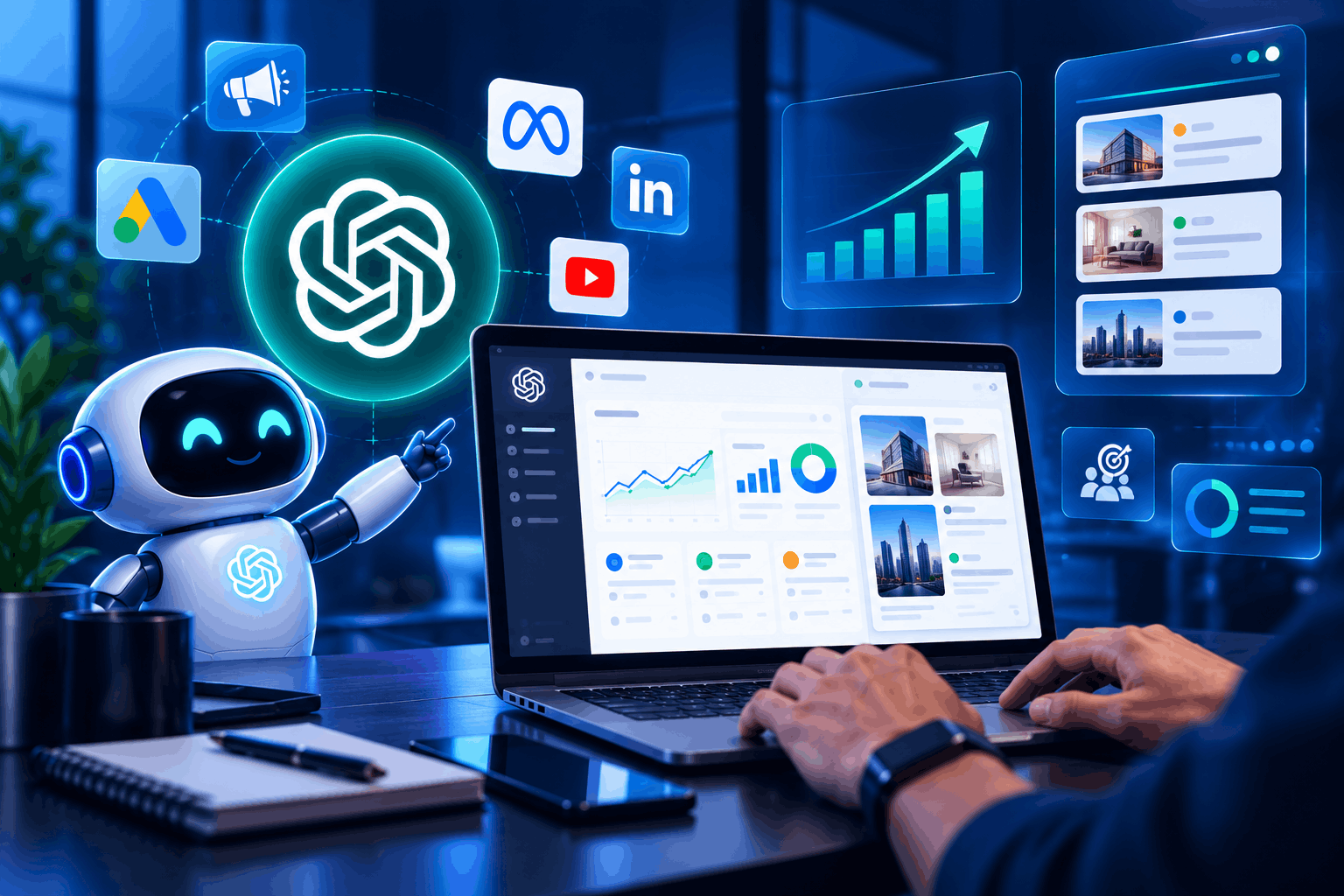
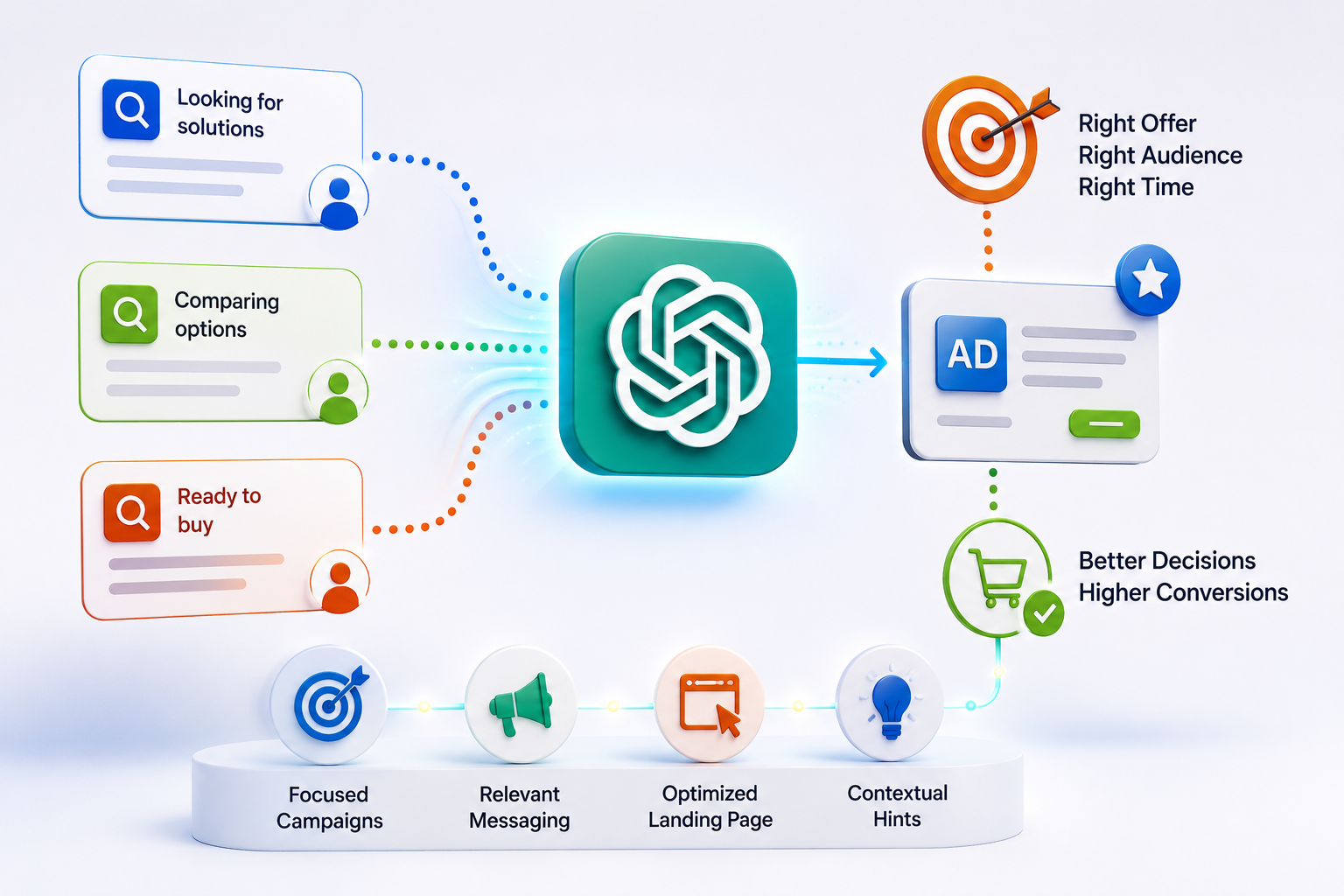
A ChatGPT ad is a single sponsored card served below an answer, targeted by descriptions of conversations rather than keywords, and ranked by a relevance-weighted second price auction where your bid is only one input.
OpenAI began testing ads in ChatGPT on 9 February 2026 in the United States. As of 1 September 2026, ads run in more than 40 markets, self-serve buying is open in the United States and expanding, and OpenAI stated on 31 August 2026 that its advertising business reached a USD 1 billion annualised revenue run rate in under 200 days.
The mechanics are narrow: one ad format, the chat card; one targeting mechanism, context hints; and three objectives, billed on CPM, CPC or oCPC. Delivery is decided by a relevance-weighted second price auction. Advertisers do not receive users’ chats, chat history, memories, names, emails, precise location or IP address, only aggregated campaign data such as impressions and clicks.
India went live on 27 August 2026, and self-serve buying opens from 4 September 2026. That is a matter of days between reading this and being able to run a campaign, which is why the timing question is live rather than theoretical.
OpenAI opens a limited pilot to large brands and agency partners, gated behind a minimum spend commitment.
The minimum spend requirement is dropped, and web conversion tracking (pixel + Conversions API) ships alongside self-serve access.
Ads start appearing to eligible ChatGPT users in India. More than 50 brands are part of the initial cohort, with WPP and Omnicom named as launch agency partners for the market.
OpenAI reports its ad business hit a USD 1 billion annualized revenue run rate in under 200 days, and confirms advertisers in India, Europe, the Middle East, and North Africa can now buy directly through Ads Manager.
At its core, a ChatGPT ad is one sponsored card that appears below the AI’s answer. It’s targeted using descriptions of conversations rather than keywords, and placement is decided through a relevance-weighted second-price auction — where your bid is just one factor among several.
Five elements make up the entire creative surface, and each one is scored for how relevant it is to the conversation the ad appears in.

Always visible, mandatory, and clearly separated from the answer above it — there’s no way to blend an ad into the response.

Minimum size of 256×256 pixels. Best practice is to export larger and let the card scale it down rather than uploading at the minimum.

3 to 50 characters, but it truncates well before the cap. Front-load the qualifier.

Up to 100 characters. This is your one real chance to pre-qualify the click and filter out people who aren’t actually a fit.

Your favicon plus a UTM-trackable destination link. Note that relevance isn’t just scored on the ad — the landing page it points to gets scored too.
Context hints are short descriptions of the conversations, needs, topics and situations where your product is relevant, and they are set at the ad group level. OpenAI is explicit that they are not exact match keywords and that they do not guarantee delivery in any specific conversation. This is the single biggest mental shift for a buyer coming from Google Ads. You are not bidding on a string a user typed. You are describing a situation, and the system decides semantically whether your ad belongs in a conversation that may never contain your words at all.
Focused on product terms — what you sell.
crm for small business
best crm software 2025
This misses most of how people actually talk to an AI assistant, and unlike search, there’s no negative-keyword tool to filter out the noise.
Focused on buyer situations — why they’re asking.
comparing accounting software for a small services business
sales team outgrowing spreadsheets and losing deals in follow-up
founder replacing a CRM their team refuses to use
You control relevance by tightening the description, the ad copy and the landing page, not by excluding terms.
The structure is familiar even though the targeting is not. Because context hints are the only real targeting lever, ad group count is how you buy control: one ad group per distinct buyer situation, each with its own hint set, bid and matching landing page. Collapsing several situations into one ad group is the fastest way to lose the ability to read what worked.
SET AT THIS LEVEL
Budget
Flight dates
Country targeting
The money and the market. One campaign per market and objective.
SET AT THIS LEVEL
Bid
Context hints
The only real targeting lever. One ad group per distinct buyer situation.
SET AT THIS LEVEL
Title
Body copy
Image
Destination URL
The chat card itself. Several variants per ad group, rotated and read.
The biggest differences come down to three things: how you target (a described situation vs. a typed keyword), who actually sees your ad (two specific ChatGPT plan tiers vs. essentially everyone on Google), and how much creative space you’re working with (a single card vs. a multi-asset responsive ad).
|
Dimension
|
ChatGPT Ads
|
Google Search Ads
|
|---|---|---|
|
Targeting
|
Context hints — descriptions of buyer needs and situations, set at the ad group level. Not exact-match, and there's no guarantee your ad shows in any specific chat.
|
Keywords with match types, plus demographic and audience layers, set at the ad group level. Negative keywords available for exclusion.
|
|
Bidding
|
Relevance-weighted second-price auction. Three objectives: Reach (CPM), Clicks (CPC), or conversion-optimized (oCPC — billed per click while optimizing toward a tracked conversion).
|
Auction combined with Quality Score. Manual CPC available, alongside a mature smart-bidding suite (target CPA, target ROAS, etc.).
|
|
Ad format
|
One chat card only — title (3–50 characters), body copy (up to 100 characters), a square image, favicon, and destination URL. No video, no carousel.
|
Responsive search ad — up to 15 headlines (30 characters) and 4 descriptions (90 characters), plus sitelinks, callouts, and other extensions.
|
|
Audience reach
|
Logged-in adults on ChatGPT's Free and Go plans only. Plus, Pro, Business, Enterprise, and Edu users see no ads. Nothing runs near health, mental health, or political conversations.
|
Anyone searching on Google — signed in or not — across virtually every type of query.
|
|
Placement
|
Appears below the AI-generated answer, clearly labeled as sponsored. Advertisers cannot influence what the answer itself says.
|
Appears above and below organic search results, labeled Sponsored, competing directly for the same screen real estate as regular listings.
|
|
Creative flexibility
|
Limited — one card, visible truncation, and relevance scored against both the conversation and your landing page.
|
Extensive — multiple assets, ad strength feedback, extensions, and far more room to differentiate.
|
Nucleosys Tech is a performance marketing agency with office in Pune that manages ChatGPT Ads for Indian and global brands, covering account setup and verification, conversation and intent mapping, context hint architecture, chat card creative, landing page alignment, conversion tracking, budget pacing and pipeline reporting. We are an independent agency rather than a holding company, so a test-sized budget gets senior attention rather than being handed down. Below is the actual scope of work.
We get the account live and compliant before a single rupee is spent.
The most research-heavy phase, and the one that shapes everything after it.
Each buyer situation gets its own dedicated ad group — hints, bid, and destination page all matched to it.
Built specifically for a format that truncates fast and forgives nothing.
Your homepage isn’t built to answer a specific buyer situation, so we don’t send traffic there.
Tracking goes live before the campaign does — not after.
Most brands go from first conversation to live campaign in roughly two to three weeks.
A short call to see whether ChatGPT Ads actually makes sense for you — is your category eligible, do your buyers sit on the ad-supported tiers, and what would a reasonable test budget look like. If it's not the right time for your brand, we'll tell you upfront instead of onboarding you anyway.
Account creation and business verification happen in parallel with conversion tracking (pixel + Conversions API) and buyer conversation mapping. Tracking is fully live before any spend goes out.
We put together the ad group structure, context hints, chat card creatives, and matching landing pages, then launch with a controlled, paced budget rather than switching everything on at once.
Weekly tuning based on early signals, followed by a proper performance review at the 6–8 week mark — the earliest point where a relevance-based auction and a still-maturing measurement system actually give you something reliable to act on.
ChatGPT Ads suit brands with working measurement and a research-heavy buying journey who can fund a genuine test, and they do not suit brands that need guaranteed near-term volume, sit in a restricted category, or sell to an audience concentrated on the paid ChatGPT tiers. For businesses looking for a ChatGPT Ads running company, the right partner can help structure the campaign, manage targeting and creative, and measure results effectively.
Ads went live for eligible users in India on 27 August 2026, and self-serve buying through the ChatGPT Ads Manager opened on 4 September 2026.
Account setup and verification, conversation and intent mapping, context hint architecture, chat card creative, landing page alignment, conversion tracking, budget pacing, and pipeline reporting — the full scope is detailed above.
Targeting is built around context hints — descriptions of buyer situations — rather than keywords, and the entire creative surface is a single chat card instead of a multi-asset responsive ad. It requires a different build process, not just a different platform login.
Typically two to three weeks from the first call to a live campaign: account setup and measurement implementation run alongside conversation mapping, then build and launch follow in week three.
There’s no fixed minimum under self-serve buying. We recommend funding a test long enough to clear an initial learning period — six to eight weeks — before drawing conclusions, since the auction and measurement stack are both still young.
Brands needing guaranteed volume this quarter, those in restricted categories (political, adult, gambling, tobacco, weapons), or those without conversion tracking in place should wait until those fundamentals are ready — full detail is in the “Who should run ChatGPT Ads” section above.
Ready to Grow Your Business with ChatGPT Ads?
© 2026 Nucleosys Tech. – All Rights Reserved.

