
Last Updated on October 6, 2026 by Nucleosystech
Modern construction firms and Pre-Engineered Building (PEB) manufacturers face unprecedented operational pressures. Balancing volatile raw material costs, tight project deadlines, decentralized field operations, and strict compliance standards requires absolute precision. Consequently, implementing a robust erp software for construction industry operations has transformed from a competitive advantage into an absolute operational necessity.
In the fast-evolving infrastructure market, relying on legacy accounting software or disconnected spreadsheets leads to cost overruns and material leakage. Furthermore, general-purpose software fails to address the unique complexities of structural engineering, shop floor fabrication, bill of quantities (BOQ) estimation, and site-level labor deployment.
This comprehensive guide breaks down everything you need to know about selecting, implementing, and maximizing the ROI of a specialized erp system for construction industry and PEB manufacturing operations.
Why General Enterprise Software Fails the Construction and PEB Sectors
Generic ERP solutions work exceptionally well for traditional retail or simple discrete manufacturing. However, when applied to structural steel fabrication or large-scale civil engineering, they quickly break down. The reason is simple: construction projects are dynamic, location-agnostic, and prone to unpredictable field variables.
The Complexity of PEB Engineering and Manufacturing
Pre-Engineered Buildings require tight integration between design engineering (CAD/BIM software) and shop-floor fabrication. A standard enterprise platform cannot track structural steel plates, cold-formed section roll-forming, built-up beam assembly, or paint shed staging at a granular level. Without specialized tracking, structural components arrive late at the site, stalling erection schedules.
Decentralized Project Workflows vs. Centralized Manufacturing
Civil construction happens across dozens of remote project sites, whereas PEB manufacturing takes place in controlled plant environments. A tailored erp for construction industry workflows must bridge this gap seamlessly. It must synchronize factory dispatch schedules with site-readiness metrics, preventing costly logistics bottlenecks.
“In EPC and PEB projects, a single missing bolt assembly or delayed anchor plan can halt an entire project site. General ERPs track accounting; specialized construction ERPs track operational velocity.”
To learn more about tailored digital transformation strategies for industrial frameworks, explore custom solutions on Nucleosys Tech.
Essential Core Modules in an Advanced Construction & PEB ERP System
When evaluating enterprise software, decision-makers must ensure the platform includes modules specifically engineered for EPC (Engineering, Procurement, Construction) and PEB demands.
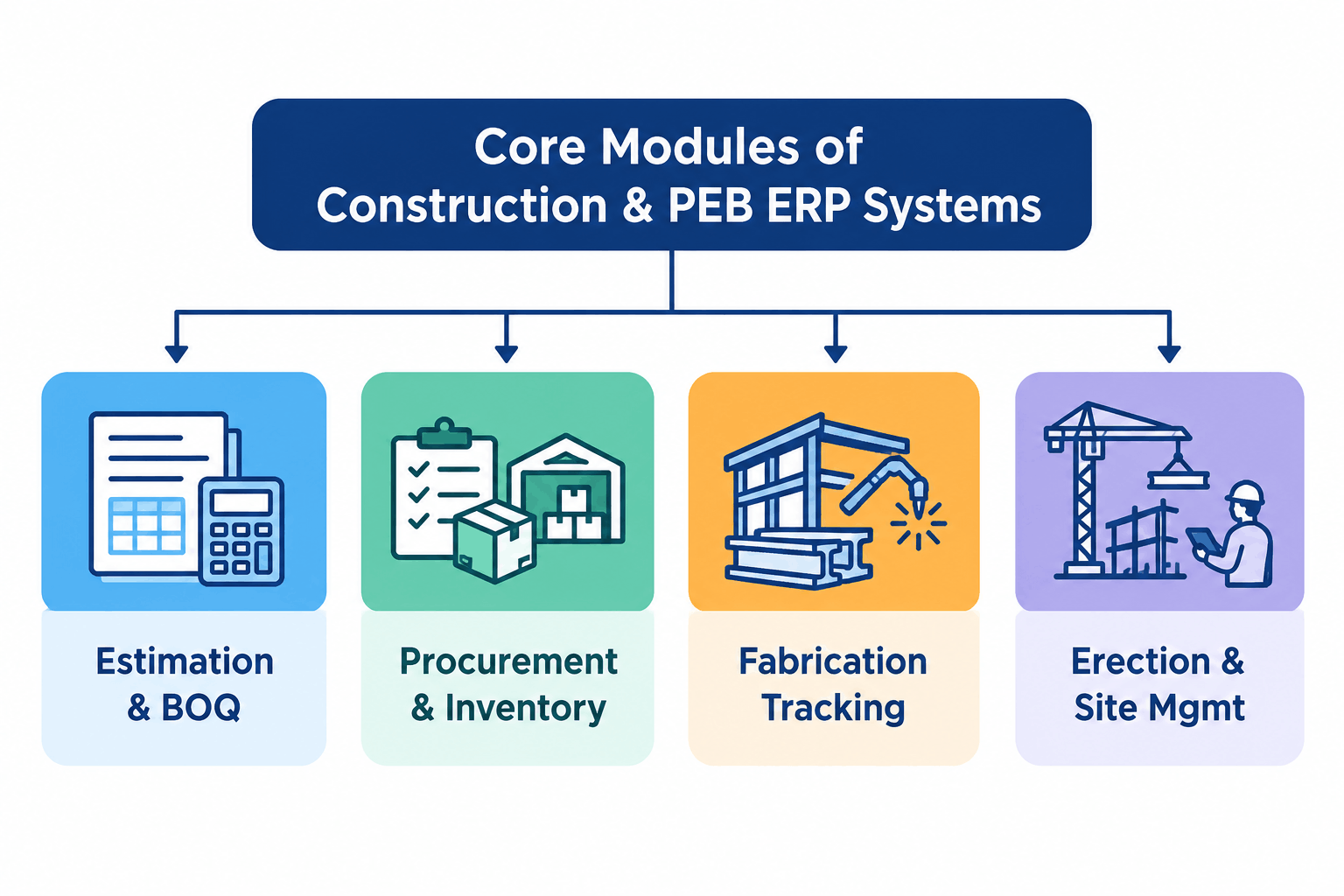
- Dynamic Estimation & Bill of Quantities (BOQ) Management
An effective platform allows estimators to upload BOQ files directly, auto-calculating material requirements, structural weights, labor hours, and sub-contracting expenses.
- Automated Material Take-off (MTO): Converts engineering drawings into actionable bills of materials instantly.
- Revision Tracking: Handles design changes without corrupting original cost baselines.
- Profitability Modeling: Predicts gross margins before submitting tenders.
2. Multi-Level Procurement & Inventory Control
Material costs represent up to 60-70% of a PEB project’s total budget. Therefore, controlling raw material acquisition is critical.
- Raw Material Batch Tracking: Tracks steel coils, plates, and fasteners by grade and heat number.
- Just-In-Time (JIT) Dispatch: Aligns raw steel procurement with production schedules to reduce carrying costs.
- Store & Yard Management: Monitors stock across central warehouses, plant yards, and remote project sites.
For a broader perspective on corporate IT strategies and structural software integration, read detailed insights from McKinsey & Company Capital Projects.
3. Integrated Construction Project Management Software
Project tracking capabilities must go beyond basic Gantt charts. Modern construction project management software built inside an ERP offers real-time milestone monitoring, earned value analysis (EVA), and resource leveling.
- WBS (Work Breakdown Structure): Divides massive EPC projects into manageable, billable work packages.
- Sub-Contractor Billing (RA Bills): Automates Running Account (RA) bill verification against site progress, eliminating overbilling risks.
- Equipment & Fleet Tracking: Monitors heavy machinery utilization, maintenance cycles, and fuel consumption across active sites.
4. PEB Plant Production & Structural Assembly
Specifically for PEB manufacturers, this module manages cut-to-length processes, shearing, fitting, welding, shot blasting, and painting stages.
Raw Coil / Plate ──> Cutting / Shearing ──> Assembly & Welding ──> Shot Blasting & Paint ──> Site Erection
By maintaining real-time visibility across these manufacturing stages, plant managers eliminate idle shop-floor hours and increase overall structural steel throughput.
Technical Comparison: Generic ERP vs. Specialized PEB & Construction ERP
Choosing the right platform requires understanding structural differences in software architecture.
| Functional Feature | Generic ERP (Off-the-shelf) | Tailored Construction & PEB ERP |
| BOQ / BOM Management | Basic single-level Bill of Materials | Multi-level, design-integrated BOQ & MTO |
| Site Billing & Progress | Basic invoicing; manual tracking | Automated Running Account (RA) bills with retention checks |
| Field Accessibility | Limited to desktop web applications | Mobile app with offline sync for site engineers |
| PEB Production Control | Fits standard discrete products | Tracks weight-based steel cutting, scrap, & painting |
| Sub-Contractor Work | Standard vendor purchase orders | Piece-rate labor contracts, joint measurements, & holdbacks |
| Integration Capability | Standard REST APIs | Direct CAD/BIM, Primavera, and MS Project connectors |
Key Benefits of Digital Transformation in Construction
Adopting a tailored construction industry digital transformation strategy delivers measurable operational benefits across every level of the organization.
Real-Time Financial Visibility & Cost Control
Without centralized data, project managers only learn about cost overruns weeks after the budget is breached. An integrated erp system for construction industry tracks real-time commitment vs. actual spend, alerting project controllers before budget deviations occur.
Streamlined Communication Between Site & Head Office
Historically, field updates arrived via fragmented emails or messaging apps. Modern solutions offer dedicated mobile interfaces where site engineers record daily progress reports (DPRs), log safety incidents, and request material requisitions on-site.
Scrap & Off-Cut Optimization in PEB Plants
Steel scrap generation directly eats into gross profit margins. Advanced ERP solutions feature nesting algorithm integration that calculates optimal steel plate cutting patterns, dramatically reducing raw material waste.
Step-by-Step Vendor Selection Checklist for Decision Makers
Selecting the right enterprise system requires careful planning. Follow this step-by-step checklist to ensure a seamless vendor evaluation process.
1.Define Technical & Operational Requirements:Focus on domain-specific capabilities rather than generic feature lists.
Identify specific pain points in your current operations. Determine whether your greatest friction lies in BOQ estimation errors, shop-floor steel tracking, sub-contractor measurement discrepancies, or delayed customer billing.
2.Evaluate Domain Expertise & Industry Footprint:Verify that vendors understand structural steel and civil engineering nuances.
Filter out vendors that primarily serve retail, hospitality, or general manufacturing. Request references specifically from PEB fabricators, EPC contractors, or commercial infrastructure developers.
3.Verify Mobile Native Accessibility & Offline Capabilities:Essential for remote project sites with unstable internet connectivity.
Ensure the software includes native Android and iOS apps capable of offline data collection for site attendance, daily progress reports, and material receiving notes (MRNs).
4.Audit Data Security & Cloud Infrastructure:Protect proprietary engineering drawings and tender pricing data.
Confirm that the cloud infrastructure complies with international data standards (ISO 27001, SOC 2). Verify daily backup protocols, role-based user access controls, and end-to-end data encryption.
5.Analyze Total Cost of Ownership (TCO):Account for hidden implementation costs beyond license fees.
Calculate the full erp implementation cost, including user licensing, data migration, customization, server infrastructure, staff training, and annual maintenance contracts (AMC).
Financial Analysis: Understanding ROI and ERP Implementation Cost
To justify a major enterprise software investment to board members, financial leaders must build a comprehensive return-on-investment (ROI) business case.
Decoding the Cost Factors
The overall cost of adopting enterprise software spans several key categories:
- Software Licensing: Subscription-based SaaS (SaaS model) or perpetual on-premise licenses.
- Implementation & Configuration: Custom workflow development, report design, and legacy data migration.
- Change Management & Training: Educating site engineers, procurement personnel, and plant supervisors.
- Maintenance & Support: Ongoing technical support, upgrades, and API maintenance.
Measuring the Return on Investment
Firms typically recover their initial capital outlay within 12 to 18 months through quantifiable operational savings:
Total ROI = (Material Waste Savings + Labor Productivity Gains + Reduced Billing Delays) / TCO
- Material Savings: A 3% to 5% reduction in raw steel wastage via optimized nesting and tight store controls yields immediate, high-volume savings.
- Reduced Billing Cycles: Automated RA billing accelerates cash collection cycles by up to 30%, directly lowering working capital interest expenses.
- Labor Efficiency: Eliminating manual data entry saves project engineers 5 to 8 hours weekly, shifting focus back to execution quality.
For additional benchmarks on enterprise software economics and implementation methodologies, refer to the industry analysis published by Gartner Research.
Overcoming Common Implementation Challenges
Despite clear benefits, implementing an enterprise system in a construction environment comes with unique organizational challenges.
Addressing Resistance to Field Adoption
Site workers and traditional project managers often resist adopting digital tools. To overcome this:
- Deploy simple, intuitive mobile interfaces requiring minimal typing.
- Conduct role-specific training sessions using practical field scenarios.
- Appoint internal “digital champions” across key site locations to support peers.
Managing Legacy Data Migration
Inaccurate master data (e.g., duplicate vendor profiles, unstructured item catalogs) will stall your new system. Cleanse, standardize, and deduplicate item master databases before initiating data transfer.
Partner with Nucleosys Tech for Custom Enterprise Solutions
Navigating digital transformation in the structural steel and construction space requires an experienced technology partner. At Nucleosys Tech, we engineer tailor-made enterprise applications designed specifically for complex project workflows, structural steel manufacturing, and EPC management.
Whether you need custom module integrations, mobile site applications, or end-to-end enterprise software development, our engineering teams build scalable solutions aligned with your business objectives.
Ready to modernize your construction and PEB operations? Discover how customized technology can streamline your site workflows and maximize project profitability.
Explore Software Development Services at Nucleosys Tech
Frequently Asked Questions (FAQs)
What makes an ERP system for construction industry distinct from standard accounting software?
A standard accounting application tracks historical financial transactions. In contrast, an erp system for construction industry manages real-time field operations, including BOQ estimation, site progress, raw material consumption, sub-contractor RA billing, heavy equipment tracking, and PEB plant manufacturing schedules.
How long does a typical ERP implementation take for a PEB manufacturing firm?
A typical implementation for a mid-sized Pre-Engineered Building (PEB) fabricator or EPC contractor ranges from 4 to 8 months. Timeline variables include organization size, custom workflow requirements, integration complexity with existing CAD/BIM software, and user training scale.
Can a construction ERP integrate with specialized engineering software like Tekla or AutoCAD?
Yes. Leading enterprise solutions offer integration connectors or REST APIs that import structural steel designs, component schedules, and material take-offs directly from software like Tekla, Revit, or AutoCAD. This eliminates manual data entry errors between design teams and plant production floors.
How does cloud-based ERP software support remote construction project sites?
Cloud-native solutions allow site engineers, storekeepers, and project managers to access the system from anywhere using mobile applications. Furthermore, top platforms offer offline synchronization, enabling users to log daily progress reports and inventory receipts even in low-connectivity locations.
What is the expected lifetime ROI of adopting specialized PEB project management tools?
Most firms realize a complete return on investment within 12 to 18 months post-implementation. Primary financial drivers include a 3–5% reduction in steel scrap, elimination of sub-contractor overbilling, faster customer invoicing cycles, and improved machine utilization rates across active job sites.

