
Why Manufacturing Companies in Pune Need SEO in 2025 | SEO for Manufacturing Industry

Introduction Pune has firmly established itself as one of India’s most powerful industrial and manufacturing hubs. With automotive giants, engineering firms, machine tool producers, heavy equipment manufacturers, and precision engineering companies, the city contributes significantly to India’s domestic and global economy. Industrial belts like Chakan, Talegaon, Pimpri-Chinchwad, Ranjangaon, and Bhosari MIDC are buzzing with factories that supply products and components to both Indian and international clients. However, while Pune’s manufacturing output is world-class, many companies still face a silent but serious challenge: digital invisibility. The problem isn’t in their machines or manpower — it’s in their online presence. In 2025, procurement managers, distributors, and buyers no longer rely only on trade fairs or references. Their search for new suppliers now begins online, with a single Google search. This digital-first approach has made SEO for manufacturing industry a necessity, not an option. SEO ensures that when buyers search for terms like “machine tool suppliers in Pune” or “precision component manufacturers India”, your company shows up at the top of search results. Without SEO, even the best factories risk being invisible. In this blog, we’ll explore: The challenges Pune manufacturers face online. Why buyers and distributors are shifting to digital research. Real success stories from Pune-based manufacturers. A deep-dive case study of Cubuilt Engineers Pvt. Ltd. Actionable SEO strategies for 2025. The Digital Challenges Manufacturers Face Even though Pune-based factories excel in production quality, many fail to attract digital visibility. Some of the most pressing issues include: 1. Weak Online Presence A large share of manufacturers still rely heavily on personal referrals, distributor channels, or repeat clients. While valuable, these are not enough in today’s digital-first procurement environment. Buyers expect suppliers to maintain a modern website with product catalogs, certifications, and enquiry options. Without it, you miss new leads every day. 2. Outdated Industrial Websites Many industrial websites resemble static brochures. They lack mobile responsiveness, clear product details, and enquiry forms. Since most B2B buyers browse on laptops or mobile devices, a poor website experience translates into lost credibility. 3. Global Competition on Google International suppliers are actively targeting the Indian market and investing heavily in SEO. Their websites often outrank Pune factories, meaning local buyers may end up contacting overseas competitors first, simply because they show up higher in search results. 4. No Lead Generation System A manufacturing website should be a 24/7 lead generation engine. Without proper keyword optimization, product-based landing pages, and strong calls-to-action, manufacturers lose the chance to attract high-intent leads. 5. Underestimating SEO’s Role Many SMEs believe industrial buyers still prefer offline interactions. While relationships matter, the first step of almost every B2B journey is digital discovery. If your factory isn’t visible during that search, you’re out of the race. Why Buyers and Distributors Search Online The procurement cycle in 2025 looks very different compared to a decade ago. Today’s buyers: Shortlist Faster – With Google, buyers can find 10 suppliers in 10 minutes. Expect Transparency – Websites showcasing product specifications, certifications, and client logos build instant trust. Use Local Search – Buyers often look for suppliers in specific clusters like “gear manufacturers in Talegaon” or “automation companies near Pimpri.” Check Credibility Digitally – Updated websites, ISO certifications, and professional online presence are trust signals. Prefer Digital Enquiries – Online enquiry forms and instant communication are faster than traditional calls. For Pune manufacturers, this means your website is no longer optional — it is your primary sales channel. Case Study 1: Pune Machine Tool Company Boosts Enquiries by 40% A mid-sized machine tool manufacturer in Pune relied heavily on trade fairs and distributor contacts. Their website was static, outdated, and not optimized for SEO. Leads were declining year after year. They decided to implement a professional SEO strategy. Steps taken included: Website Overhaul: A structured product catalog with enquiry forms and responsive design. Local SEO Focus: Targeted keywords like “machine tool suppliers in Chakan” and “precision engineering companies Pune.” Content Marketing: Publishing blogs and technical insights. Technical SEO Fixes: Improved speed, added SSL, and optimized site structure. Result: Within six months, enquiries grew by 40%. The company started receiving RFQs from both Indian and international buyers, showing that SEO can directly influence industrial sales. Case Study 2: Cubuilt Engineers Pvt. Ltd. Cubuilt Engineers Pvt. Ltd., a Pune-based company specializing in structural steel detailing and BIM services for industrial projects, faced a similar challenge. Despite providing highly specialized engineering services, they struggled with visibility outside their referral network. The Challenge Their website wasn’t ranking for core industry keywords. Most enquiries came from word-of-mouth. They weren’t attracting international clients despite having the expertise. SEO Strategy Implemented Keyword Research & TargetingKeywords were mapped around services like “rebar detailing services Pune,” “steel detailing outsourcing India,” and “BIM services for industrial projects.” Website OptimizationService pages were rewritten with clear descriptions, project images, and strong CTAs. Content CreationCase studies, blogs, and industry insights were published to highlight expertise. International SEOOptimized pages for global searches to attract clients in the USA, UK, and UAE. Technical ImprovementsEnhanced page load speed, ensured mobile readiness, and improved indexing. The Results Cubuilt started ranking on the first page for multiple high-value keywords. Within months, they began receiving enquiries from international clients. The website shifted from being a passive brochure to an active business development tool. This case proves that SEO for manufacturing industry and allied engineering services can not only increase domestic enquiries but also expand reach to global markets. Why SEO Matters More Than Ever in 2025 Google is the New Trade FairInstead of waiting for annual exhibitions, buyers now start with Google. SEO ensures you’re visible 365 days a year. Local Search Drives BusinessWith Pune’s booming industrial clusters, local SEO helps manufacturers dominate geo-targeted searches. Builds Brand AuthorityRanking high establishes credibility and builds long-term trust with distributors and buyers. Cost-Effective Compared to AdsUnlike PPC ads, SEO continues to deliver results long after the investment. Levels the Playing FieldSmall and mid-sized manufacturers can compete with industry giants if their SEO strategy is strong. Practical SEO Strategies
AI-Powered Business Automation: Future of Companies
Introduction AI-Powered Business Automation: Future of Companies is rapidly becoming one of the most important trends shaping modern organizations. Businesses today are under constant pressure to improve efficiency, reduce operational costs, and deliver faster services. Artificial intelligence is helping companies automate repetitive tasks, improve decision-making, and transform the way they operate. From startups to large enterprises, organizations are now adopting AI-based automation to streamline workflows, enhance customer experiences, and gain a competitive advantage. In 2026 and beyond, automation powered by AI will not just support businesses — it will define how successful companies grow and scale. What Is AI-Powered Business Automation? AI-powered business automation refers to the use of artificial intelligence technologies such as machine learning, data analytics, and robotic process automation to manage tasks without constant human involvement. These systems can: Analyze data in real time Automate repetitive processes Improve accuracy Predict trends Enhance productivity Businesses looking to build intelligent platforms can explore development solutions like those available athttps://nucleosystech.com/web-development/ Why AI-Powered Business Automation: Future of Companies Is Transforming Industries AI is not just another technological trend. It is a fundamental shift in how businesses operate. Companies are moving from manual processes to intelligent systems that can perform complex tasks faster and more accurately. AI automation helps companies: Reduce human error Improve efficiency Save time Enhance customer service Scale operations faster Key Benefits of AI-Powered Business Automation: Future of Companies 1. Increased Operational Efficiency One of the biggest advantages of AI automation is efficiency. Tasks that previously took hours can now be completed in minutes. Examples include: Automated data entry Smart scheduling Customer query handling Inventory tracking This allows employees to focus on strategic and creative work. 2. Cost Reduction Automation reduces the need for repetitive manual work, which helps companies lower operational costs over time. Businesses can: Reduce staffing costs for repetitive tasks Minimize errors and rework Optimize resource allocation Over time, AI becomes a cost-effective investment. 3. Better Decision-Making with Data AI systems analyze large volumes of data quickly and accurately. This helps businesses make smarter and faster decisions. AI-driven insights support: Sales forecasting Customer behavior analysis Market trend predictions Performance tracking 4. Improved Customer Experience AI automation enhances customer interactions by providing fast and personalized responses. Applications include: Chatbots for instant support AI recommendation engines Automated service requests These tools help businesses deliver better service 24/7. 5. Scalability and Growth AI automation makes it easier for businesses to grow without increasing operational complexity. Automated systems can handle: Higher workloads Larger customer databases Expanding operations This makes AI ideal for startups and SMEs planning long-term growth. Real-World Applications of AI in Business AI-powered automation is being used across multiple industries. Common applications include: CRM automation HR process automation Finance and accounting automation Supply chain management Marketing automation Businesses adopting digital transformation strategies are also strengthening their websites and online presence to support intelligent automation systems and modern growth models. AI-Powered Business Automation: Future of Companies in Digital Transformation AI plays a central role in digital transformation. Companies that combine AI tools with strong digital infrastructure gain a major advantage. To implement AI successfully, businesses need: Modern websites Scalable software systems Integrated digital platforms Professional development services like those offered at Nucleosys Tech.help companies build intelligent digital ecosystems. Insights from industry discussions on the importance of professional websites and maintaining a strong online presence further highlight how technology and automation together create powerful growth opportunities for modern businesses. AI in Marketing Automation AI is transforming marketing strategies by automating customer engagement and improving targeting accuracy. Examples include: AI-based email campaigns Smart ad targeting Customer segmentation Predictive analytics Businesses can integrate AI with digital marketing strategies through services available atNucleosys Tech. Enhancing Productivity Across Departments AI automation is not limited to one function. It improves productivity across departments: Sales: Lead scoring and automated follow-upsHR: Resume screening and employee onboardingFinance: Automated billing and expense trackingOperations: Workflow optimization This organization-wide efficiency leads to faster growth. AI Automation for SMEs Small and medium businesses can benefit greatly from AI-powered automation. It allows them to compete with larger companies without large teams. Key advantages for SMEs: Faster processes Reduced manual workload Improved accuracy Better customer service AI enables SMEs to scale smarter and operate more efficiently. Challenges Businesses May Face While AI automation offers huge benefits, companies must also address certain challenges: Initial investment costs Data security concerns Employee training requirements Integration with existing systems With the right technology partner, these challenges can be managed effectively. The Future of Companies with AI-Powered Business Autom The future of companies will be shaped by AI-powered systems that: Predict customer needs Automate decision-making Optimize operations Enhance innovation Businesses that adopt AI early will lead the next generation of digital transformation. Building a Strong Digital Foundation for AI AI automation works best when supported by strong digital infrastructure. This includes: Professional websites Scalable software Secure cloud systems Integrated platforms Many organizations are already learning how a well-developed website and strong digital presence play a key role in supporting automation, online growth, and long-term success. Conclusion AI-Powered Business Automation: Future of Companies is not just a concept — it is the reality shaping modern businesses. From improving efficiency and reducing costs to enhancing customer experience and enabling smarter decisions, AI is transforming the way companies operate. Organizations that embrace AI automation today will gain a strong competitive advantage and build a future-ready business. AI-Powered Business Automation: Future of Companies is becoming the backbone of modern digital transformation and long-term business success. For deeper insights, read our article on Why Every Business Needs a Professional Website in 2026 and explore how a strong online presence transforms business growth in 2026. Transform Your Business with AI Solutions Ready to take your business to the next level with AI-powered automation? At Nucleosys Tech, we specialize in developing intelligent software solutions, automation systems, and digital platforms that help businesses grow faster and operate smarter. Whether you need custom software, digital marketing integration, or AI-driven systems, our experts can help you build
Top Digital Marketing Strategies for Indian Businesses
Introduction India’s digital economy keeps growing, with more first-time internet users coming online every year. That’s a big opportunity, but also tougher competition. Having a website and a social media page is no longer enough to get noticed. This guide covers 10 digital marketing strategies for Indian businesses that bring visibility, leads and sales, whether you’re a startup, an SME or an established enterprise. You’ll also see how to choose where to begin and which mistakes to avoid. Why Digital Marketing Matters for Indian Businesses Most Indian customers now search online, read reviews and compare options on their phones before they buy or call. If you’re not visible at that moment, a competitor is. A well-planned strategy helps you: Build brand awareness and credibility Generate quality leads at a predictable cost Engage customers across platforms Measure results and grow revenue Compared with traditional media, digital marketing lets even small businesses start with modest budgets, track every rupee and scale what works. 1. Search Engine Optimization (SEO) and Local SEO SEO helps your website rank on Google so people searching for your products or services find you without paid ads. It builds long-term visibility, trust and a steady flow of organic traffic. For businesses serving specific cities, local SEO is just as important. Customers search phrases such as “digital marketing agency in Pune” or “best CA near me”. To show up: Claim and fully optimize your Google Business Profile Keep your name, address and phone number consistent everywhere Collect genuine customer reviews and reply to them Create location pages for each city you serve SEO usually takes a few months to show results, but the traffic compounds over time. Our SEO services cover both national and local rankings, and online stores can look at ecommerce SEO. 2. Content Marketing Blogs, guides, case studies and FAQs show customers you understand their problems. Good content answers real questions, supports SEO and gives sales teams something to share. To make it work in India: Write for how people actually search, including long, conversational queries Publish in Hindi or regional languages if your audience prefers them Back claims with real examples, data and author expertise Content is also how you earn visibility in AI-powered search such as Google’s AI Overviews. Clear, well-structured, trustworthy answers are more likely to be cited. 3. Social Media Marketing India has one of the largest social media audiences in the world. Pick platforms by audience, not by trend: Instagram and Facebook: consumer brands, retail, food, fashion and services LinkedIn: B2B, IT, consulting and recruitment YouTube: tutorials, product explainers and long-term brand building Consistent posting, short-form video and community engagement build brand recall. Our social media marketing team plans content and campaigns around your goals. 4. Performance Marketing and PPC Advertising Performance marketing means paying for measurable results such as clicks, leads or sales, so you can see exactly what your budget delivers. Google Ads catch people actively searching for what you sell. Meta Ads reach audiences on Facebook and Instagram, including click-to-WhatsApp ads. YouTube Ads build awareness and retarget viewers. The benefits are fast visibility, tight budget control and constant optimization. See how it works on our performance marketing page. 5. WhatsApp and Messaging Marketing WhatsApp is how many Indian customers prefer to talk to businesses. Use WhatsApp Business for: Quick customer queries and lead follow-ups Product catalogs and order updates Click-to-WhatsApp ads that start a conversation instantly Always get opt-in consent before sending messages. It protects your reputation and keeps you aligned with privacy rules such as the DPDP Act. 6. Email Marketing Email remains one of the most cost-effective ways to nurture leads and bring customers back. Use it for welcome series, offers, abandoned-cart reminders and newsletters. Segment your list by interest or purchase history, since relevant emails outperform mass blasts. 7. Mobile-First Marketing Most Indian users browse and buy on smartphones, often on mid-range devices and variable networks. Make sure your: Website loads fast and works smoothly on mobile Forms are short and easy to complete Checkout supports UPI and popular wallets Ads and landing pages are designed for small screens first 8. Video Marketing Short-form video, demos, testimonials and explainers earn higher engagement than static posts. Reels, Shorts and YouTube videos help you build trust quickly, especially for services people want to see before they buy. Subtitles and regional-language versions widen your reach. 9. Website Optimization for Conversions Every channel sends people to your website, so a weak site wastes your marketing spend. A high-converting site has: Fast loading speed and a mobile-responsive design Clear service or product pages Visible calls to action and trust signals such as reviews and client logos Proper tracking for calls, forms and purchases If your site needs work, explore our website design services. 10. Marketing Automation and AI AI tools now help with ad optimization, personalization, chatbots and lead scoring. Automating follow-ups and reporting saves time and stops leads slipping through the cracks. Tools like AI chatbots can handle first-level customer queries around the clock. Use automation to support your team, not replace the human touch. Which Strategy Should You Start With? Your Business Start With Then Add Local service business Local SEO and Google Business Profile Google Ads, WhatsApp E-commerce store Meta and Google Shopping ads, ecommerce SEO Email, video B2B or IT company SEO, LinkedIn and content Google Ads, email nurturing New startup Performance marketing for quick feedback SEO and content for the long term Integrating Your Strategies The best results come from combining channels. SEO and content build lasting visibility, paid ads bring fast leads, social media builds brand trust, and email and WhatsApp turn interest into repeat business. Track results in one dashboard so you can see which channels deserve more budget. Common Digital Marketing Mistakes to Avoid Ignoring SEO and relying only on paid ads Posting inconsistently on social media Sending traffic to a slow, confusing website Skipping tracking, so you can’t tell what works Spreading the budget too thin across too many channels
Custom Software Development Benefits for SMEs in 2026
Introduction Small and medium enterprises (SMEs) are the backbone of the global economy. However, in today’s fast-changing digital environment, SMEs must adapt quickly to stay competitive. Off-the-shelf software may offer temporary solutions, but it often fails to address unique business challenges. This is where custom software development benefits for SMEs become highly valuable. Tailored software solutions help businesses streamline operations, improve productivity, enhance security, and scale efficiently. In 2026, digital transformation is no longer optional — it is a strategic necessity for growth. What Is Custom Software Development? Custom software development refers to building software specifically designed to meet the unique needs of a business. Unlike ready-made applications, custom solutions are tailored to your workflows, goals, and customer requirements. These solutions can include: Custom CRM systems ERP software Business process automation tools Inventory management systems Cloud-based platforms Customer portals Learn more about professional development services at Nucleosys Tech. 1. Tailored to Your Business Needs One of the biggest custom software development benefits for SMEs is personalization. Every SME operates differently. Pre-built software often forces businesses to adjust their processes to fit the software. Custom development does the opposite — it adapts to your existing processes. Benefits include: Improved workflow efficiency Reduced manual errors Better team collaboration Seamless integration with existing systems This level of customization ensures higher productivity. 2. Improved Scalability for Business Growth As your business grows, your software should grow with you. Custom software is designed with scalability in mind. You can: Add new features Expand user access Integrate third-party tools Upgrade functionalities 3. Cost-Effective in the Long Run Many SMEs assume custom software is expensive. While initial investment may be higher, it reduces long-term costs significantly. How? No recurring license fees Reduced dependency on multiple tools Lower maintenance expenses Improved operational efficiency Custom solutions eliminate unnecessary features and focus only on what your business truly needs. 4. Enhanced Data Security Data breaches are a growing concern for businesses worldwide. Off-the-shelf software is often targeted by hackers because of its widespread use. Custom software offers stronger security measures tailored to your system. Security advantages include: Advanced encryption Controlled user access Secure hosting Regular updates 5. Competitive Advantage SMEs operate in highly competitive markets. Having unique digital capabilities gives you a strong advantage. Custom software enables: Faster service delivery Better customer experience Unique features competitors don’t offer More efficient operations This differentiation helps SMEs stand out. If you’re building your digital foundation, you may also find valuable insights in related discussions about professional websites and online presence in 2026, which highlight how technology shapes modern business success. 6. Seamless Integration with Existing Systems Many SMEs use multiple tools for accounting, sales, HR, and marketing. Managing disconnected systems reduces efficiency. Custom software can integrate all systems into one unified platform. Integration benefits: Centralized data Better reporting Faster decision-making Improved collaboration Digital marketing integration services are also available at Nucleosys Tech. 7. Better Automation and Productivity Manual processes consume time and increase errors. Custom software allows business process automation such as: Automated billing Inventory tracking Customer notifications Workflow management 8. Greater Control and Ownership When you use custom software, you own the solution. This gives you: Full control over features Flexible upgrades Custom security policies No vendor lock-in You are not dependent on third-party providers who may change pricing or discontinue features. 9. Improved Customer Experience Customer satisfaction directly impacts business growth. Custom software helps improve: Faster response time Personalized services Smooth communication Better service tracking Satisfied customers are more likely to return and recommend your business. 10. Supports Digital Transformation Strategy SMEs aiming for digital transformation need flexible and adaptive technology. Custom software aligns with: Long-term business goals Industry-specific requirements Market expansion plans Technology innovation As discussed in various insights on strengthening online presence and building professional digital platforms, technology plays a central role in shaping modern SMEs. A strong digital foundation, supported by tailored IT solutions, accelerates business growth. Why SMEs Should Avoid Generic Software While off-the-shelf tools may seem convenient, they often: Include unnecessary features Lack flexibility Have security limitations Restrict scalability Over time, these limitations slow down growth. Custom solutions eliminate these constraints and focus entirely on business success. Key Features of Effective Custom Software For maximum impact, SME software should include: User-friendly interface Cloud compatibility Mobile responsiveness High security standards Analytics and reporting tools Easy scalability Professional development ensures all these elements are implemented effectively. Why Choose Professional Developers? Custom software requires expertise in: System architecture UI/UX design Security implementation Testing and maintenance Future scalability planning Partnering with experienced developers ensures long-term reliability and performance. At Nucleosys Tech, we specialize in delivering scalable, secure, and innovative software solutions tailored to SME needs. Conclusion The custom software development benefits for SMEs are undeniable. From improved efficiency and security to scalability and competitive advantage, tailored solutions empower businesses to grow sustainably. In 2026, SMEs that invest in customized technology solutions position themselves for long-term success in a competitive digital market. Technology is no longer just support — it is the foundation of business growth. For deeper insights, read our article on Why Every Business Needs a Professional Website in 2026 and explore how a strong online presence transforms business growth in 2026. Transform Your Business with Custom Software Are you ready to streamline operations, improve productivity, and scale your SME with confidence? At Nucleosys Tech, we design and develop custom software solutions tailored to your business needs. Whether you need automation tools, CRM systems, enterprise applications, or scalable digital platforms, our expert team is here to help. Frequently Asked Questions (FAQs) 1. What are the main custom software development benefits for SMEs? Custom software offers scalability, better security, automation, cost-efficiency, and improved productivity tailored to business needs. 2. Is custom software expensive for small businesses? While the initial investment may be higher, it reduces long-term costs by eliminating licensing fees and improving efficiency. 3. How long does custom software development take? Development time depends on project complexity, but proper planning ensures efficient delivery. 4. Can custom software
Why Every Business Needs a Professional Website in 2026
Introduction In today’s fast-moving digital world, having a professional website is no longer optional — it is essential. Whether you run a small startup, a local business, or a large enterprise, your website acts as your online identity, sales platform, and brand representative 24/7. Many businesses still rely only on social media or word-of-mouth marketing, but without a strong website, they miss countless opportunities. A professionally developed website builds credibility, attracts customers, increases visibility, and generates consistent leads. If your business wants to grow, compete, and succeed in 2026 and beyond, investing in a professional website is one of the smartest decisions you can make. What is a Professional Business Website? A professional website is more than just a digital brochure. It is a powerful platform that represents your brand, communicates your services, and converts visitors into customers. It includes: Clean and modern design Mobile-friendly layout Fast loading speed SEO optimization Easy navigation Strong security Lead generation features A well-developed website works like a full-time marketing employee for your business. You can explore advanced web development solutions at Nucleosys Tech. Builds Trust and Credibility When customers search for a product or service, the first thing they do is check the company online. If they don’t find a website, they may assume the business is not professional or trustworthy. A professional website: Shows your expertise Displays services clearly Builds brand authority Increases customer confidence 24/7 Online Presence for Your Business Unlike physical stores, your website works 24 hours a day, 7 days a week. This means customers can: Learn about your services anytime Contact you anytime Send enquiries anytime Purchase products anytime This constant availability increases business opportunities and improves customer engagement. Helps Generate More Leads One of the biggest advantages of having a professional website is lead generation. With the right strategy, your website can: Capture visitor information Convert traffic into enquiries Bring organic leads through SEO Support marketing campaigns Businesses using SEO-friendly websites receive more consistent leads compared to those without an online presence. Strengthens Your Brand Identity A professional website helps create a strong brand image. It allows you to showcase: Company story Vision and mission Client testimonials Portfolio Achievements This helps customers connect with your brand emotionally and increases loyalty. Improves Search Engine Visibility If your business does not appear on Google, customers may never find you. A well-optimized website helps your business: Rank higher on search engines Get more organic traffic Reach local and global audiences Increase visibility Cost-Effective Marketing Tool Compared to traditional advertising, a website is one of the most cost-effective marketing tools. It supports: SEO campaigns Content marketing Paid ads Email marketing Social media marketing Instead of spending repeatedly on ads, your website becomes a long-term asset that keeps generating results. Competitive Advantage If your competitors have professional websites and you don’t, you are already behind. A modern website gives you: Strong market presence Better customer reach More credibility Higher conversion rates Businesses that invest in digital transformation grow faster than those that rely only on offline marketing. Mobile Users Are Increasing Rapidly More than half of internet users browse through mobile phones. A professional website is designed to work smoothly on all devices. Responsive design ensures: Better user experience Higher engagement Lower bounce rates Better SEO performance Mobile-friendly websites are prioritized by search engines. Showcases Your Services Clearly Your website is the best place to explain your services in detail. You can highlight: Key offerings Unique solutions Case studies Customer success stories This helps visitors understand your value and increases chances of conversion. Builds Long-Term Business Growth A professional website is not just an expense — it is an investment. It helps businesses: Scale operations Expand reach Build authority Generate long-term ROI As your business grows, your website grows with you. Key Features Every Professional Website Must Have To get maximum results, a business website should include: Fast loading speed Secure hosting SEO-friendly structure Easy navigation Contact forms Clear call-to-action Modern UI/UX design These elements improve performance and help convert visitors into customers. Why Choose Experts for Website Development? Many businesses try to create websites using free tools, but these often lack quality, performance, and SEO capabilities. Professional developers provide: Custom design SEO optimization Secure coding Performance improvements Scalable solutions Working with experienced teams ensures better results and long-term success. Grow Your Business with a Professional Website If your business still does not have a professional website, now is the time to take the next step. A powerful, SEO-friendly, and well-designed website can transform your business by increasing visibility, generating leads, and building trust. At Nucleosys Tech, we help businesses create modern, high-performing websites tailored to their goals. From design to development and digital marketing, our experts provide complete solutions to help your brand grow online. Visit Nucleosys Tech today to build a strong digital presence and turn your website into a powerful lead generation machine. For deeper insights, read our article on Why Every Business Needs a Professional Website in 2026 and explore how a strong online presence transforms business. Frequently Asked Questions (FAQs) 1. Why is a professional website important for business? A professional website builds trust, increases visibility, and helps generate leads. It acts as a 24/7 marketing platform for your business. 2. Can a small business benefit from having a website? Yes, small businesses can attract more local customers, improve credibility, and grow faster with a strong online presence. 3. How does a website help in lead generation? SEO optimization, contact forms, and service pages help convert visitors into enquiries and potential clients. 4. What features should a business website have? It should be mobile-friendly, fast, secure, SEO-optimized, and easy to navigate. 5. How often should a website be updated? Updating content regularly helps improve SEO performance, maintain relevance, and keep users engaged.
The Ultimate Guide to Media Buying: Strategies, Benefits & Future Trends
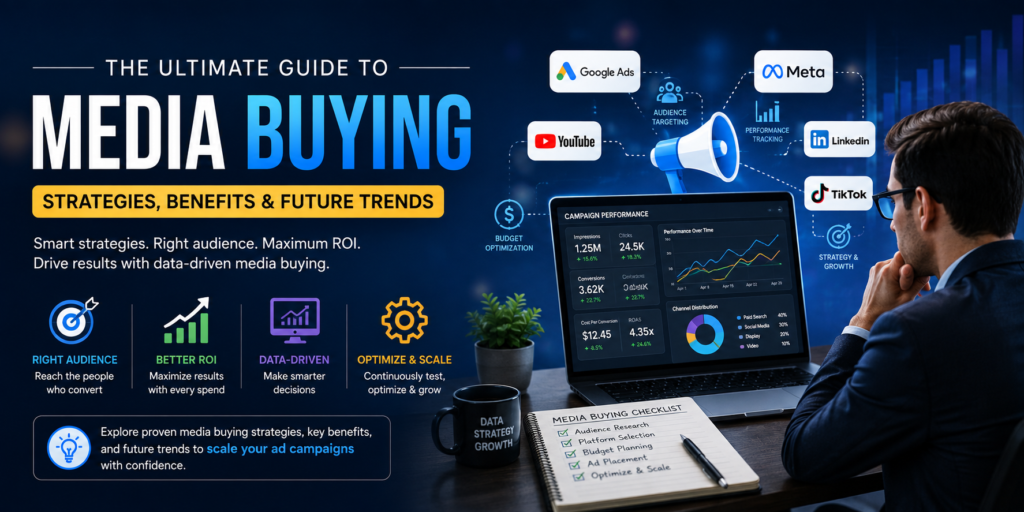
Introduction Great ads don’t pay off unless they reach the right person at the right moment, at a price that makes sense. That is the job of media buying. Whether you run an e-commerce store, a B2B company or a local service business, media buying is the foundation of paid advertising. This guide explains what it is, how it works, the strategies that raise ROI, the metrics to track, and the trends shaping 2026. If you’d rather hand it off to specialists, our performance marketing team can run it for you. What Is Media Buying? Media buying is the process of purchasing ad space on search engines, social networks, websites, streaming platforms and apps to reach a target audience at the best possible price. The goal is the maximum reach, engagement and conversions for every rupee spent. Digital media buying has moved far beyond phone calls and negotiations with publishers. Today it runs on real-time auctions, machine learning and audience data. Every campaign follows three phases: Planning and research: Define buyer personas, study competitors, choose channels and set budgets. Execution: Select ad networks, set bidding strategies, secure inventory and configure conversion tracking. Optimization and scaling: Run A/B tests, shift budget to what works and scale the winners. Media Planning vs Media Buying: What’s the Difference? People often mix up the two, but they cover different stages of a campaign. Media Planning Media Buying Focus Strategy, research, channel mix and budget split Execution, bidding, ad setup and optimization Output Campaign roadmap, personas and media mix Live ads, active bids and performance reports Key metrics Reach, frequency and timeline CPC, CPM and ROAS Tools Market research and audience analytics DSPs, publisher networks and ad managers Good media buying starts with good media planning. When strategy and execution line up, campaigns convert far better. How Does Digital Media Buying Work? The Core Methods 1. Programmatic Media Buying Programmatic media buying uses software to buy ad impressions across thousands of websites and apps automatically, in milliseconds. It relies on three components: Demand-Side Platform (DSP): Lets advertisers buy inventory across many exchanges from one dashboard. Supply-Side Platform (SSP): Lets publishers sell their ad space automatically. Ad exchange: The marketplace where DSPs and SSPs meet in automated auctions. Programmatic now accounts for most digital display spending globally, which is why it sits at the center of modern campaigns. 2. Direct Ad Buying Here you buy placements straight from a publisher, such as a sponsorship on an industry website. It usually needs a higher minimum spend, but you get guaranteed placement and tighter brand-safety control. It works well for awareness campaigns and premium placements. 3. Real-Time Bidding (RTB) RTB is the auction model behind most programmatic buying. When a user opens a page, an auction runs while it loads, and the highest bidder’s ad appears. Benefits of Media Buying for Your Business Organic marketing builds long-term growth. Media buying adds speed, control and measurability. Precise Audience Targeting You can target by: Demographics: age, gender, income and education Location: country, city, pin code or a radius around your store Interests and behavior: hobbies, professions and media habits Intent: searched keywords, site visits and app activity Your budget goes to people already showing interest or buying intent. Scalable Return on Ad Spend (ROAS) With proper tracking, media buying becomes predictable. When every rupee spent returns more than a rupee earned, you can scale spend with confidence. Ad Spend Optimization Unmanaged budgets leak money through poor targeting, weak creative and careless bidding. Ongoing ad spend optimization moves budget toward the best keywords, audiences, creatives and times of day. See how this works in practice on our performance marketing services page. Consistent Presence Across Channels Buyers see your brand on search, social, video and news sites before they decide. Coordinated media buying keeps your message consistent at every touchpoint. Media Buying Strategies That Improve ROI Strategy 1: Map Your Ads to the Full Funnel Don’t show everyone the same offer. Awareness: Use video and display ads to introduce your brand and address common problems. Consideration: Retarget engaged users with case studies, demos and guides. Conversion: Serve direct offers, such as a free consultation or a limited-time discount, to high-intent users. Strategy 2: Choose Placements Wisely Above-the-fold banners stay visible without scrolling. In-feed social ads blend into LinkedIn, Facebook, Instagram and TikTok feeds. Search ads capture high-intent queries. Our Google Ads services and Meta Ads services cover both. Contextual placements put you on blogs and publications related to your niche. Strategy 3: Use Dynamic Retargeting Most first-time visitors don’t convert on the first visit. Dynamic retargeting shows them the exact products or content they viewed, which typically lowers customer acquisition cost compared with cold traffic. Strategy 4: Test and Optimize Continuously Audiences tire of the same ad. Keep testing: Headlines: benefit-led vs problem-led Formats: static image, carousel, short video CTAs: “Get a Free Audit” vs “Book a Demo” Landing pages: make sure the page matches the ad’s message and design Key Media Buying Metrics to Track Metric What It Tells You CPM (cost per 1,000 impressions) How efficient your reach is CPC (cost per click) Cost of traffic and audience interest CTR (click-through rate) How relevant your creative and targeting are CPA (cost per acquisition) What each lead or sale costs you ROAS (return on ad spend) Revenue generated per rupee spent Conversion rate How well your landing page turns clicks into actions Media Buying Trends for 2026 and Beyond AI-Driven Optimization AI now handles bidding, creative variations and budget shifts in real time. Media buyers who pair AI tools with human strategy outperform those who rely on automation alone. Early-stage ad placements inside AI assistants, such as ChatGPT ads, are also emerging. Privacy Rules and First-Party Data Chrome has kept third-party cookies, but Safari and Firefox already block them, and privacy laws are tightening, including India’s DPDP Act. Smart advertisers are: Building first-party data through CRM lists and opt-in subscribers Using contextual targeting based on page content instead of individual
Media Planning: The Strategic Backbone of Successful Marketing Campaigns

In today’s highly fragmented digital landscape, capturing consumer attention is harder than ever. Brands launch dozens of ad campaigns every day across social platforms, search engines, streaming networks, and traditional channels. However, throwing money at ads without a deliberate blueprint leads to wasted budgets and missed revenue targets. Understanding why Media Planning: The Strategic Backbone of Successful Marketing Campaigns is essential for any brand that wants to maximize impact and turn ad spend into predictable growth. Media planning serves as the compass for your marketing efforts. It determines where, when, and how often your brand messaging appears before your target audience. By grounding creative ideas in rigorous market research, consumer behavior analysis, and performance data, a well-structured plan ensures every ad dollar works as hard as possible. In this comprehensive guide, we will break down the essential components of modern media planning, explore how it aligns with media buying, and outline a step-by-step strategy to elevate your marketing campaigns and drive scalable return on ad spend. What Is Media Planning and Why Does It Matter? Media planning is the process of evaluating, selecting, and scheduling media channels to deliver a brand’s message to the right audience at the right time. It bridges the gap between creative storytelling and real-world business outcomes. Without a structured digital media strategy, even the most compelling creative assets can fail. Broadcasting a high-end video ad to an uninterested demographic or placing a enterprise B2B ad on a consumer-focused entertainment app wastes valuable resources. Effective planning solves this challenge by analyzing audience media habits, defining clear campaign goals, and allocating capital where it delivers the highest return. Media Planning vs. Media Buying: Understanding the Operational Distinction Marketing teams frequently mix up media planning and media buying, but they represent two distinct phases of a campaign lifecycle: While media buying vs media planning are closely connected, planning always comes first. The planner establishes the roadmap, target metrics, and media mix. Once the strategic blueprint is approved, the buyer executes negotiations, sets up programmatic bids, and secures ad placements. Core Pillars of an Effective Strategic Media Plan Developing a successful campaign requires balancing audience data, budget constraints, and creative capabilities. A modern media plan relies on four core pillars: 1. In-Depth Target Audience Segmentation Mass marketing is largely a thing of the past. Modern campaigns succeed through granular target audience segmentation. Planners evaluate demographic data, psychographic traits, geographic locations, and digital behavior patterns to build precise buyer personas. Knowing whether your ideal buyer frequents LinkedIn, consumes industry podcasts, or searches Google for immediate solutions ensures your messaging lands in the right context. 2. Strategic Campaign Budget Allocation Determining campaign budget allocation across multiple platforms requires a clear understanding of your customer acquisition funnel. Upper-funnel brand awareness initiatives on display or video networks usually require broader reach at a lower Cost Per Mille (CPM). Conversely, lower-funnel conversion campaigns on search engines demand higher Cost Per Click (CPC) investments to capture high-intent prospects. 3. Balanced Integrated Marketing Channels Relying on a single ad channel leaves your brand vulnerable to rising ad costs and platform updates. High-performing planners build a mix of integrated marketing channels—combining paid search, social media ads, programmatic display, email workflows, and out-of-home (OOH) placements to surround the consumer at key touchpoints throughout their buying journey. 4. Continuous Optimization for Maximum Return on Ad Spend (ROAS) Media planning does not end once an ad campaign goes live. Modern marketers continually track performance indicators, evaluate channel efficiency, and shift ad spend toward top-performing placements to improve overall return on ad spend (ROAS). To dive deeper into digital ad standards, privacy guidelines, and performance frameworks, consult official resources like the Interactive Advertising Bureau (IAB) Standards. Step-by-Step Blueprint for Building a Data-Driven Media Plan Creating a comprehensive media strategy requires a systematic process. Here is the six-step framework leading marketing agencies follow: Step 1: Establish Clear Campaign Objectives and Business KPIs Every successful plan begins with defined goals. Are you launching a new product, generating B2B leads, or driving e-commerce sales? Map your goals directly to measurable Key Performance Indicators (KPIs), such as Cost Per Lead (CPL), Customer Acquisition Cost (CAC), or Conversion Rate (CR). Step 2: Conduct Thorough Market and Competitor Research Analyze competitor ad strategies, industry benchmarks, and seasonal buying trends. Tools like Google Keyword Planner and platform ad libraries help reveal where competitors spend their budgets and which messaging angles resonate in your market. For independent industry data on global ad spending and media consumption trends, review the latest market reports from eMarketer Advertising Insights. Step 3: Select the Optimal Media Mix Match your buyer personas with the platforms they use daily. A modern B2B campaign might pair LinkedIn Sponsored Content with Google Search Ads and programmatic retargeting. An e-commerce brand, on the other hand, might focus on Instagram Reels, TikTok video ads, and Google Shopping feeds. Step 4: Determine Media Scheduling Strategies Choosing the right timing for your ad delivery is critical for controlling costs and preventing audience fatigue. Planners choose from three primary media scheduling strategies: Continuity: Running ads at a constant rate over the campaign duration. Ideal for essential products with steady demand. Flighting: Alternate periods of active advertising with complete breaks. Useful for seasonal products or tight budgets. Pulsing: Maintaining a low-level baseline of continuous ads, punctuated by heavy promotional pushes during peak sales periods. Step 5: Implement Programmatic Media Distribution and Ad Tracking Modern digital media plans rely heavily on programmatic media distribution to automate ad purchases using real-time bidding algorithms. Before launching, verify that conversion tracking pixels, custom event parameters, and Google Analytics goal flows are configured correctly across all landing pages. Step 6: Measure, Refine, and Scale Analyze impression delivery, click-through rates (CTR), and conversion volume daily. Reallocate capital away from underperforming ad groups and expand budgets on high-converting channels to scale campaign performance smoothly. Common Media Planning Challenges and How to Overcome Them Even well-crafted plans can run into hurdles. Here are the most common challenges media planners face
Lead Generation Secrets 2026: How SEO Turns Traffic Into Customers
Introduction In the digital age, driving traffic to your website is just the beginning. The real challenge is turning that traffic into leads—potential customers who are genuinely interested in your products or services. This is where lead generation by SEO comes into play. By optimizing your website for search engines, you not only attract more visitors but also attract the right kind of visitors who are ready to engage with your brand. In 2026, businesses can no longer rely on generic traffic; they need targeted, high-intent leads that can be nurtured into customers. SEO has evolved beyond simple keyword placement—it now focuses on delivering value, relevance, and engagement to your audience. Why SEO is Critical for Lead Generation SEO isn’t just about ranking higher on Google. When executed strategically, it becomes a powerful tool for lead generation. Here’s why: Attracts Targeted Traffic: By optimizing for keywords your ideal customers are searching for, you bring in visitors who are more likely to convert. Builds Credibility and Trust: High-ranking pages signal authority, which increases the chances of visitors sharing their contact information. Supports Inbound Marketing: SEO works hand-in-hand with content marketing, email campaigns, and social media, guiding visitors down the sales funnel. Cost-Effective Lead Acquisition: Unlike paid advertising, SEO generates organic leads that continue to flow over time without recurring ad spend. Top SEO Strategies to Generate Leads To maximize lead generation, your SEO strategy should focus on both content and technical aspects. 1. Keyword Optimization for Lead Intent Understanding search intent is key. Target keywords that indicate a desire to take action, such as “buy,” “hire,” “services,” or “get a quote.” Incorporate these naturally into your: Page titles Meta descriptions Headings Blog content 2. High-Quality, Conversion-Focused Content Content should not just attract visitors but encourage them to engage. This includes: Educational blogs and guides FAQs that address customer pain points Landing pages with clear call-to-actions (CTAs) 3. On-Page SEO Optimization Ensure your website is technically optimized: Fast loading speed Mobile-friendly design Proper internal linking Clear navigation These elements improve user experience, keeping visitors on your site longer and increasing lead conversion chances. 4. Off-Page SEO for Authority and Visibility High-quality backlinks signal trust to search engines and can improve rankings, resulting in more organic leads. Strategies include: Guest blogging on authoritative sites Social sharing and engagement Collaborations with industry influencers 5. Conversion-Oriented Landing Pages Even with high traffic, if your landing pages are weak, leads won’t convert. Focus on: Clear headlines Persuasive copy Easy-to-fill forms Minimal distractions Measuring SEO Lead Generation Success To ensure your SEO efforts are effective, track key metrics: Organic Traffic Growth: More visitors indicate better visibility. Lead Conversion Rate: Percentage of visitors who submit contact information or inquiries. Keyword Ranking: Track how your target keywords perform. Bounce Rate and Engagement: Low bounce rate means visitors are finding value in your content. Regular monitoring helps refine strategies, focusing on the tactics that generate the best results. Challenges in SEO Lead Generation While SEO is powerful, it comes with challenges: High Competition: Many businesses are targeting the same keywords. Algorithm Updates: Search engines frequently update their algorithms, affecting rankings. Content Saturation: Standing out in a crowded market requires high-quality, unique content. The key is consistency, continuous optimization, and staying updated with SEO trends. Tips to Boost Lead Generation by SEO Use Long-Tail Keywords: Target specific search queries to attract highly qualified leads. Integrate SEO with Marketing Automation: Capture leads directly into CRM systems for faster follow-up. Optimize for Local Search: If you serve a specific area, local SEO can drive nearby leads. Leverage Analytics: Identify which pages generate leads and optimize them further. Create Value-Driven CTAs: Every blog or page should guide visitors toward taking action. Conclusion In 2026, lead generation by SEO isn’t optional—it’s essential. By combining targeted keywords, high-quality content, technical optimization, and strategic tracking, businesses can consistently attract high-quality leads that convert. SEO transforms your website from a static presence into a lead-generating machine, helping you grow your business sustainably. Start implementing these SEO strategies today and watch your traffic turn into valuable leads that fuel your business growth.
WhatsApp vs Arattai– The Battle for India’s Messaging Future

Introduction Messaging apps have become an inseparable part of our daily lives. From quick texts to video calls, platforms like WhatsApp dominate global communication. However, concerns about data privacy, dependency on foreign-owned platforms, and rising interest in local alternatives have sparked debates around WhatsApp vs Arattai. Arattai, developed by Zoho Corporation, is India’s homegrown alternative to WhatsApp. It promises not just secure conversations but also data sovereignty, ensuring that your information never leaves the country. As digital India grows, many users are now considering switching to Arattai for secure, lightweight, and Indian-hosted communication. In this blog, we’ll compare WhatsApp vs Arattai, explore their features, discuss why Arattai matters for Indian users, and whether it has the potential to be a true rival to WhatsApp. The Global Giant: WhatsApp WhatsApp, owned by Meta Platforms (formerly Facebook), is the most widely used messaging app in the world. With more than 2 billion users globally, it offers instant messaging, voice calls, video calls, group chats, and business integration. Key Advantages of WhatsApp: Global reach and massive user base. Wide feature set (status, media sharing, business tools). End-to-end encryption for messages. Strong integration with Facebook and Instagram. However, WhatsApp has often faced criticism regarding: Data sharing with Meta – leading to concerns over privacy. Dependence on foreign servers. Increasing data usage, making it heavy on low-cost devices. This is where Arattai positions itself differently. The Indian Challenger: Arattai Arattai, meaning “chit-chat” in Tamil, is Zoho’s answer to WhatsApp. Launched during a time when privacy concerns around WhatsApp were at their peak, Arattai is designed as a lightweight, privacy-focused messaging app built entirely in India. Why Arattai Stands Out Servers hosted in India → ensuring no dependency on foreign data centers. Lightweight application → consumes less data and runs smoothly even on budget smartphones. End-to-end encryption → secure chats without compromising privacy. Developed by Zoho → a globally trusted SaaS company with 90+ million users worldwide. No foreign ownership → aligns with India’s vision of data sovereignty and “Digital Atmanirbhar Bharat.” WhatsApp vs Arattai: Feature Comparison Let’s break down the major aspects in the WhatsApp vs Arattai debate: Feature WhatsApp (Meta, US) Arattai (Zoho, India) Ownership Meta (USA) Zoho (India) User Base 2+ Billion (Global) Growing (Focused on India) Encryption End-to-end encryption End-to-end encryption Data Hosting Global servers (outside India) Indian servers (local hosting) App Size Heavy, higher data usage Lightweight, data-efficient Cross-platform iOS, Android, Web, Desktop iOS, Android (web coming soon) Business Tools WhatsApp Business API Yet to develop fully Privacy Concerns Meta’s data-sharing policies No foreign data access From the above, it’s clear that WhatsApp has the advantage of global dominance, but Arattai’s “Made in India” privacy-first approach gives it a unique edge for Indian users. Why India Needs Arattai Data SovereigntyIn the digital age, data is power. By hosting servers within India, Arattai ensures user information stays within national borders, protecting against foreign surveillance. Privacy Concerns with WhatsAppWhatsApp’s updated policies around data sharing with Meta raised alarms among privacy-conscious users. Arattai, on the other hand, emphasizes zero data monetization. Digital Atmanirbhar BharatJust as UPI revolutionized payments, Indian-made alternatives like Arattai can strengthen the country’s independence in communication technology. Optimized for India’s MarketWith millions of users relying on budget smartphones and limited data, Arattai’s lightweight design makes it accessible to all sections of society. Challenges Ahead for Arattai While Arattai brings promising features, it faces significant challenges in the WhatsApp vs Arattai battle: User Base Gap: WhatsApp’s billions of users vs. Arattai’s relatively small numbers. Feature Maturity: WhatsApp has advanced business tools, desktop apps, and integrations. Arattai needs to catch up. Habit and Ecosystem: Users are deeply integrated with WhatsApp, making migration difficult. However, with consistent innovation and government support, Arattai can scale rapidly, much like Indian payment platforms did against global players. The Trust Factor: Zoho vs Meta One of Arattai’s biggest strengths is its parent company, Zoho Corporation. Unlike Meta, which thrives on data-driven advertising, Zoho’s philosophy is privacy-first, no ads, and no user data selling. This trust factor is crucial for Indians who seek transparency in how their data is managed. Arattai aligns with that philosophy by offering a clean, ad-free, secure messaging experience. The Future of Messaging in India The rise of Arattai reflects a larger movement: Indians want homegrown, secure, and transparent digital platforms. Just as Jio transformed telecom and UPI changed digital payments, Arattai could play a major role in redefining communication for India. If Arattai continues to improve its features, scale up its infrastructure, and market itself as the “Indian alternative,” it can bridge the user base gap with WhatsApp. Conclusion The debate of WhatsApp vs Arattai is not just about two apps – it’s about data, trust, and independence. WhatsApp remains the global leader with advanced features and massive adoption. Arattai, however, represents India’s ambition to create a secure, privacy-focused, and locally hosted messaging platform. In the long run, the choice between WhatsApp and Arattai will depend on whether users prioritize global connectivity or local privacy and sovereignty. With its tagline, “Chat Indian. Stay Secure,” Arattai offers more than just messaging—it offers the promise of trust and independence in digital communication.
Google’s September(August) Spam Update: Everything You Need to Know

Introduction Did your organic traffic fall after a Google algorithm update? You’re not alone. Many sites saw ranking drops around September 2025, and Google’s core updates in December 2025, March 2026 and May 2026 shook up results again. The good news is that a drop is rarely random, and it is not a penalty. A Google core update re-evaluates which pages are most helpful and trustworthy for a search. This guide explains what changed, how to confirm whether you were affected, and the exact steps for Google core update recovery. What Is a Google Core Update? A Google core update is a broad change to the systems that decide which content ranks. It isn’t aimed at one site, niche or violation. Google describes it as improving how it surfaces relevant, satisfying content from all types of sites. Core update vs spam update: what’s the difference? Core Update Spam Update Purpose Re-ranks content by overall quality and relevance Targets policy violations (link spam, scaled low-value content, cloaking) Is it a penalty? No Can reduce or remove rankings for violating pages Typical fix Improve content, expertise and user experience Remove violating tactics, then wait for the next update Rollout Roughly 1 to 3 weeks Often 1 to 4 weeks Many people searching for the “September core update” were actually feeling the August 2025 spam update, which kept rolling out into late September. Knowing which type hit you decides which fix to use. Recent Google Algorithm Updates at a Glance August 2025 Spam Update: August 26 – September 22, 2025 December 2025 Core Update: December 11 – December 29, 2025 March 2026 Core Update: March 27 – April 8, 2026 May 2026 Core Update: May 21 – June 2, 2026 August 2026 Spam Update: Mid-August 2026 September 2026 Spam Update: September 24 – October 8, 2026 Google now ships updates more often and with little commentary. That makes a regular SEO audit and ongoing monitoring more important than reacting to any single date. Why Did My Rankings Drop After the Update? A ranking drop usually means other pages now answer the searcher’s question better than yours. Common reasons: Thin or repetitive content. Pages that repeat what everyone else says, without original insight, lose ground. Weak E-E-A-T signals. Experience, expertise, authoritativeness and trust matter most on health, finance and other “your money or your life” topics. Scaled, low-value content. Mass-produced pages, whether written by people or AI, are a known spam target. Intent mismatch. Your page targets a keyword but doesn’t match what users want, such as a sales page where searchers want a guide. Poor user experience. Slow pages, intrusive pop-ups and weak mobile design all count against you. Low-quality backlinks. Relevant, editorial links carry weight. Volume without context does not. How to Check Whether You Were Affected Don’t judge your site on day-one volatility. Google recommends waiting at least a week after the rollout is marked complete. Confirm the dates on the Google Search Status Dashboard. Open Google Search Console and compare the week after the rollout with the week before it. Segment the data. Look at which pages, queries, countries and devices dropped. Rule out other causes, such as site migrations, tracking errors, seasonality or manual actions. Check intent on lost queries. Search your key terms and see what now ranks above you. How to Recover from a Google Core Update Recovery is gradual, and the biggest gains often arrive with the next core update. Work through these steps in order. 1. Improve Content Quality and Match Search Intent Expand thin posts into complete answers that cover the topic fully Lead with the direct answer, then add depth Add original data, examples, screenshots and step-by-step guidance Merge or remove near-duplicate pages 2. Strengthen Your E-E-A-T Signals Add author bios with real credentials and first-hand experience Cite credible sources and link to them Publish clear About, Contact, editorial and privacy pages Show case studies, client results and reviews 3. Refresh Underperforming Pages Audit the pages that lost traffic. Update outdated stats, fix broken links, improve internal linking and rewrite sections that no longer match the intent. Refresh only what is genuinely out of date. Changing dates alone doesn’t work. 4. Use AI Content Responsibly Google doesn’t penalize content just because AI was involved. It penalizes unhelpful content produced at scale. Use AI to draft or research, then add expert review, fact-checking and your own experience before publishing. 5. Fix Technical SEO Issues Meet Core Web Vitals (loading speed, responsiveness, visual stability) Use a mobile-first design Add schema markup where it fits (Article, FAQ, Organization) Fix crawl errors, duplicate URLs and indexing problems 6. Earn Quality Backlinks Focus on relevant, editorial links from industry publications, partners and digital PR. Disavow only clearly toxic links, and only when necessary. Which Websites Were Hit Hardest? Industry reports commonly point to: Health and finance sites with thin, unverified or generic advice Affiliate sites with templated or duplicated reviews E-commerce stores with manufacturer-copied product descriptions, while stores adding buying guides and comparisons did better Content farms publishing large volumes with little original value The pattern is consistent. Depth, originality and real expertise win. The Future of SEO After Core Updates SEO is moving from tricks to trust. Sustainable growth will come from: Building topical authority in a focused niche Publishing content based on real experience Matching search intent at every stage of the buyer journey Combining strong content with technical SEO and a fast, simple user experience Frequently Asked Questions Was there a Google September core update in 2025? No. Google didn’t confirm a core update in September 2025. The changes many sites saw then were tied to the August 2025 spam update, which rolled out into late September. Is a core update a penalty? No. It re-evaluates content quality and relevance across the web. A drop means competitors now serve searchers better, not that you broke a rule. How long does recovery take? It varies. Improvements can start showing within weeks, but significant recovery often

