Last Updated on September 16, 2026 by Nucleosystech
In an era defined by rapid technological acceleration, adopting artificial intelligence is no longer an option—it is a strategic necessity. However, off-the-shelf AI tools often fail to solve complex, enterprise-specific challenges. To gain a true competitive edge, organizations require tailored solutions designed for their unique workflows. Selecting the right custom AI development company is the single most critical decision you will make on your digital transformation journey.
Partnering with an experienced custom AI software development company ensures that your technology roadmap aligns perfectly with your long-term business goals. Whether you want to automate complex operations, enhance customer engagement, or leverage predictive analytics, the right team turns high-level concepts into scalable software.
In this comprehensive guide, we will walk you through the entire selection process. You will learn how to evaluate technical expertise, analyze case studies, ask the right questions, and secure high-ROI custom AI solutions built to scale.
The Rising Need for Custom AI Development Services
The modern business environment generates massive amounts of data every second. Standard software application suites can organize this data, but they cannot extract actionable intelligence or automate decision-making. This gap is precisely why demand for custom AI development services has surged across every major industry, from healthcare and finance to manufacturing and logistics.
Off-the-shelf AI platforms offer quick deployment, but they come with severe limitations:
- Rigid Architecture: Pre-built solutions cannot adapt easily to proprietary workflows or complex internal legacy systems.
- Data Security Risks: Sharing sensitive enterprise data with public or shared AI models can create severe compliance vulnerabilities.
- Lack of Competitive Differentiation: If your competitors use the exact same off-the-shelf tools, you lose the opportunity to innovate or establish a distinct operational advantage.
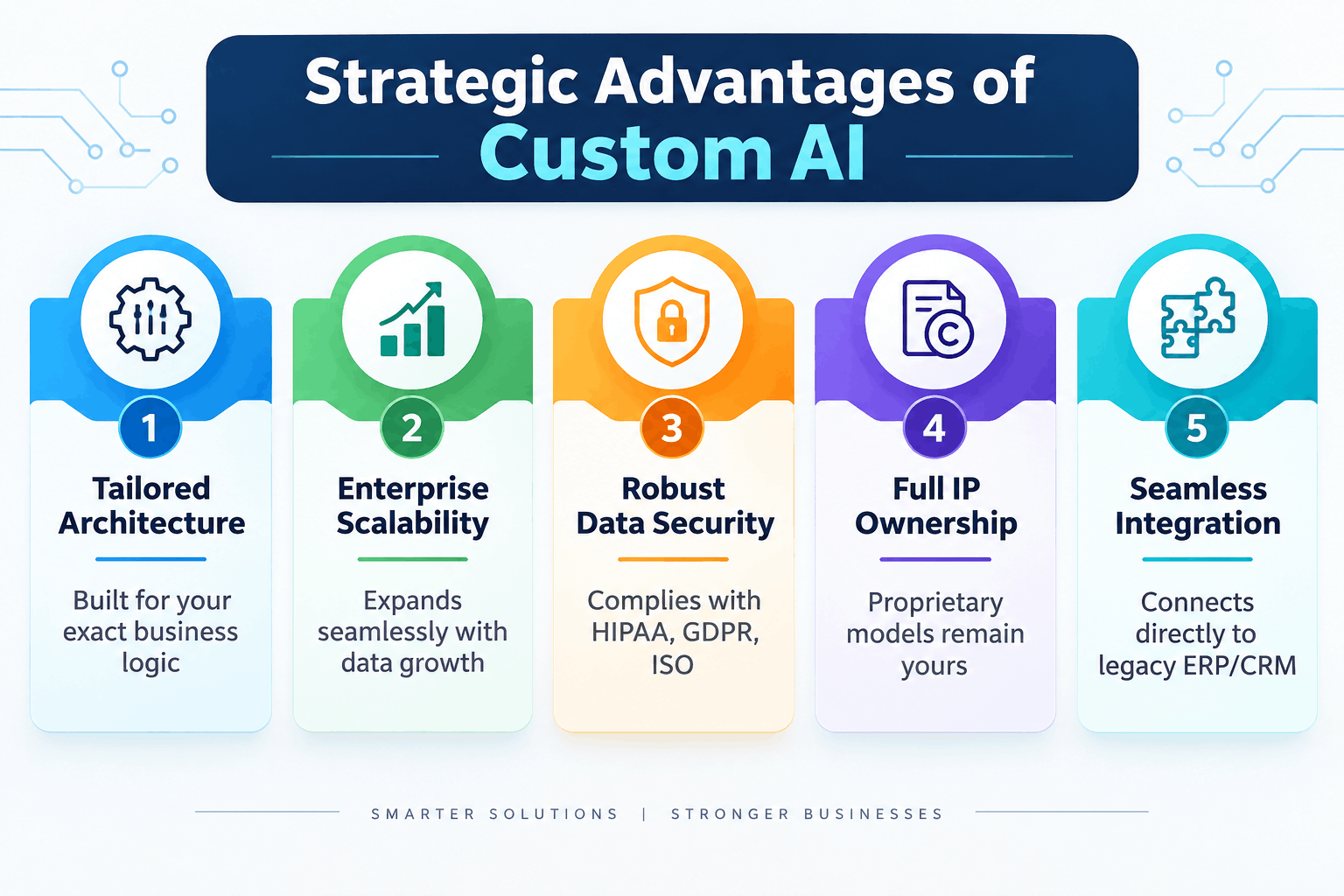
By contrast, an experienced AI development company builds systems tailored to your exact data structures, security requirements, and operational goals. Custom solutions allow you to maintain full ownership of your intellectual property while creating AI-powered business solutions that grow alongside your enterprise.
Core Benefits of Partnering with an AI Application Development Company
Investing in custom artificial intelligence delivers benefits far beyond simple task automation. When you collaborate with a dedicated AI application development company, you gain access to end-to-end expertise that transforms raw data into a revenue driver.
1. Tailored Integration with Existing Systems
Legacy infrastructure often presents a significant barrier to modernizing IT operations. A specialized custom AI software development company designs middleware and custom APIs that seamlessly connect modern machine learning models with your existing ERP, CRM, and database architectures.
2. Enhanced Data Privacy and Regulatory Compliance
Data governance is a top priority for modern enterprises. Custom development allows you to deploy models within private cloud environments or on-premise servers. This architecture ensures strict adherence to international standards like GDPR, HIPAA, and ISO 27001.
3. Scalability and Future-Proofing
As your enterprise expands, your data volume grows exponentially. A bespoke AI system features a scalable architecture designed to handle increased computational loads without requiring complete system overhauls.
Key Steps to Select the Ideal Custom AI Software Development Company
Selecting a technology partner requires a structured evaluation process. Rushing into a contract without thorough vetting often leads to missed deadlines, budget overruns, and unusable software models. Follow this step-by-step framework to identify the right partner for your project.
Step 1: Define Your Internal AI Objectives and Scope
Before reaching out to external vendors, establish a clear internal scope. Identify the exact business problems you intend to solve.
- Are you looking to implement predictive maintenance in your supply chain?
- Do you require generative AI models to handle customer support?
- Do you need advanced image recognition for quality control?
Defining your requirements allows prospective vendors to provide accurate project estimates and realistic timelines.
Step 2: Evaluate Technical Expertise and Core Competencies
Artificial intelligence is a vast field containing numerous specialized domains. A reliable AI application development company should possess deep, hands-on experience across multiple technical disciplines, including:
- Machine Learning (ML): Supervised, unsupervised, and reinforcement learning models.
- Natural Language Processing (NLP): Large Language Model (LLM) fine-tuning, sentiment analysis, and intelligent document processing.
- Computer Vision: Object detection, facial recognition, and automated visual inspection.
- Predictive Analytics: Forecasting algorithms, anomaly detection, and risk scoring engines.
Ensure that the vendor’s engineers are proficient in industry-standard frameworks like TensorFlow, PyTorch, Scikit-learn, and OpenCV.
Step 3: Review Portfolios, Case Studies, and Industry Experience
Theoretical knowledge alone is insufficient. Look for an AI development company with a proven track record of delivering production-ready applications. Request case studies that demonstrate:
- Problem Formulation: How the company approached the client’s initial challenges.
- Model Performance: Metrics such as accuracy, precision, latency, and computational efficiency.
- Business Impact: Quantifiable results, such as reduced operational costs, increased processing speed, or higher conversion rates.
Step 4: Assess Data Engineering and Management Capabilities
An AI model is only as effective as the data used to train it. High-performing artificial intelligence software development relies heavily on robust data engineering. Your ideal vendor must be highly skilled in:
- Data Cleaning and Preprocessing: Removing noise, handling missing values, and standardizing disparate data sets.
- Data Labeling and Annotation: Building accurate training datasets for supervised learning models.
- Pipeline Architecture: Constructing automated ETL (Extract, Transform, Load) pipelines for continuous model training.
Ask prospective partners how they handle data quality issues and dirty data during initial development stages.
Step 5: Understand Development Methodologies and Communication
Clear communication prevents project misalignment. The vendor should follow Agile or DevOps development methodologies, providing weekly sprints, continuous demonstration sessions, and transparent progress tracking through tools like Jira, Trello, or Azure DevOps.
Red Flags to Watch Out For During Vendor Evaluation
Knowing what to avoid is just as important as knowing what to look for. Watch out for these common red flags during preliminary discussions:
| Red Flag | Potential Risk | How to Avoid |
| Over-Promising 100% Accuracy | AI models are probabilistic, not deterministic. No legitimate company promises absolute perfection. | Choose vendors who talk in terms of precision, recall, and iterative optimization. |
| Lack of Data Security Protocols | Risk of sensitive corporate data leaks and regulatory non-compliance. | Demand clear NDA agreements and verify ISO/SOC2 security certifications. |
| No Post-Deployment Strategy | Models degrade over time due to data drift, rendering the system obsolete. | Ensure the contract includes ongoing model monitoring and maintenance services. |
| Vague Pricing Structures | Hidden development costs, unexpected cloud compute charges, and scope creep. | Request detailed milestone-based pricing with defined deliverables. |
The Cost of Custom AI Software Development Services
Pricing for custom development varies significantly based on project complexity, data preparation requirements, and integration depth. Understanding the main cost drivers helps you plan your budget effectively.
Primary Drivers of AI Project Costs
- Complexity of the Model: Fine-tuning an existing open-source Large Language Model costs significantly less than training a custom deep learning architecture from scratch.
- Data Preparation Needs: Unstructured, unorganized data requires extensive cleaning and manual annotation, increasing project hours.
- Integration Requirements: Connecting custom AI endpoints to legacy databases or multi-tier enterprise systems adds structural complexity.
- Compute Infrastructure: High-performance GPU hardware (such as NVIDIA H100s or A100s) for model training and deployment impacts overall operational expenditures.
Step-by-Step Guide: Moving from Concept to Deployment
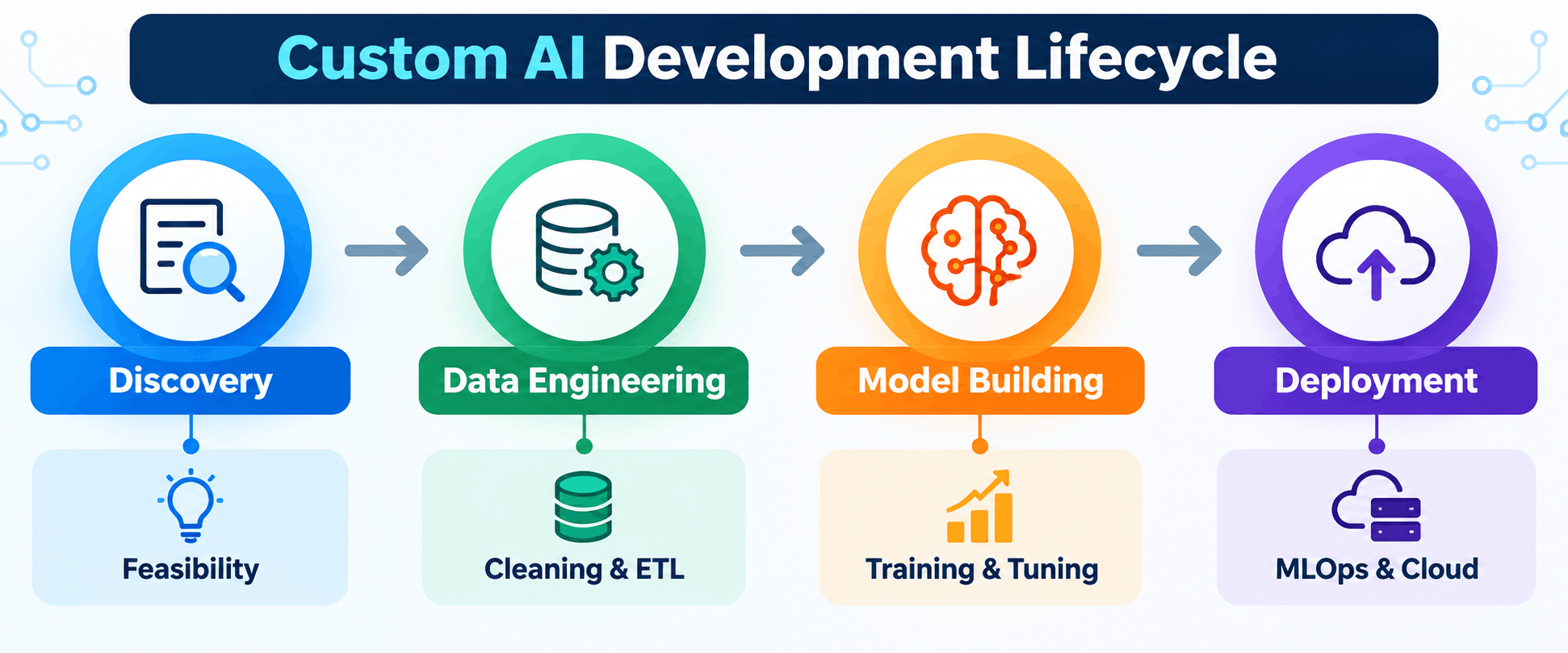
Working with a custom AI development company follows a structured lifecycle designed to reduce risk and deliver high-value software.
1. Discovery and Feasibility Analysis
The development team analyzes your objectives, evaluates available datasets, and verifies technical feasibility before writing code. This stage sets clear key performance indicators (KPIs) for model accuracy and business performance.
2. Data Engineering and Preparation
Engineers build secure data pipelines, clean incoming datasets, handle missing variables, and split data into training, validation, and testing sets.
3. Model Building, Training, and Fine-Tuning
Using frameworks like PyTorch or TensorFlow, data scientists select optimal algorithms, train baseline models, and fine-tune hyperparameters to achieve target performance metrics.
4. Integration and UI/UX Development
The trained model is wrapped inside secure REST or gRPC APIs. Frontend developers build intuitive user interfaces that allow your internal teams to interact seamlessly with AI features.
5. Deployment and MLOps Infrastructure
The system moves to production environments hosted on cloud platforms like AWS, Azure, or Google Cloud. MLOps frameworks monitor latency, resource utilization, and model accuracy in real time to catch data drift early.
To see how modern web and mobile applications integrate complex backend AI models, read our guide on Nucleosys Tech Web Development Solutions.
Key Questions to Ask Vendors Before Signing a Contract
Before executing a master services agreement (MSA) with an AI application development company, ask these essential questions during technical discovery calls:
- How do you protect our proprietary data during model training?
Ensure your data is never used to train public models or shared with third-party entities. - Who retains intellectual property rights for custom code and trained models?
Your business should maintain 100% ownership of all custom software artifacts, model weights, and source code. - What is your post-launch support and MLOps maintenance policy?
Verify if the vendor offers service level agreements (SLAs) for ongoing model retrainings, bug fixes, and infrastructure management. - How do you monitor and prevent algorithmic bias?
Inquire about their validation techniques to ensure models deliver fair, unbiased predictions. - What is the expected compute infrastructure cost during production runtimes?
A expert development partner provides accurate estimates for ongoing cloud compute usage.
For additional insights on selecting technology partners and managing outsourced teams, review standard software engineering practices outlined by the IEEE Computer Society.
Transform Your Enterprise with Nucleosys Tech
Navigating the complexities of artificial intelligence requires an engineering partner with proven technical skill, high security standards, and deep domain experience. At Nucleosys Tech, we build production-ready custom AI solutions that solve complex business challenges, streamline operations, and drive measurable return on investment.
Our team delivers tailored end-to-end services, including:
- Custom Machine Learning & Deep Learning Model Development
- Generative AI & LLM Fine-Tuning
- Computer Vision & Natural Language Processing Systems
- Enterprise Data Engineering & MLOps Infrastructure
Whether you are building an AI-powered MVP or modernizing legacy infrastructure, we deliver secure, scalable software designed for long-term success.
👉 Ready to transform your business operations with custom artificial intelligence?
Contact Nucleosys Tech Today to schedule a technical consultation with our AI solutions architects!
Frequently Asked Questions (Q&A)
Q1: What is the primary difference between off-the-shelf AI and custom AI solutions?
Off-the-shelf AI tools are pre-built software applications meant for general use cases. They offer quick setup but lack custom features, system integration capabilities, and data privacy controls. Custom AI solutions are engineered specifically for your enterprise workflows, legacy applications, and target outcomes, ensuring full intellectual property ownership and complete security control.
Q2: How long does it take to develop a custom AI application?
Development timelines depend entirely on project scope and data readiness. A Proof of Concept (PoC) or basic Minimum Viable Product (MVP) typically takes 6 to 10 weeks. Comprehensive enterprise-grade applications with complex integrations generally take 3 to 9 months from initial discovery to final cloud deployment.
Q3: Why is MLOps important for custom AI software development?
Machine Learning Operations (MLOps) is essential because AI models, unlike traditional code, degrade over time as real-world data patterns change (known as data drift). MLOps provides continuous monitoring, automated testing, and seamless model retraining, ensuring your software maintains high accuracy over time.
Q4: Do I need a massive dataset to build custom AI software?
Not always. While deep learning models require extensive data, strategies like transfer learning, synthetic data generation, and fine-tuning existing foundation models allow us to build high-accuracy tools using smaller, high-quality, domain-specific datasets.
Q5: How do I ensure my proprietary business data remains secure during development?
Work with a custom AI development company that enforces strict non-disclosure agreements (NDAs), uses isolated private cloud compute environments (like AWS VPC or Azure Isolated VNet), and complies with standards such as GDPR, ISO 27001, or SOC 2. Your training data should never leave your controlled environment or be exposed to public APIs.

