Last Updated on October 3, 2026 by Nucleosystech
The global tech landscape is experiencing a seismic paradigm shift. From automated code generation to self-healing application architectures, AI software development has moved from a futuristic concept to the core backbone of modern enterprise engineering. Organizations no longer ask if they should integrate artificial intelligence into their software workflows; instead, they are competing to adopt it before their rivals outpace them.
Historically, custom software engineering required months of painstaking manual coding, extensive human review, and manual regression testing. Today, leveraging artificial intelligence development allows businesses to accelerate delivery cycles while significantly reducing operational overhead. Whether through predictive bug detection or real-time automated refactoring, artificial intelligence is rewriting the rules of the Software Development Life Cycle (SDLC).
At Nucleosys Tech, we help businesses bridge the gap between legacy engineering and cutting-edge intelligence. As a leading AI software development company, we specialize in crafting tailored digital systems that harness automated intelligence to deliver measurable business performance. In this comprehensive guide, we will explore how AI is fundamentally transforming custom software engineering, why enterprises must adapt, and how you can leverage these changes for a decisive competitive edge.
The Paradigm Shift: From Traditional Coding to AI Software Development
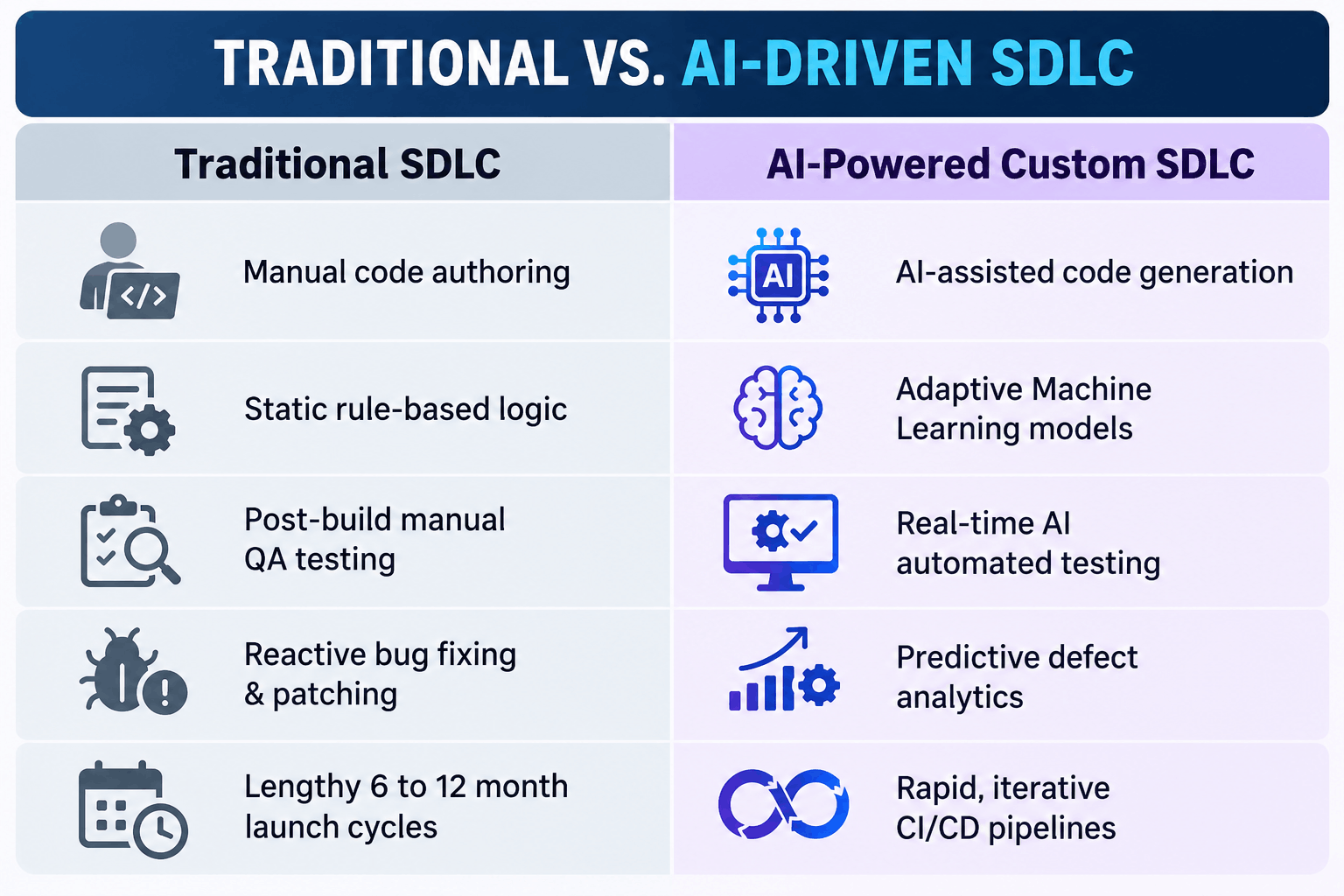
Traditional software development relies heavily on hardcoded logic written by human developers line by line. While this approach has powered digital transformation for decades, it struggles with the scale, speed, and complexity demanded by modern enterprises.
The entry of AI in software development fundamentally alters this dynamic by shifting engineering from static procedural logic to adaptive, data-driven systems.
Key Differences in Software Execution
- Rule-Based vs. Pattern-Based Execution: Traditional applications follow strict conditional paths. In contrast, applications powered by Machine Learning analyze massive datasets to adapt their responses dynamically without needing constant human intervention.
- Speed of Deployment: AI-assisted development tools dramatically compress development timelines, allowing engineers to build and deploy complex products in weeks rather than months.
- Continuous Self-Improvement: Unlike standard applications that remain static until an engineer pushes a code update, systems integrated with Generative AI and neural networks learn continuously from live user interactions.
By augmenting developer ingenuity with computational speed, businesses can create flexible, highly scalability solutions tailored precisely to their operational demands.
5 Core Ways Artificial Intelligence Development Boosts the SDLC
Integrating artificial intelligence across the SDLC yields dramatic improvements in efficiency, accuracy, and agility. Here is how modern AI development services are reshaping every phase of software creation.
1. Intelligent Code Generation and Copilot Assistance
Writing boilerplate code, repetitive CRUD operations, and standard API integrations historically consumed up to 40% of a developer’s working hours. Modern developer copilots powered by Generative AI change this entirely.
These AI models analyze context across vast repositories to provide precise context-aware code completions, complete full functions from simple comments, and translate logic across programming languages seamlessly. Consequently, developers spend far less time on mundane syntax and focus more time on high-level architecture and unique business logic.
2. Predictive Analytics and Bug Detection
Addressing bugs in production environment can cost up to 30 times more than detecting them early in the design stage. Through Predictive Analytics, AI tools continuously evaluate source code during execution to flag syntax flaws, logical anti-patterns, and security vulnerabilities before the code is ever committed.
These intelligent systems study historical bug trends within a repository, accurately predicting which modules carry the highest risk during updates and highlighting potential bottlenecks long before deployment.
3. AI Automation in Testing and Quality Assurance
Manual quality assurance is inherently time-consuming and prone to oversight. Integrating AI Automation into testing workflows replaces brittle, manual scripts with dynamic, self-healing test frameworks.
- Dynamic Test Generation: AI tools automatically generate complete unit and integration test suites based on updated user requirements.
- Self-Healing Test Scripts: When UI elements change during design updates, AI scripts identify the change and update element selectors on the fly, eliminating broken test suites.
- Smart Coverage Analysis: AI algorithms highlight untested code branches, ensuring robust overall test coverage.
According to research published on IEEE Xplore, implementing automated AI testing frameworks can reduce regression test suite execution time by over 60% while simultaneously increasing defect detection accuracy.
4. Automated UI/UX to Code Conversion
Bridging the gap between UI/UX designs and front-end code has long been a friction point for development teams. Advanced vision-language models now translate design files (such as Figma or Adobe XD mockups) directly into functional, clean, responsive HTML, React, or Vue code. This automated translation speeds up design handoffs and drastically reduces frontend visual defects.
5. Smart Refactoring and Legacy System Modernization
Legacy codebases often pose massive security risks and hinder feature expansion. However, rewriting legacy systems from scratch carries high cost and operational risk. AI software development techniques streamline modernization by analyzing outdated code structures (such as COBOL or legacy Java), mapping business logic dependencies, and assisting engineers in modularizing and translating them into cloud-native microservices.
Harnessing Generative AI and Machine Learning for Custom Systems
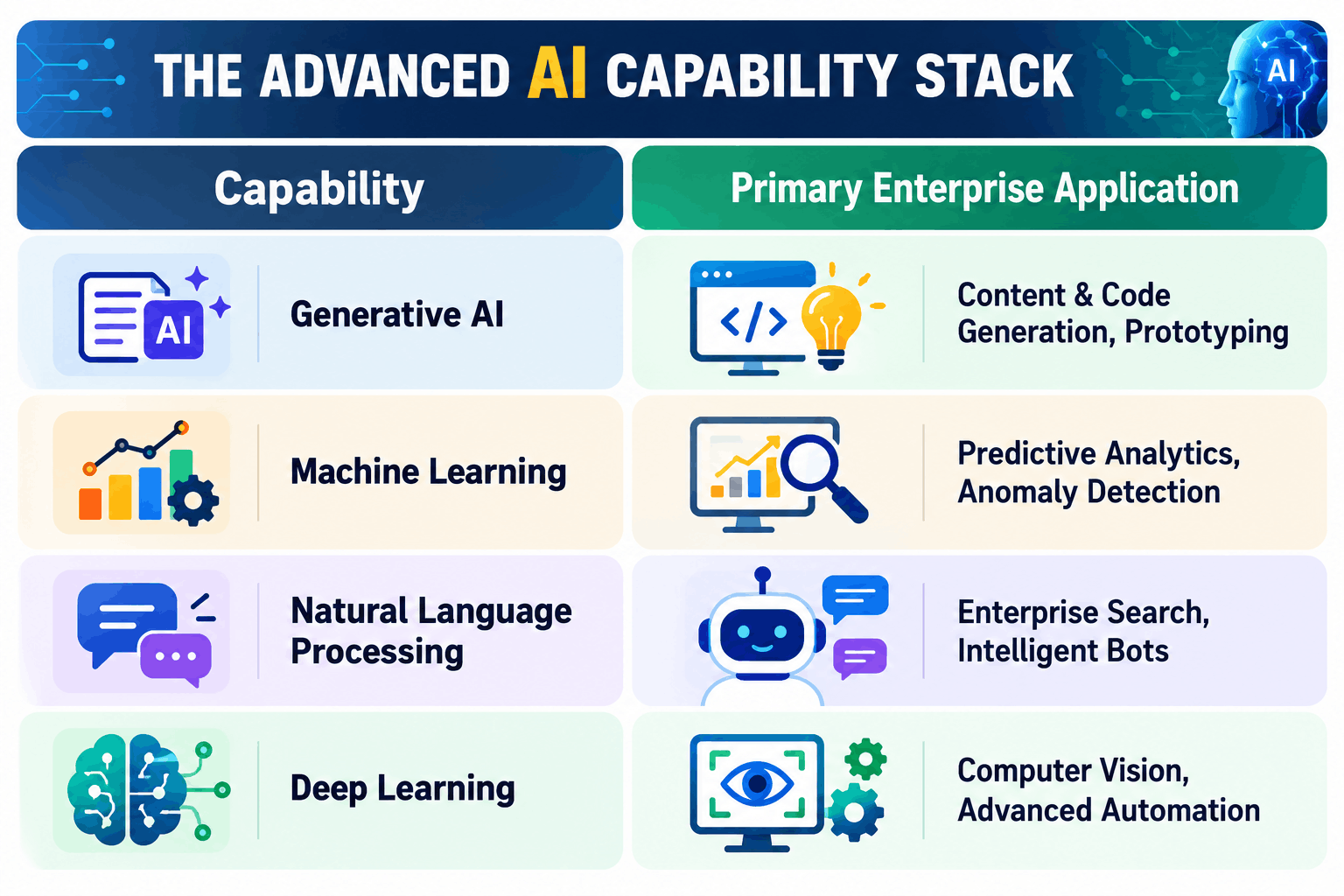
Generic off-the-shelf software rarely meets the complex demands of modern enterprises. Custom software tailored to your specific business model is vital for building sustainable market dominance. Integrating advanced algorithms into custom application frameworks transforms standard tools into predictive engines.
Transforming Raw Data into Strategic Assets
Businesses collect vast volumes of data daily. Without intelligent processing, however, this data remains underutilized. By leveraging specialized custom algorithms, organizations can extract actionable intelligence from disparate data streams:
- Predictive Maintenance: Industrial platforms evaluate real-time IoT sensor feeds to predict equipment failures days before they occur.
- Dynamic Pricing Engine: E-commerce solutions adjust pricing structures autonomously in real time based on fluctuating supply, demand, and competitor behavior.
- Hyper-Personalization: Recommendation algorithms deliver tailored user experiences based on behavioral patterns, boosting customer retention and lifetime value.
To read more about real-world applications of these technologies, review the comprehensive research guides published by the MIT Computer Science and Artificial Intelligence Laboratory (CSAIL), which highlight the practical benefits of machine learning in modern enterprise software.
Overcoming Key Challenges in AI Development Services
While the advantages of AI in software development are vast, successful implementation requires navigating technical and strategic challenges. Partnering with an experienced tech provider ensures these hurdles are addressed proactively.
Data Privacy and IP Protection
Using public generative tools poses significant data privacy risks if proprietary code or customer information is exposed to public training sets. Enterprise solutions overcome this issue by establishing private, dedicated instances with strict data encryption, ensuring your proprietary IP remains entirely protected.
Eliminating Algorithmic Bias and Hallucinations
AI models can occasionally generate false responses or inherit biases present in their training data. Responsible software development mandates a human-in-the-loop (HITL) architecture. Human engineers review and validate high-stakes outputs to ensure software reliability, compliance, and safety.
Seamless Legacy Integration
Connecting modern models to older infrastructure can introduce technical friction. Utilizing a modern, API-first architecture simplifies this transition, enabling legacy systems to exchange data smoothly with cutting-edge microservices.
Why Modern Enterprises Require Custom Enterprise AI Solutions
Off-the-shelf SaaS applications offer quick setup times, but they enforce rigid workflows, lack proprietary security controls, and carry subscription costs that grow rapidly as you scale.
Investing in custom Enterprise AI Solutions gives organizations complete ownership of their digital ecosystem, allowing them to tailor functionality directly to their competitive advantages.
Enterprise Advantages of Custom AI Engineering
- Total IP Ownership: You hold exclusive rights to your software architecture, custom models, and specialized workflows.
- Tailored Integrations: Custom software integrates directly with your existing ERP, CRM, and internal infrastructure, eliminating data silos.
- Scalable Performance: Custom architectures scale smoothly with your growing data volume and user base, avoiding forced tier upgrades from third-party vendors.
- Enhanced Security and Compliance: Custom platforms can be built from the ground up to satisfy strict industry standards like HIPAA, GDPR, and ISO 27001.
Learn more about how custom engineering drives scalable growth by exploring our dedicated Custom Software Development Services platform.
The Strategic Roadmap to Building an AI-Powered Software Architecture
Transitioning from traditional development to intelligent software engineering requires a structured, step-by-step framework. Here is how we lead digital transformations for our clients.
1.Strategic Discovery and Feasibility Assessment:Defining objectives and data readiness.
We assess your business ecosystem to identify high-impact AI integration points. Our team evaluates data quality, infrastructure compatibility, and ROI projections to build a clear project roadmap.
2.Data Engineering and Infrastructure Setup:Structuring data pipelines and security.
High-performing AI models require clean, structured data. We build secure data pipelines, implement role-based access control (RBAC), and organize cloud infrastructure to handle training and inference demands safely.
3.Model Selection, Fine-Tuning, and Integration:Building custom intelligence architectures.
We select and fine-tune specialized models to match your business requirements. Using custom APIs and microservices, we embed these intelligent models into your software applications without disrupting live operations.
4.Human-in-the-Loop Validation and Testing:Ensuring safety, performance, and precision.
Before deployment, we subject the software to dynamic automated testing, security audits, and human-in-the-loop validation to ensure zero hallucination risk, compliance, and reliable execution under heavy loads.
5.Continuous Deployment and Model Optimization:Monitoring real-world performance over time.
After launch, we monitor model performance, telemetry data, and user feedback continuously. Our iterative optimization loop ensures your custom software adapts seamlessly as your business scales.
The Future of Software Engineering: Autonomous Agents and Beyond
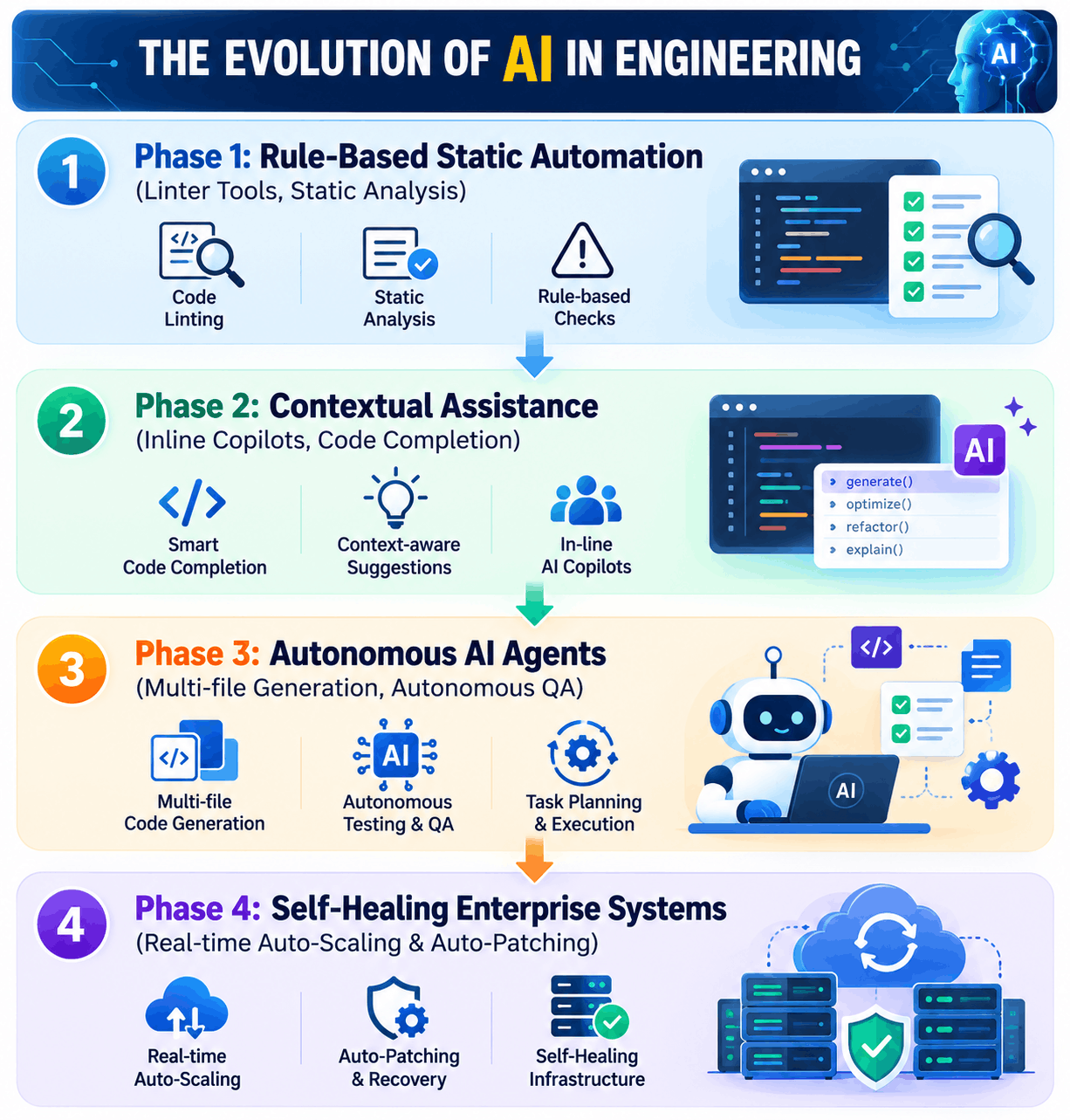
The evolution of artificial intelligence development is moving forward at an incredible pace. Moving beyond basic code completion tools, the next era of engineering centers on autonomous AI agents.
Autonomous agents can analyze complex business goals, decompose them into actionable user stories, write necessary source code across multiple files, execute unit tests, and submit pull requests independently—all while under developer oversight.
What Lies Ahead for Enterprise Tech?
- Self-Healing Application Architectures: Future applications will identify system faults in production, formulate patches, run regression checks autonomously, and deploy fixes without service downtime.
- Natural Language System Architecture: Product managers and engineers will outline complex system designs in clear natural language, with AI platforms generating base infrastructure setups instantly.
- Hyper-Automated Data Governance: Automated compliance platforms will monitor data transfers in real time, automatically masking sensitive information and enforcing regulatory standards everywhere.
Partner with Nucleosys Tech to Transform Your Digital Infrastructure
Navigating this changing technical landscape requires an experienced engineering partner who understands modern artificial intelligence and software architecture.
At Nucleosys Tech, we combine deep technical expertise with industry experience to deliver modern, resilient custom software solutions. Whether you want to modernize a legacy application, deploy custom machine learning pipelines, or build an intelligent platform from scratch, our software specialists are here to bring your vision to life.
Our Specialized AI Services Include:
- Custom AI Software Development tailored to your precise industry workflows.
- Secure AI Integration Services designed to elevate existing mobile and web platforms.
- End-to-end cloud optimization, security hardening, and database design.
- Scalable machine learning development and automated QA execution.
Don’t let legacy technical debt slow down your organization. Contact our technical team today to schedule an architecture evaluation and explore how our software services can accelerate your digital transformation.
Frequently Asked Questions (Q&A)
What is AI software development?
AI software development is the process of applying artificial intelligence techniques—such as Machine Learning, Generative AI, and Natural Language Processing—across the software development lifecycle. It includes using intelligent tools to write code, design architectures, run automated testing, and build smart applications that learn continuously from real-world data.
How does AI improve custom software development compared to standard off-the-shelf software?
AI improves custom software development by analyzing your unique business data to build tailored features like predictive analytics, intelligent automation, and automated user workflows. Unlike rigid off-the-shelf applications, custom AI systems give you complete control, higher scalability, and full ownership of your intellectual property.
Can small and mid-sized businesses benefit from AI software development services?
Yes. Smaller businesses can use AI development services to automate repetitive operational tasks, deliver 24/7 intelligent customer support, and automate testing workflows. This level of automation enables smaller teams to scale efficiently and compete directly with larger enterprise organizations.
Will AI replace human custom software developers?
No, AI will not replace human developers. Instead, it transforms their role by taking care of repetitive boilerplate code, syntax checks, and standard unit tests. This shift allows human engineers to spend more time on complex architecture, strategic problem-solving, UX design, and business logic validation.
How do you ensure data privacy and security when building custom AI software?
We ensure complete data security by deploying localized, private AI models inside dedicated cloud environments. By implementing strong role-based access controls, robust encryption, and strict data-handling policies, we ensure your internal business data and proprietary source code are never shared with public LLM training sets.
How do I get started with AI integration services for my business?
Getting started is simple. Contact the engineering team at Nucleosys Tech to arrange an initial architectural discovery session. We will evaluate your current infrastructure, outline clear AI integration options, and build a phased development roadmap tailored to your strategic goals.

