
Last Updated on September 28, 2026 by Nucleosystech
In an era of rapid technological evolution, industrial floors across the globe are undergoing a profound digital overhaul. Traditional automation—once relying strictly on pre-programmed scripts and manual quality audits—is no longer sufficient to keep pace with shifting global demand, volatile supply chains, and rising material costs. Today, forward-thinking enterprise leaders are leveraging artificial intelligence (AI) to introduce real-time adaptability, predictive intelligence, and operational efficiency into their production lines. Understanding how AI software solutions are transforming manufacturing operations has become the primary roadmap for industrial enterprises aiming to retain market leadership, minimize operational downtime, and scale profitably in Industry 4.0.
From predicting machinery failures before they occur to executing computer vision quality control at micro-millimeter precision, intelligent software systems are fundamentally redefining workshop efficiency. Instead of relying on reactive fixes, modern production environments use custom web applications, IoT integrations, and deep-learning models to convert fragmented plant data into actionable operational strategies.
1. The Dawn of Industry 4.0: Why AI Software Solutions Are Transforming Manufacturing Operations
The manufacturing landscape has officially transitioned from basic mechanical automation into cognitive factory operations. At the center of this paradigm shift is the integration of custom enterprise software with machine learning models capable of handling massive volumes of telemetry data.
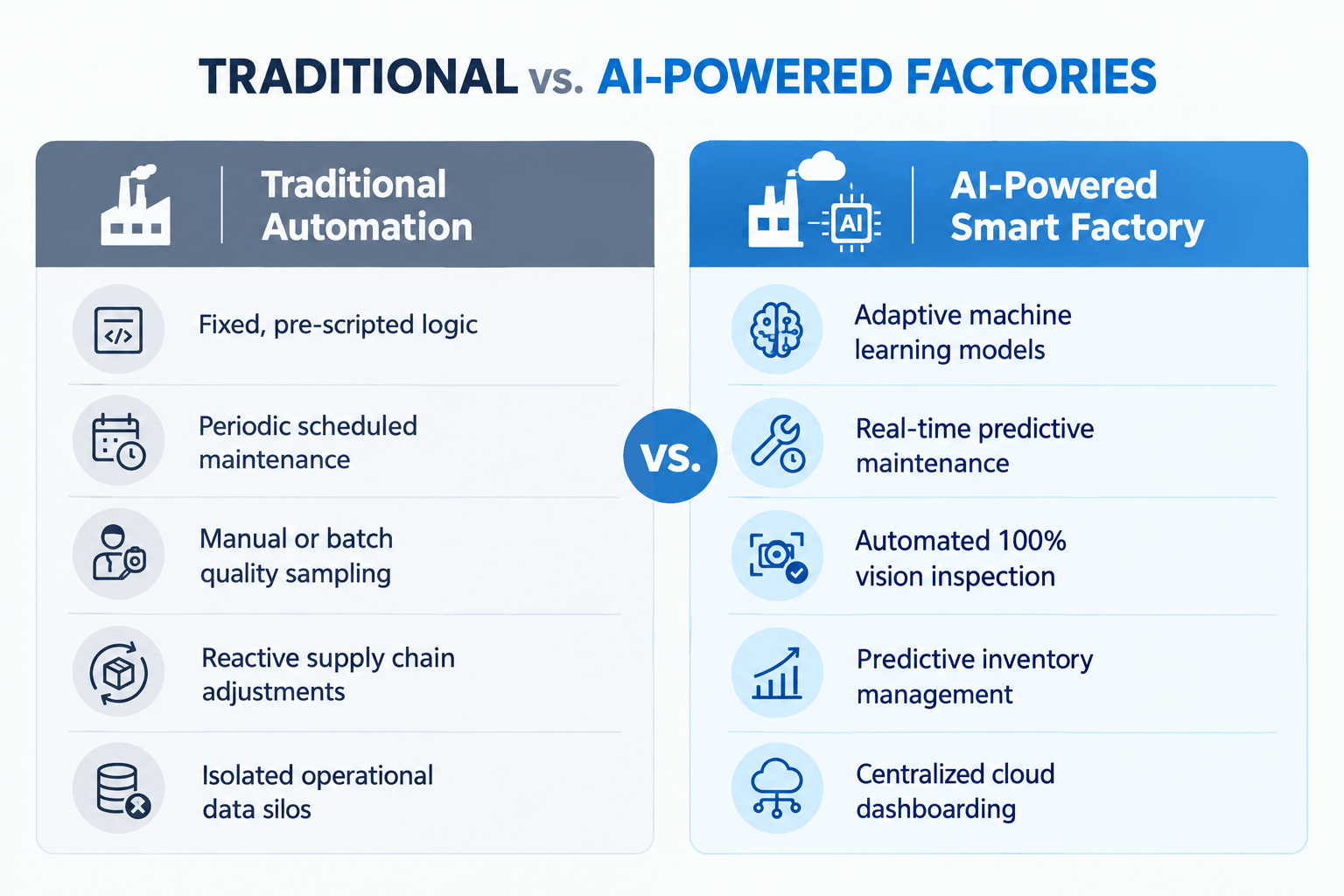
When analyzing how AI software solutions are transforming manufacturing operations, the primary differentiator lies in the transition from static automation to adaptive machine learning in manufacturing. Traditional systems simply follow fixed, repeating instructions. If an anomaly occurs on the assembly line, the system halts, requiring manual human intervention. In contrast, AI-powered software constantly monitors variables like temperature, vibrational signatures, pressure variances, and cycle durations, adjusting line parameters dynamically to maintain peak throughput without stopping production.
Furthermore, modern smart factory solutions unify siloed production databases. By wrapping artificial intelligence models inside intuitive custom web application development platforms, enterprise executives gain a bird’s-eye view of plant performance across multiple facilities, standardizing decision-making and eliminating operational blind spots.
2. Predictive Maintenance: Turning Unplanned Downtime into Proactive Scheduling
Unplanned equipment downtime remains one of the single most expensive bottlenecks in heavy manufacturing. When a key robotic arm, CNC spindle, or conveyor motor fails unexpectedly, entire assembly lines stall, triggering exponential revenue losses and disrupted delivery schedules.
Eliminating Failure Before It Occurs
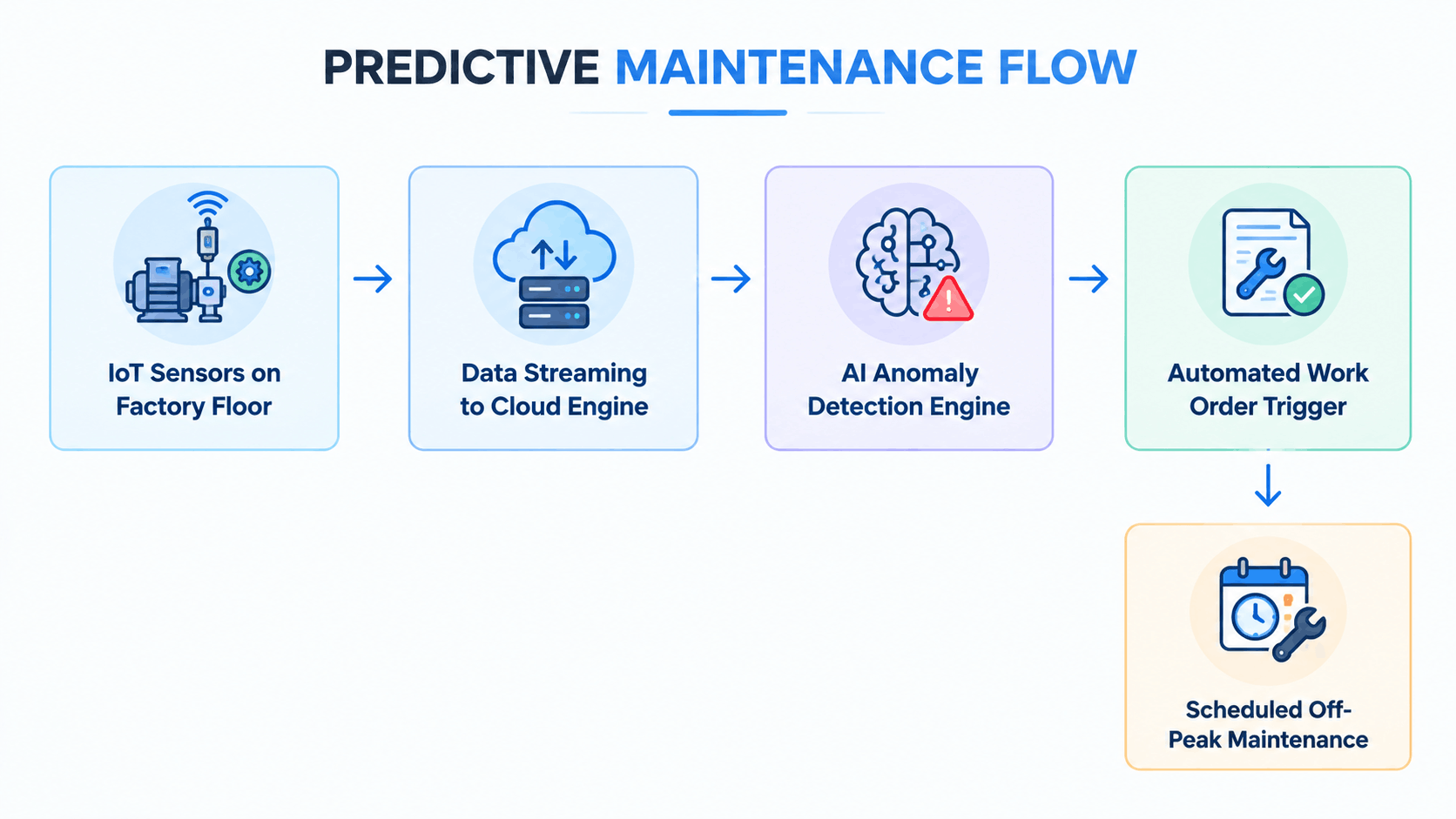
By embedding predictive maintenance software into factory machinery via Industrial Internet of Things (IIoT) sensors, manufacturers shift from reactive maintenance to proactive, data-backed scheduling. These sensors capture continuous streams of operational metrics, such as:
- Vibrational spectrums indicating bearing wear or shaft misalignment.
- Thermal fluctuations highlighting insufficient lubrication or electrical overload.
- Pressure and acoustic anomalies warning of pump cavitation or hydraulic degradation.
AI algorithms compare these real-time streams against historical performance baselines. When subtle deviations emerge—weeks before a physical component actually breaks down—the AI software generates automated maintenance tickets, orders replacement parts, and suggests optimal, off-peak repair windows. This continuous loop dramatically lowers operational expenditure, extends machinery lifespan, and maximizes overall equipment effectiveness (OEE).
3. Automated Quality Control through Computer Vision in Manufacturing
Maintaining uniform product quality across high-volume production lines is inherently difficult when relying solely on visual inspections by human operators. Fatigue, distraction, and line speed constraints inevitably lead to defective components passing undetected into final distribution.
Precision Quality Control at Production Speeds
The implementation of computer vision in manufacturing has established a new benchmark for quality assurance. High-resolution industrial cameras, paired with deep neural networks, continuously inspect items moving down conveyor belts at high speeds.
- Micro-Defect Detection: Computer vision models analyze microscopic surface cracks, welding porosity, incorrect paint coverage, or missing fasteners in fractions of a second.
- Instant Automated Ejection: Identified non-conforming units are automatically flagged and routed to reject bins via pneumatics, preventing defective parts from moving downstream.
- Root Cause Feedback: The AI system logs defect types and frequencies, feeding this data back to upstream machine controllers so operators can correct calibration drift before it turns into a widespread scrap issue.
By achieving near 100% inspection coverage without slowing line speed, manufacturers protect brand reputation, eliminate expensive product recalls, and significantly reduce material waste.
4. Smart Supply Chain Optimization and Demand Forecasting
Modern manufacturing does not exist in isolation; it depends heavily on complex, global supply webs. Geopolitical events, material shortages, and sudden shifts in consumer sentiment can quickly undermine traditional inventory planning.
Synchronizing Inventory with Real-Time Market Demand
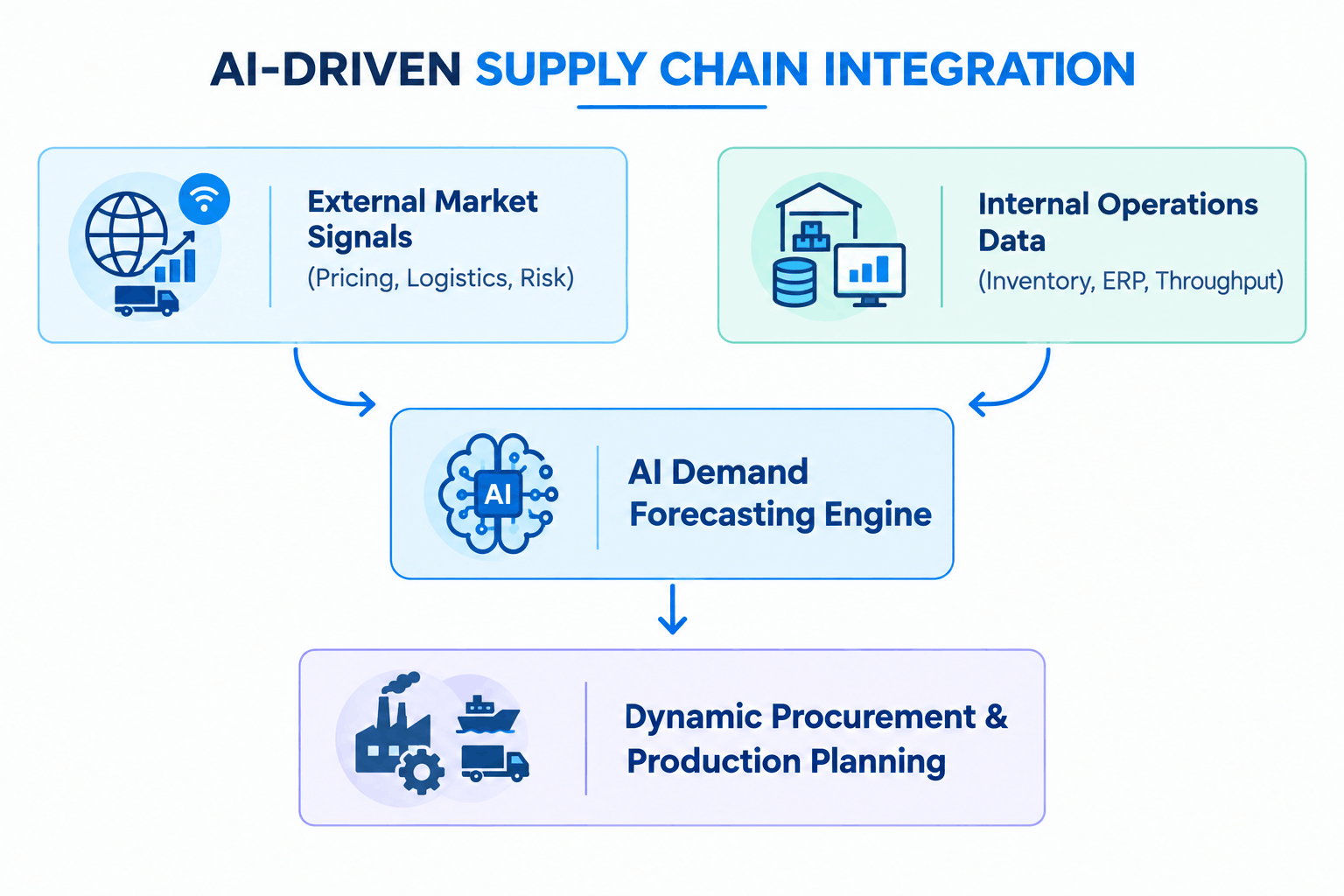
By deploying intelligent algorithms for smart supply chain optimization, manufacturing leaders gain predictive visibility across their entire vendor network. AI platforms process internal Enterprise Resource Planning (ERP) metrics alongside external datasets—such as market trends, shipping delays, weather patterns, and raw material index prices—to deliver accurate demand forecasts.
- Dynamic Raw Material Procurement: AI platforms automatically adjust order sizes and schedules, keeping raw material inventories aligned with near-term demand to prevent capital lockup.
- Warehouse & Logistics Management: Intelligent route optimization software streamlines intra-factory logistics, automated guided vehicles (AGVs), and finished-goods distribution networks.
- Supplier Risk Scoring: Machine learning continuously evaluates vendor delivery performance, highlighting potential bottleneck risks before they disrupt the production schedule.
5. Industrial Robotics and Collaborative Robots (Cobots)
Industrial robotics has moved beyond massive, rigid cages where machines operate completely separate from human workers. The modern shop floor features intelligent industrial robotics and collaborative robots (cobots) designed to safely work side-by-side with human personnel.
Enhancing Human Capability on the Factory Floor
Unlike legacy automation, AI-driven cobots utilize advanced spatial sensors, force-torque control, and vision algorithms to adapt dynamically to human motion. When a human operator enters a cobot’s working envelope, the system automatically slows or redirects its trajectory to prevent collisions, maintaining high safety standards without shutting down production.
These smart systems excel at handling repetitive, high-precision tasks—such as intricate PCB assembly, bin picking, seam welding, and palletizing. By offloading physically demanding and repetitive tasks to adaptive cobots, factories boost total output while allowing their skilled workforce to focus on high-value supervisory, maintenance, and engineering roles.
6. Generative AI and Digital Twins in Factory Design
Two of the most transformative advances in modern manufacturing engineering are generative AI and digital twin technology. Together, these tools let industrial engineers design, test, and optimize products and entire plant layouts in virtual space before spending capital on physical implementation.
Simulating Success Before Physical Execution
A digital twin is an exact, real-time virtual representation of a physical asset, production line, or factory facility. Powered by continuous IoT data streams, the virtual model updates dynamically to match real-world operations.
- Scenario Simulation: Engineers can model alternative assembly layouts, introduce new product SKUs, or simulate power outages within the digital twin to observe bottlenecks without interrupting actual factory operations.
- Generative Design Optimization: Generative AI software creates component designs based on specific constraints like weight, load strength, material choice, and cost. It tests thousands of geometries in seconds to identify lightweight, structurally superior components that traditional computer-aided design (CAD) could never produce.
- Virtual Commissioning: Software code, robotic motion trajectories, and PLC logic can be tested and validated inside a digital twin prior to hardware installation, dramatically reducing factory startup times.
7. Energy Management and Sustainable Manufacturing
Rising energy costs and corporate sustainability goals make environmental efficiency a top priority for modern industrial operations. Heavy manufacturing equipment consumes substantial electrical and thermal energy, often wasting resources during idle periods or suboptimal operating cycles.
Driving Sustainability Through Real-Time Efficiency
Understanding how AI software solutions are transforming manufacturing operations extends to resource utilization and waste reduction. Intelligent software applications track real-time power consumption across every cell in a manufacturing plant, identifying inefficiency and automating smart energy responses:
- Peak-Load Shaving: AI platforms balance machine start-up sequences to prevent simultaneous energy spikes that trigger expensive utility surge charges.
- Automated Idle Power Down: When production pauses or slows, the software intelligently throttles down auxiliary systems—such as HVAC units, hydraulic pumps, and extraction fans—without impacting line readiness.
- Material Waste Reduction: By identifying material flaws early through automated quality control, factories minimize scrapped raw inputs, lowering their overall carbon footprint.
By pairing sustainability goals with AI-driven energy analytics, industrial enterprises lower operational costs while meeting environmental regulatory standards.
8. Navigating Challenges in Implementing AI Software Solutions
While the advantages of industrial artificial intelligence are clear, deploying these technologies across legacy environments presents distinct implementation challenges. Achieving a high return on investment (ROI) requires addressing technical, organizational, and security considerations upfront.
Overcoming Integration and Operational Barriers
To execute a successful digital transformation, enterprise IT and plant operations teams must address four core operational hurdles:
- Integrating Legacy Hardware: Older factory machinery often lacks native digital connectivity. Modern deployments solve this by adding industrial edge-computing gateways and retrofit IoT sensor kits that bridge legacy systems to central cloud architectures.
- Ensuring Data Quality: Machine learning models depend on high-quality input data. Establishing structured data pipelines ensures telemetry collected from heterogeneous machines is cleaned, normalized, and correctly time-stamped.
- Upward Workforce Reskilling: Introducing AI tools requires upskilling shop-floor employees. Developing tailored, user-friendly software interfaces allows operators to easily interpret AI recommendations without needing advanced data science backgrounds.
- Protecting OT Cybersecurity: As operational technology (OT) connects to IT networks, protecting critical equipment from cyber threats becomes vital. Implementing robust, end-to-end security protocols protects connected production lines from malicious intrusions.
9. Future Trends: What Lies Ahead for Smart Manufacturing?
The convergence of artificial intelligence with industrial technologies continues to accelerate. Looking beyond current deployments, several emerging trends will shape the next generation of smart factory operations:
- Autonomous Factories: Fully self-correcting facilities where AI software orchestrates production, material handling, quality assurance, and equipment maintenance with minimal human intervention.
- Generative AI Copilots for Plant Operators: Natural language AI interfaces allowing factory workers to query operational manuals, pull machine health metrics, and execute complex PLC recalibrations using simple voice commands.
- 5G-Enabled Edge Computing: Ultra-low latency private 5G networks enabling real-time computer vision processing and cobot coordination directly on edge devices on the factory floor.
- Hyper-Personalized Mass Production: Flexible, AI-orchestrated manufacturing lines capable of switching between customized product configurations on the fly without setup downtime.
Strategic Summary: Comparing Key AI Manufacturing Technologies
To summarize the practical applications of these intelligent systems, the table below highlights how each core AI software solution addresses specific factory challenges, its operational benefits, and typical performance metrics.
| AI Software Application | Core Operational Function | Primary Business Benefit | Measured Impact Metric |
| Predictive Maintenance | Analyzes vibrational, thermal, and sensor data to forecast equipment failure. | Eliminates unplanned downtime and extends machine lifespan. | Up to 50% reduction in downtime costs. |
| Computer Vision QA | High-speed, automated camera inspection of products for micro-defects. | Guarantees 100% quality checking and drastically cuts scrap waste. | Near 99%+ defect detection accuracy. |
| Supply Chain Analytics | Predictive demand modeling and automated inventory optimization. | Reduces buffer stock inventory and prevents supply shortages. | 20-30% improvement in forecast accuracy. |
| Collaborative Cobots | Adaptive robotic automation operating safely alongside human workers. | Boosts line output while relieving humans of hazardous tasks. | 35% increase in operational throughput. |
| Digital Twins & Sim | Virtual modeling of factory layouts, assets, and operational workflows. | Enables risk-free process testing and faster commissioning. | 40% faster production rollout times. |
Transform Your Industrial Operations with Nucleosys Tech
Transitioning from traditional manufacturing to an AI-powered smart factory requires a partner who understands complex industrial software development, cloud infrastructure, and modern machine learning integration.
At Nucleosys Tech, we specialize in building custom, high-performance AI software solutions engineered to elevate modern business operations. Whether you need scalable industrial web portals, custom IoT management dashboards, or custom enterprise applications, our full-stack engineering team turns complex operational data into actionable, bottom-line results.
Our end-to-end expertise spans tailored custom software development, cloud architecture, predictive analytics platforms, and intelligent business solutions. We partner closely with your team to audit your current workflows, eliminate operational bottlenecks, and build reliable digital tools tailored specifically to your growth goals.
Ready to modernize your production floor and drive measurable ROI?
Contact the experts at Nucleosys Tech today to schedule your custom software consultation and accelerate your industrial digital transformation journey.
Frequently Asked Questions (Q&A)
Q1: What is the main benefit of understanding how AI software solutions are transforming manufacturing operations?
Understanding how AI software solutions are transforming manufacturing operations gives business leaders a clear roadmap to reduce downtime, automate quality control, optimize supply chains, and cut operational expenses. It helps companies shift from reactive, manual processes to proactive, data-driven smart factory models.
Q2: How does predictive maintenance differ from traditional preventive maintenance?
Traditional preventive maintenance relies on fixed schedules or operating hours to service equipment, often replacing components that are still functional. Predictive maintenance uses real-time IoT sensors and AI software to monitor actual equipment health, alerting engineers to perform maintenance only when early signs of wear appear—preventing failures while reducing unnecessary servicing.
Q3: Do manufacturers need to replace all legacy equipment to implement AI software?
No, complete equipment replacement is rarely necessary. Modern AI software solutions integrate with legacy machines using industrial edge gateways and retrofitted IoT sensor kits. These tools gather operational data from existing assets and send it to central AI platforms for analysis.
Q4: How does computer vision improve quality control on high-speed production lines?
Computer vision systems use industrial cameras paired with deep-learning models to capture and evaluate detailed images of products in real time. These systems detect microscopic surface flaws, assembly errors, or material anomalies faster and more accurately than human inspection, automatically flagging defective items without slowing down the line.
Q5: How can small to medium-sized manufacturers start with AI adoption?
Small and medium enterprises (SMEs) can begin by targeting high-impact bottlenecks—such as deploying predictive maintenance on critical machinery or automating quality inspection on a single assembly line. Partnering with custom software providers like Nucleosys Tech allows companies to build scalable, phased solutions that deliver fast ROI before expanding AI across the entire plant.

