Last Updated on October 21, 2026 by Nucleosystech
In today’s hyper-competitive digital landscape, off-the-shelf software solutions often fall short of meeting unique business demands. Generic applications come with rigid features, unnecessary bloat, and frustrating security limitations that can slow down enterprise workflows. This is where custom software development changes the game, offering tailored technological infrastructure engineered specifically to address precise operational workflows, unique scaling goals, and specialized industry requirements. Whether an organization handles complex supply chains, sensitive medical records, or high-volume financial transactions, bespoke tech architectures empower businesses to operate with absolute precision and unmatched agility.
Building proprietary software gives companies the ultimate competitive advantage. Rather than forcing your operational team to adapt to the limitations of a rigid platform built for the average vendor, custom applications are designed around your exact business logic. From automated backend workflows to customized user interfaces, tailored platforms reduce friction, boost productivity, and turn software into an asset that drives measurable enterprise growth.
Which Industry Need Custom Software?
Every modern sector encounters distinct digital bottlenecks, but certain verticals experience immediate, transformative returns on investment when they transition away from cookie-cutter applications. Sectors dealing with strict regulatory compliance, intricate data processing, or heavy consumer interaction require specialized frameworks that standard out-of-the-box platforms simply cannot support.
Organizations that handle high-value logistics, sensitive client information, or massive inventories find that generic tools limit their potential. Custom solutions fill these capability gaps, acting as the critical engine for scalable business automation and long-term digital resilience. Furthermore, industries navigating rapidly changing regulatory policies—such as telecommunications, energy, and legal tech—rely on bespoke engineering to ensure continuous compliance updates without breaking core functionality.
Why Should You Invest in Custom Software Development?
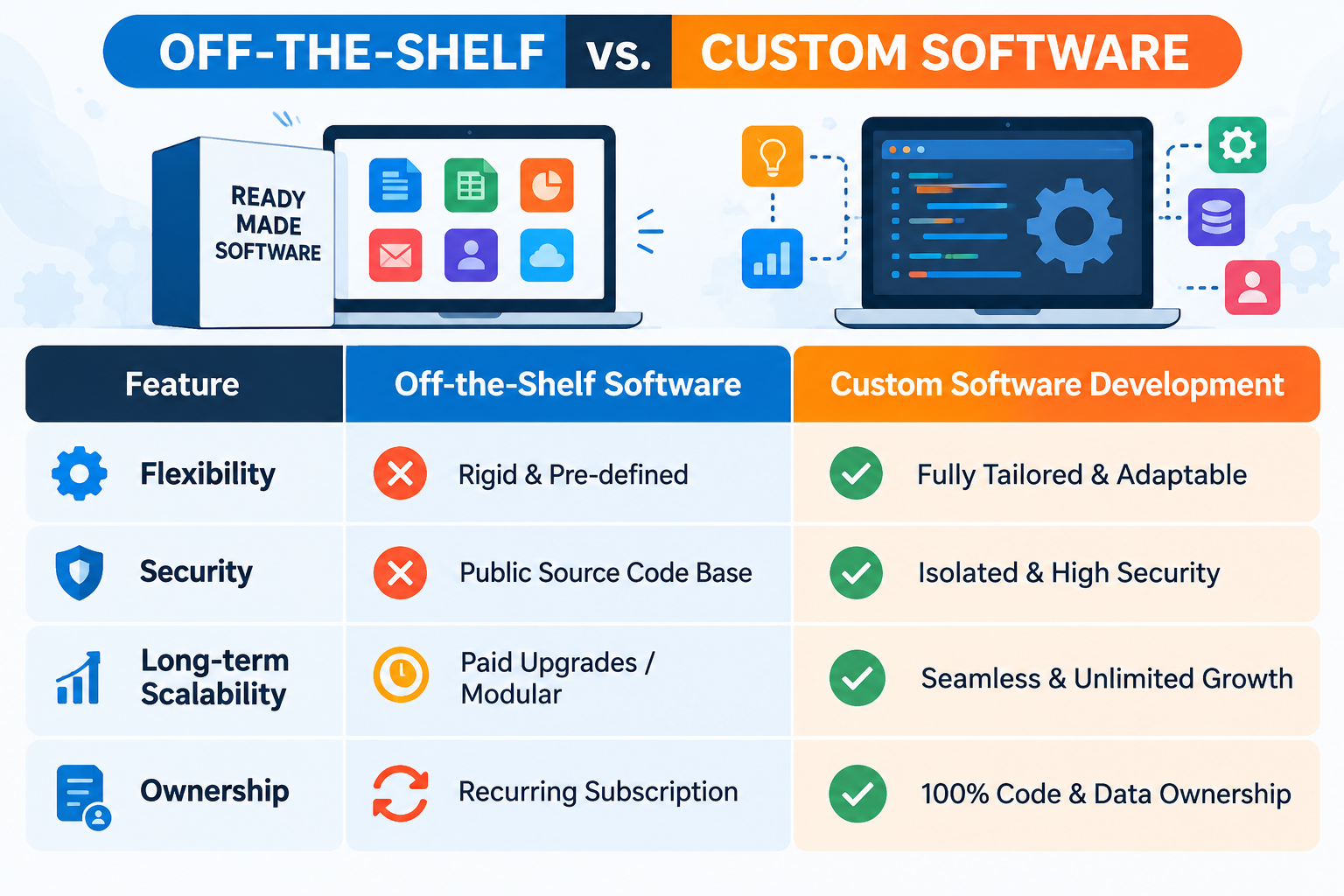
Investing in proprietary applications is much more than a routine tech upgrade; it is a strategic business decision that directly impacts operational efficiency and bottom-line profitability. Off-the-shelf tools frequently demand expensive licensing fees for features you never use, while failing to provide the exact functionality your team relies on daily.
- Tailored Scalability: Bespoke platforms grow organically alongside your enterprise, effortlessly adapting to rising transaction volumes and expanding user bases without requiring messy platform migrations.
- Enhanced Data Security: Custom applications provide robust, isolated security perimeters that drastically reduce vulnerability to malicious cyber threats compared to widely targeted commercial software.
- Seamless System Integration: Tailored code connects smoothly with your legacy systems, third-party APIs, and proprietary databases, eliminating data silos and manual entry errors.
- Complete Ownership: Owning your source code eliminates recurring subscription price hikes and dependency on external vendors who might discontinue essential features overnight.
To explore how bespoke applications can completely transform your organization’s workflow, look into partnering with an experienced team specializing in Custom Software Development.
Top Industries and Use Cases for Custom Software Development
Different verticals harness specialized technology in unique ways to solve complex challenges, minimize overhead, and optimize client experiences. According to research on software architecture standards from IEEE Spectrum and technology insights from Gartner, customized enterprise frameworks significantly reduce operational technical debt over time.
1. Healthcare and Medical Technology
The medical sector manages highly confidential patient records, strict privacy regulations like HIPAA, and intricate hospital administration networks. Generic programs create dangerous communication barriers between departments.
Bespoke medical portals, electronic health record (EHR) systems, and telemedicine applications enable practitioners to securely access patient history, automate appointment scheduling, and streamline diagnostic workflows without risking compliance violations.
2. Finance, Banking, and FinTech
Financial institutions operate in an environment where speed, accuracy, and absolute security are non-negotiable. Standard accounting templates or generic banking portals cannot handle massive volumes of real-time transactions or advanced fraud detection safely.
Financial firms utilize custom applications to build secure payment gateways, algorithmic trading platforms, automated compliance auditing tools, and personalized mobile banking dashboards that protect user assets while delivering exceptional digital experiences.
3. E-Commerce and Retail Enterprises
Retail and digital commerce brands face fierce competition and fluctuating consumer expectations. Off-the-shelf shopping cart platforms often lack the flexibility required to run complex inventory synchronizations, personalized product recommendation engines, or multi-vendor marketplace architectures.
Tailored e-commerce systems allow retailers to manage complex supply chains, analyze deep customer behavioral data, and execute hyper-targeted marketing campaigns that maximize conversion rates.
4. Logistics, Supply Chain, and Transportation
Global supply chains involve countless moving parts, from fleet tracking and warehouse inventory management to multi-modal freight routing. Commercial software frequently lacks real-time visibility tools tailored to specific regional or operational nuances.
Custom logistics software integrates IoT sensors, GPS tracking, and predictive analytics to optimize delivery routes, reduce fuel consumption, and provide automated status transparency to end customers.
5. Education and E-Learning Tech
Modern educational institutions and private e-learning platforms are moving rapidly beyond standard virtual classrooms. Standard learning management systems (LMS) often struggle with multi-tier grading hierarchies, custom exam proctoring tools, and interactive student analytics.
Bespoke educational platforms allow institutions to create immersive learning environments, track student progress with real-time AI dashboards, integrate payment gateways for online certifications, and build responsive portals for seamless teacher-student communication.
6. Real Estate and Property Management
Real estate firms handle massive property portfolios, multi-party legal documentation, tenant portals, and complex commission structures. Off-the-shelf CRM solutions fail to capture the specific multi-layered sales and leasing pipelines inherent to modern property management.
Custom real estate portals automate contract workflows, enable 3D virtual property walkthroughs, track leasing maintenance requests in real-time, and calculate investment returns directly within unified cloud dashboards.
How to Decide if Custom Software Development Is Right for Your Business?
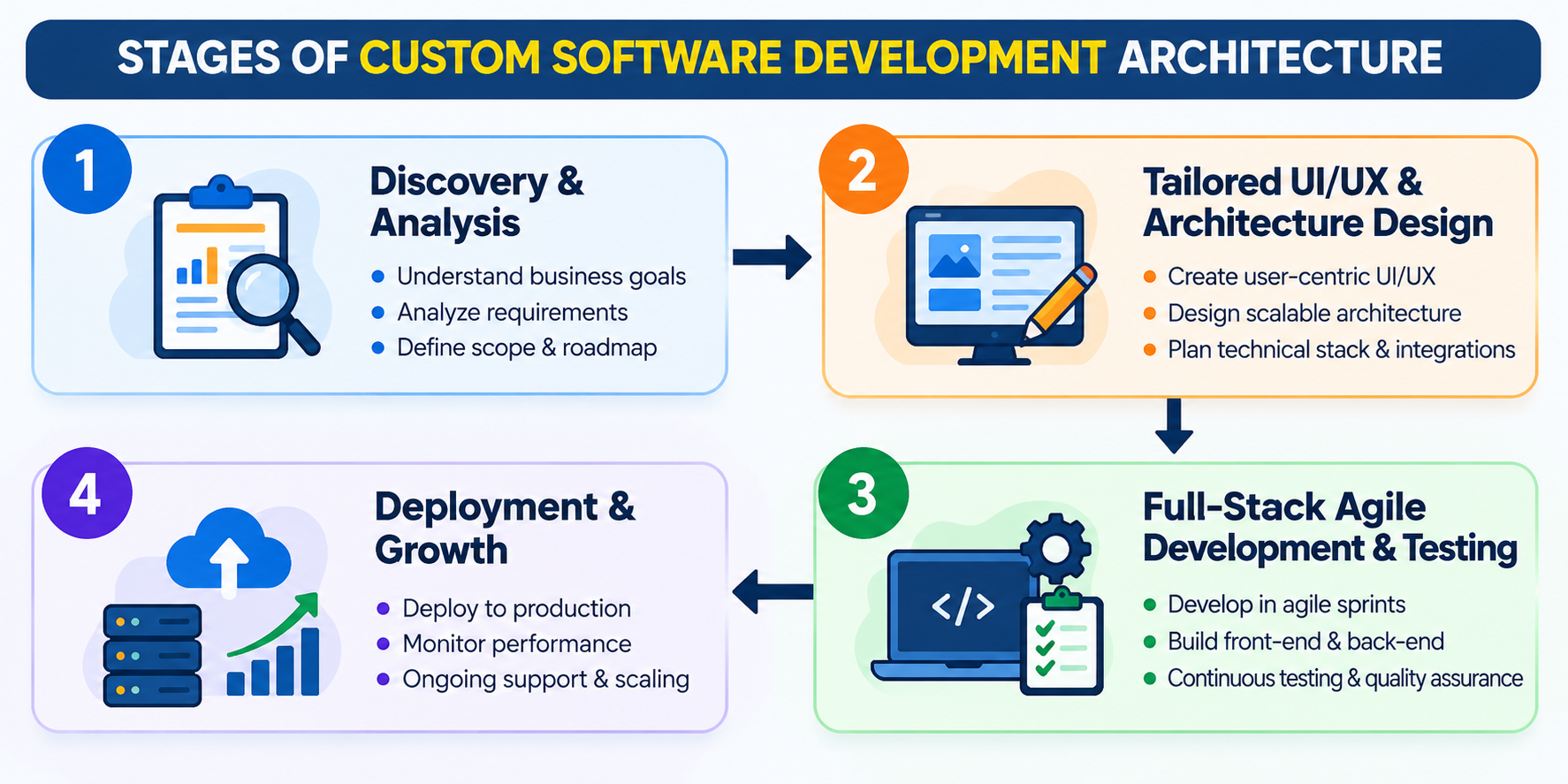
Deciding whether to build a proprietary solution or stick with commercial software requires an objective evaluation of your current operational bottlenecks, budget parameters, and long-term trajectory. Consider the following core diagnostic questions:
- Are repetitive manual tasks slowing down your team? If your staff spends hours moving data between disconnected spreadsheets and standard apps, automation through bespoke code will save thousands of productive hours.
- Does commercial software lack critical features you need? If you find yourself constantly compromising your internal workflows to fit the rigid limitations of software built for the “average” user, it is time for a tailored approach.
- Is your business constrained by software licensing costs? Paying per-user fees across a growing workforce often ends up far more expensive over a three-to-five-year period than developing an owned, scalable platform.
- Are you limited by legacy technology integration issues? Older operational systems often cannot connect cleanly with cloud-based commercial software, creating isolated data islands that hurt decision-making.
When you are ready to modernize your digital infrastructure, professional assistance can ensure your project is built right from the ground up. For expert guidance, explore comprehensive enterprise solutions at Nucleosys Tech.
Accelerate Your Growth with Tailored Digital Solutions
Navigating the complexities of digital transformation requires a technical partner who understands your unique operational vision. Whether you need an automated enterprise resource planning (ERP) tool, a secure customer relationship management (CRM) platform, or an advanced customer-facing mobile application, building the right architecture determines your long-term success.
Don’t let rigid, generic software restrict your enterprise potential. Reach out to the experts today to schedule your consultation and build a scalable digital foundation designed exclusively for your business goals. Discover how our engineering capabilities can empower your brand by visiting Custom Software Development Services.
Top Industries for Custom Software Development: FAQs
Why do businesses choose custom software over off-the-shelf packages?
Businesses opt for custom solutions because they offer 100% feature relevance, superior security, seamless integration with existing systems, and long-term cost efficiency without recurring license constraints.
How long does it typically take to build a bespoke software solution?
Timelines vary based on project scope, feature complexity, and integration requirements. Smaller applications may take a few weeks, while enterprise-grade systems require a structured, milestone-driven development lifecycle lasting several months.
Is custom software more secure than commercial alternatives?
Yes. Because custom software is built exclusively for your organization and does not share a universal source code base with thousands of other companies, it presents a much harder target for hackers and cybercriminals.
How does bespoke software integration improve workflow efficiency?
It eliminates data silos by connecting disparate departments, automating repetitive manual tasks, and synchronizing real-time information across your entire business ecosystem.
What is the ROI of custom software development over standard software subscriptions?
While custom software requires a higher initial capital investment, it eliminates long-term recurring per-user license fees, reduces manual labor overhead, and generates substantial ROI through tailored efficiency gains and proprietary asset creation.