Last Updated on October 9, 2026 by Nucleosystech
Managing workforce operations manually is one of the quickest ways to stall growth in an emerging company. For startup founders, HR teams, and finance managers across the nation, selecting a reliable payroll software for small business in India is no longer a luxury—it is an operational necessity.
Processing salaries on traditional spreadsheets often creates costly bottlenecks. Between calculating complex tax deductions, tracking biometric attendance, managing leave balances, and complying with statutory laws, manual payroll administration quickly turns into a nightmare.
Adopting a modern cloud payroll solution transforms this chaotic, error-prone workflow into a smooth, one-click process. In this comprehensive guide, we examine why Indian small and medium-sized enterprises (SMEs) must adopt automated systems, explore key features to evaluate, break down statutory obligations, and outline how modern platforms streamline business operations.
Why Every Growing SME Needs Automated Payroll Software for Small Business in India
Small business operations move fast, but manual salary calculations drag productivity down. Processing compensation involves more than just depositing money into bank accounts; it requires precise handling of variable pay, reimbursements, attendance records, and government compliance filings.
Transitioning from manual workflows to a streamlined HR software ecosystem unlocks significant operational advantages:
1. Zero Salary Calculation Errors
Spreadsheets rely on manual inputs and fragile formulas that break easily. An automated engine calculates gross earnings, net salaries, attendance adjustments, and tax deductions automatically, guaranteeing 100% mathematical precision.
2. Time and Cost Savings for HR Teams
HR professionals lose dozens of hours every month reconciling attendance records and responding to employee queries. Automated systems process payroll runs in minutes, freeing up valuable time for strategic talent initiatives.
3. Absolute Statutory Compliance
Indian labor regulations change frequently. Modern payroll tools automatically calculate statutory components—such as Provident Fund (PF), Employee State Insurance (ESI), Professional Tax (PT), and Tax Deducted at Source (TDS)—eliminating human error and protecting your organization from hefty non-compliance fines.
Must-Have Features in a Payroll Management System
When searching for the ideal platform, business owners must evaluate whether the application handles complex workforce demands smoothly. Here are the essential features to look for:
Biometric Attendance & Shift Syncing
A top-tier payroll management platform integrates natively with biometric machines, mobile selfie-punch systems, and GPS trackers. This connection ensures real-time tracking of attendance, shift allowances, overtime pay, and loss-of-pay (LOP) deductions without requiring manual data transfers.
Automated Statutory Compliance Reporting
Your system should automatically generate accurate statutory filings. It should generate PF Electronic Challan cum Return (ECR) files, calculate ESI contributions, handle state-wise PT schedules, and aggregate quarterly TDS (Form 24Q) data without requiring manual calculations.
Self-Service Employee Portal (ESS)
Providing an intuitive self-service portal empowers staff to download monthly payslips, inspect tax structures, request reimbursements, view YTD earnings, and submit proof of investments independently. This feature drastically reduces daily internal HR support tickets.
Flexible Salary Component Builder
Every organization structures pay differently. Leading software lets administrators define custom salary templates that incorporate basic pay, HRA, special allowances, flexible benefit plans (FBP), performance incentives, arrears, and loan deductions based on job grades.
Navigating Indian Statutory Compliance in Cloud Payroll
Navigating Indian labor regulations is essential for running a business cleanly. Ignorance of updating laws offers no protection against severe administrative penalties.
Using a compliance-first payroll software for small business in India automates the management of four core statutory components:
- Employees’ Provident Fund (EPF): Under the Employees’ Provident Funds and Miscellaneous Provisions Act, companies with 20 or more employees must deduct EPF contributions for eligible staff. The system automatically computes salary limits, handles employer matching contributions, and exports ready-to-upload ECR text files.
- Employee State Insurance (ESI): Applicable to establishments employing 10 or more workers with monthly salary caps, ESI offers medical and disability benefits. Software platforms monitor dynamic salary changes to apply ESI deductions correctly whenever an employee’s compensation crosses statutory limits.
- Professional Tax (PT): Enforced at the state level, PT rates vary based on location. Advanced platforms feature state-wise tax engine algorithms that automatically update state rules for businesses operating across multiple locations in India.
- Income Tax & TDS Calculation: The dual income tax framework (Old Regime vs. New Regime) requires continuous tax computation updates. Intelligent platforms let employees select their preferred regime, project annual tax liabilities, deduct accurate monthly TDS, and generate Form 16 documents automatically at fiscal year-end.
Key Benefits of Upgrading from Spreadsheets to HR Automation Software
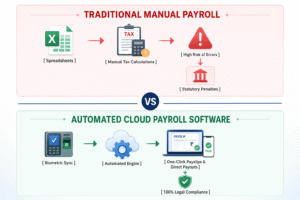
Continuing to use legacy manual workflows introduces serious security and operational risks. Upgrading your HR infrastructure delivers immediate, measurable performance gains:
- Bank-Grade Data Security: Sensitive payroll information on unencrypted spreadsheets can lead to data breaches. Cloud-based HR systems protect confidential salary records using role-based access controls and encrypted storage.
- Scalable Infrastructure: As business operations expand from 10 to 500 employees, cloud applications scale seamlessly without slowing down performance or requiring complete process overhauls.
- Integrated Expense Management: Staff expense claims, travel allowances, and outdoor duty (OD) tracking link directly into monthly payroll runs. This integration eliminates manual reimbursement entry errors entirely.
- Real-time Business Insights: Built-in business analytics generate instant customizable reports on labor costs, department budgets, tax liabilities, and overtime trends. These insights help business leaders make data-backed financial decisions.
How to Choose the Right Software for Your Business
Selecting software requires careful evaluation of your company’s operational footprint, budget, and expansion goals.
Step 1: Assess Employee Count and Workflow Requirements
Startups with fewer than 15 employees need straightforward salary calculation software, while growing companies with 50+ staff require attendance integrations, leave approvals, and multi-tier workflow management.
Step 2: Audit Compliance Automation Features
Ensure the vendor guarantees full compliance with Indian tax laws. The software must generate ready-to-file returns for PF, ESI, PT, and TDS without requiring extra manual data formatting.
Step 3: Check Biometric and Third-Party System Integrations
Confirm that the platform connects directly with your existing biometric hardware, time-tracking apps, and ERP accounting systems to ensure uninterrupted data flow.
Step 4: Test the Employee Mobile Experience
Request a demo to test the self-service mobile portal. An easy-to-use mobile interface increases internal adoption while reducing HR administration work by up to 80%.
Step 5: Evaluate Total Cost of Ownership
Review pricing structures carefully. Watch for hidden costs such as implementation fees, charge-per-payslip pricing, and premium charges for standard compliance modules.
Streamline Business Operations with Nucleosys Tech Custom Enterprise Software Solutions
Off-the-shelf software solutions often fail to handle unique operational workflows, specialized salary structures, or complex custom integrations. Nucleosys Tech provides high-performance, tailored enterprise platforms built to solve complex business challenges.
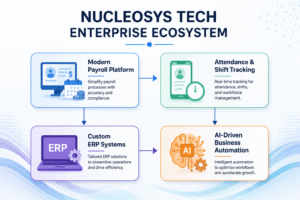
Our advanced Payroll Management System delivers high-speed automation designed specifically for modern organizational demands:
- Configurable Salary Templates: Define custom allowance structures, incentive models, loan repayments, and variable pay matrices effortlessly based on employee roles.
- Real-time Attendance and Shift Synchronization: Sync biometric punch logs, leave approvals, and outdoor duty records directly to finalize accurate monthly payouts in clicks.
- Automated Statutory Engine: Auto-calculate PF, ESI, PT, and TDS liabilities while generating audit-ready compliance reports instantly.
- Unified Business Ecosystem: Connect your human resource workflows directly with custom enterprise management applications, such as our ERP Automation Systems, to eliminate operational silos.
Transform your HR operational processes with a platform built to scale alongside your business. Book a Free Consultation with Nucleosys Tech Experts to upgrade your core administrative software infrastructure today!
Frequently Asked Questions (FAQs)
What is payroll software for small business in India?
It is a cloud application designed to automate salary calculations, track attendance, deduct statutory taxes (PF, ESI, PT, TDS), generate payslips, and streamline monthly employee salary disbursements for growing companies.
How does cloud payroll software calculate PF, ESI, and TDS automatically?
The software uses pre-configured statutory algorithms compliant with Indian tax regulations. It evaluates employee gross salary, tax regime selections, and statutory limits to calculate exact deductions and output compliance reports automatically.
Is cloud-based payroll software secure for handling confidential employee data?
Yes, modern cloud platforms provide advanced data protection using enterprise-grade encryption, secure database hosting, and multi-factor role-based access control to keep payroll records completely confidential.
Can custom payroll systems integrate with existing biometric attendance devices?
Yes, robust solutions—such as the custom enterprise applications developed by Nucleosys Tech—integrate directly with biometric hardware and digital timesheets to process attendance-based salaries automatically.

