Last Updated on August 6, 2026 by Nucleosystech
In today’s hyper-competitive digital landscape, relying on outdated or generic tools is one of the fastest ways to fall behind. Modern enterprises face complex operational challenges, evolving customer expectations, and rapid technological shifts. This brings forward a critical strategic question: Why do businesses need custom software development?
While off-the-shelf applications offer a quick fix, they rarely provide a long-term competitive edge. Commercial software forces companies to adapt their unique operational models to fit pre-packaged features. Conversely, custom software development builds technology around your specific business processes, providing unparalleled flexibility, robust security, and seamless scalability.
Whether you operate in finance, healthcare, logistics, or e-commerce, investing in tailored digital architecture is no longer a luxury—it is a core business necessity. According to strategic technology research from Gartner, digital transformation initiatives that leverage tailored software solutions yield significantly higher operational efficiency and ROI compared to standardized software implementations.
In this comprehensive guide, we examine why custom software is essential for modern organizations, how it drives long-term profitability, and how partnering with an expert development provider like Nucleosys Tech can transform your operations.
The Hidden Costs and Constraints of Off-the-Shelf Software
Off-the-shelf (COTS) software appears attractive at first glance. It offers low initial setup costs, immediate deployment, and familiar user interfaces. However, as an organization grows, the hidden limitations of generic platforms quickly begin to surface.
1. The Bloatware Dilemma
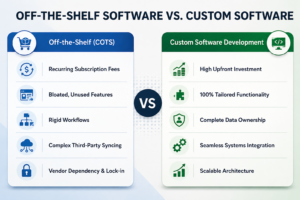
Generic platforms attempt to serve thousands of different businesses across various industries simultaneously. As a result, they come packed with dozens of features your team will never use, while lacking the specific functions you actually need. Your employees are left navigating complex, cluttered interfaces that slow down daily productivity.
2. Rigid Operational Bottlenecks
When using standard software, your company must alter its established workflows to match the software’s hardcoded logic. Forcing your business processes into a pre-designed mold creates operational friction, reduces agility, and restricts innovation.
3. Escalating Subscription Costs
Commercial applications rely on recurring per-user licensing fees. As your team expands, your software costs compound exponentially. Over a 3 to 5-year timeline, these cumulative licensing fees often exceed the one-time investment required to build proprietary software.
4. Vendor Dependency and Abandonment
With off-the-shelf software, you are completely dependent on the vendor’s roadmap. If the vendor increases subscription prices, discontinues key features, or experiences major service outages, your operations suffer without recourse.
Core Reasons Why Businesses Need Custom Software Development
To stay ahead of market shifts, forward-thinking organizations choose custom application development to construct solutions tailored directly to their core objectives. Below are the foundational reasons why custom software development is vital for scalable growth.
1. Tailored Functionality Built Around Your Unique Workflows
Every business possesses distinct competitive advantages, internal processes, and customer delivery models. Tailored software solutions are architected from the ground up to support your specific workflows rather than forcing you to compromise.
By engineering software around your exact requirements, every feature serves a direct purpose. Whether you require specialized financial reporting, specialized inventory management, or multi-channel customer relationship management (CRM), custom development ensures your software aligns perfectly with your goals.
2. Unmatched Scalability for Long-Term Enterprise Growth
As your organization expands into new markets, handles higher transaction volumes, or adds operational divisions, your digital infrastructure must scale effortlessly. Standard applications often hit performance ceilings, requiring costly plan upgrades or complex migration projects.
With enterprise software development, scalability is built into the core system architecture. Developers design cloud-native systems using microservices and modular code, allowing individual components to scale independently. This ensures your software adapts seamlessly as your user base and data volumes grow.
3. Seamless Integration with Existing Legacy Systems
Most enterprises rely on a mix of software platforms, including ERPs, HR portals, accounting tools, and communication channels. Off-the-shelf software often fails to connect smoothly with proprietary or legacy databases, creating isolated data silos.
Custom software applications bridge these gaps through custom-built Application Programming Interfaces (APIs). By unifying disparate software tools into a centralized database, your leadership team gains real-time visibility across all operational departments.
4. Advanced Security and Total Data Ownership
Data breaches and cyber threats pose severe risks to modern enterprises. Using popular off-the-shelf platforms makes your organization a target, as hackers frequently exploit known vulnerabilities in widely used software.
A core reason why businesses need custom software is enhanced cybersecurity control. Custom platforms allow you to implement enterprise-grade encryption, role-based access controls (RBAC), and multi-factor authentication (MFA) tailored to your risk profile. Furthermore, you retain 100% ownership of your source code and intellectual property, ensuring strict compliance with regulations such as GDPR, HIPAA, and PCI-DSS.
Driving Productivity Through Automation and Efficiency
Beyond operational alignment, custom technology serves as a key driver of employee productivity and enterprise-wide efficiency.
Streamlining Operations with Process Automation
Manual data entry, multi-step approvals, and repetitive administrative tasks waste valuable team hours and introduce human error. By implementing process automation, custom applications handle routine tasks automatically behind the scenes.
For instance, a custom system can automatically trigger invoice generation upon order delivery, update inventory levels across global warehouses, and notify regional sales teams—all without requiring manual input.
Optimizing Team Output with Workflow Management
Effective workflow management requires clear visibility into task ownership, project milestones, and delivery timelines. Standard project management tools often lack the specific tracking features needed for complex industrial or technical operations.
Custom software provides intuitive dashboards that reflect your exact project lifecycle stages. This eliminates friction points, improves cross-departmental coordination, and ensures deadlines are met reliably.
Maximizing Overall Business Efficiency
When systems talk to each other and administrative friction is removed, your organization achieves peak business efficiency. Employees shift their focus from repetitive data entry to high-value strategic tasks, directly improving overall output and revenue generation.
To optimize business operations with intelligent digital solutions, explore our specialized custom software development services engineered to elevate operational performance.
Custom Software vs. Off-the-Shelf: A Strategic Comparison
To help evaluate the technical and financial tradeoffs between custom engineering and commercial software, consider this detailed comparison matrix:
| Feature Criteria | Off-the-Shelf Software (COTS) | Custom Software Development |
| Initial Investment | Low upfront costs; subscription-based. | Higher upfront development investment. |
| Long-Term Costs | High recurring per-user fees that scale indefinitely. | Minimal ongoing costs; full code ownership. |
| Customization Capability | Limited to built-in settings and plugin ecosystems. | 100% customizable to exact business needs. |
| System Integration | Restricted to supported third-party APIs. | Native integration with any legacy or web service. |
| Scalability Potential | Constrained by vendor plan tiers and system caps. | Unlimited elastic scaling on cloud architecture. |
| Data Control & Security | Data stored on shared vendor servers; risk of platform hacks. | Full data ownership; bespoke enterprise security. |
| Competitive Advantage | None—competitors have access to the same tools. | High—proprietary features create market differentiation. |
Industries Benefiting Most from Tailored Software Solutions
While custom software delivers clear value across all commercial domains, specific industries experience transformative operational gains when transitioning to tailored platforms:
Healthcare & Life Sciences
Healthcare institutions require strict regulatory compliance (HIPAA, HITECH), secure patient portals, and real-time electronic health record (EHR) sync. Custom medical software improves patient management, supports secure telemedicine consultations, and streamlines diagnostic data workflows.
Finance & FinTech
Financial organizations demand ultra-low latency, robust cryptography, and automated regulatory reporting. Custom software powers algorithmic trading, automated risk assessments, secure payment portals, and personalized digital banking platforms.
Logistics & Supply Chain Management
Modern logistics operators depend on real-time fleet management, dynamic routing algorithms, automated warehouse tracking, and predictive supply chain analytics. Industry insights from Forbes Tech Analysis highlight that supply chain leaders implementing custom digital platforms achieve significant reductions in transit delays and operating expenses.
E-Commerce & Retail
As retail markets shift toward omnichannel customer experiences, off-the-shelf e-commerce platforms often struggle to handle complex multi-warehouse inventory, dynamic pricing engines, and personalized recommendation systems. Custom retail applications provide unified shopping experiences across mobile apps, web channels, and physical stores.
Step-by-Step Custom Software Engineering Lifecycle
Building enterprise-grade applications requires a disciplined, agile software development lifecycle (SDLC). At Nucleosys Tech, we follow a structured approach to transform ideas into high-performing digital platforms:
Phase 1: Discovery & Architectural Planning
Our team collaborates with your stakeholders to define system scope, business objectives, and technical specifications. We map out database architectures, user roles, and system workflows before writing code.
Phase 2: User Experience (UI/UX) Design
We create intuitive user interfaces that streamline complex user journeys. Through interactive wireframes and visual prototypes, we ensure your team and customers enjoy an accessible, efficient user experience.
Phase 3: Agile Sprint Development
Utilizing modern software development services, we build your solution through short, iterative sprint cycles. This approach gives you regular visibility into project progress and allows for flexible adjustments based on user feedback.
Phase 4: Rigorous Quality Assurance & Security Testing
Before deployment, dedicated QA engineers execute end-to-end testing—including automated unit tests, stress testing, API performance checks, and penetration testing—ensuring a bug-free, highly secure release.
Phase 5: Production Deployment & Legacy Migration
We handle production setup on leading cloud platforms (AWS, Azure, Google Cloud), execute database migrations, and connect existing internal tools with zero operational downtime.
Phase 6: Ongoing Maintenance & System Evolution
Technology must evolve alongside business needs. Continuous post-launch support guarantees that your software receives security patches, performance tuning, and new features as your market demands change.
How Nucleosys Tech Empowers Your Digital Transformation
Choosing the right engineering team is just as crucial as choosing to build custom software. Nucleosys Tech is a leading global technology provider specializing in modern custom application development, cloud modernization, and enterprise digital solutions.
Why Leading Brands Partner with Nucleosys Tech:
- Deep Industry Domain Expertise: Our software engineers and architects bring deep technical knowledge across FinTech, Healthcare, Logistics, E-Commerce, and SaaS sectors.
- Modern Stack Architecture: We build using modern technologies—including React, Angular, Node.js, Python, Java, Docker, Kubernetes, and serverless cloud systems—ensuring high performance and maintainability.
- Agile, Transparent Communication: We prioritize open communication, offering real-time sprint tracking, transparent milestone reporting, and collaborative feedback loops.
- End-to-End Delivery Capabilities: From initial concept design to full production deployment and ongoing maintenance, we manage the complete software lifecycle under one roof.
Whether you need powerful business automation software, a custom mobile experience, or an enterprise-wide ERP modernizing project, Nucleosys Tech translates complex business requirements into high-impact digital products.
Ready to Elevate Your Business with Custom Solutions?
Stop letting the limitations of generic software hold back your enterprise growth. Investing in custom application development grants your business the operational efficiency, data security, and long-term scalability required to dominate your industry.
At Nucleosys Tech, we build tailored software solutions designed to streamline your daily operations, automate key workflows, and maximize your return on technology investments.
Ready to transform your vision into software?
Contact our expert team today for a free discovery session and technical consultation!
Frequently Asked Questions (FAQs)
Q1: What is the main difference between custom software and off-the-shelf software?
Custom software is built specifically for your organization to match your exact business processes, workflows, and security requirements. Off-the-shelf software is a mass-market, standardized application designed to fit general industry needs, often requiring businesses to modify their operations to fit the tool.
Q2: How much does custom software development cost?
The total investment for custom software development varies based on project complexity, feature scope, system integrations, and performance requirements. While upfront costs are higher than standard monthly software subscriptions, custom solutions eliminate per-user licensing fees and deliver superior long-term ROI.
Q3: How long does it take to develop custom software?
Development timelines depend on overall scope. A streamlined Minimum Viable Product (MVP) or targeted application typically takes 2 to 4 months, whereas complex enterprise platforms may take 6 to 12 months. Utilizing agile development sprint cycles ensures functional software modules are delivered iteratively throughout the process.
Q4: Will custom software integrate with our existing legacy systems?
Yes. One of the greatest advantages of custom software is its ability to connect with legacy databases, third-party services, and internal systems using modern, custom-built APIs. This unifies isolated data sources across your organization.
Q5: Who owns the intellectual property and source code of the custom software?
When you partner with a custom software engineering provider like Nucleosys Tech, your business retains 100% ownership of the final source code, intellectual property rights, and underlying architecture upon project completion.
Q6: How does custom software improve overall business efficiency?
Custom software improves efficiency by automating repetitive tasks, removing manual data entry errors, connecting disconnected business platforms, and creating streamlined digital workflows tailored precisely to how your employees operate.

