
Industries That Benefit Most From Custom Software Development
In today’s hyper-competitive digital landscape, off-the-shelf software solutions often fall short of meeting unique business demands. Generic applications come with rigid features, unnecessary bloat, and frustrating security limitations that can slow down enterprise workflows. This is where custom software development changes the game, offering tailored technological infrastructure engineered specifically to address precise operational workflows, unique scaling goals, and specialized industry requirements. Whether an organization handles complex supply chains, sensitive medical records, or high-volume financial transactions, bespoke tech architectures empower businesses to operate with absolute precision and unmatched agility. Building proprietary software gives companies the ultimate competitive advantage. Rather than forcing your operational team to adapt to the limitations of a rigid platform built for the average vendor, custom applications are designed around your exact business logic. From automated backend workflows to customized user interfaces, tailored platforms reduce friction, boost productivity, and turn software into an asset that drives measurable enterprise growth. Which Industry Need Custom Software? Every modern sector encounters distinct digital bottlenecks, but certain verticals experience immediate, transformative returns on investment when they transition away from cookie-cutter applications. Sectors dealing with strict regulatory compliance, intricate data processing, or heavy consumer interaction require specialized frameworks that standard out-of-the-box platforms simply cannot support. Organizations that handle high-value logistics, sensitive client information, or massive inventories find that generic tools limit their potential. Custom solutions fill these capability gaps, acting as the critical engine for scalable business automation and long-term digital resilience. Furthermore, industries navigating rapidly changing regulatory policies—such as telecommunications, energy, and legal tech—rely on bespoke engineering to ensure continuous compliance updates without breaking core functionality. Why Should You Invest in Custom Software Development? Investing in proprietary applications is much more than a routine tech upgrade; it is a strategic business decision that directly impacts operational efficiency and bottom-line profitability. Off-the-shelf tools frequently demand expensive licensing fees for features you never use, while failing to provide the exact functionality your team relies on daily. Tailored Scalability: Bespoke platforms grow organically alongside your enterprise, effortlessly adapting to rising transaction volumes and expanding user bases without requiring messy platform migrations. Enhanced Data Security: Custom applications provide robust, isolated security perimeters that drastically reduce vulnerability to malicious cyber threats compared to widely targeted commercial software. Seamless System Integration: Tailored code connects smoothly with your legacy systems, third-party APIs, and proprietary databases, eliminating data silos and manual entry errors. Complete Ownership: Owning your source code eliminates recurring subscription price hikes and dependency on external vendors who might discontinue essential features overnight. To explore how bespoke applications can completely transform your organization’s workflow, look into partnering with an experienced team specializing in Custom Software Development. Top Industries and Use Cases for Custom Software Development Different verticals harness specialized technology in unique ways to solve complex challenges, minimize overhead, and optimize client experiences. According to research on software architecture standards from IEEE Spectrum and technology insights from Gartner, customized enterprise frameworks significantly reduce operational technical debt over time. 1. Healthcare and Medical Technology The medical sector manages highly confidential patient records, strict privacy regulations like HIPAA, and intricate hospital administration networks. Generic programs create dangerous communication barriers between departments. Bespoke medical portals, electronic health record (EHR) systems, and telemedicine applications enable practitioners to securely access patient history, automate appointment scheduling, and streamline diagnostic workflows without risking compliance violations. 2. Finance, Banking, and FinTech Financial institutions operate in an environment where speed, accuracy, and absolute security are non-negotiable. Standard accounting templates or generic banking portals cannot handle massive volumes of real-time transactions or advanced fraud detection safely. Financial firms utilize custom applications to build secure payment gateways, algorithmic trading platforms, automated compliance auditing tools, and personalized mobile banking dashboards that protect user assets while delivering exceptional digital experiences. 3. E-Commerce and Retail Enterprises Retail and digital commerce brands face fierce competition and fluctuating consumer expectations. Off-the-shelf shopping cart platforms often lack the flexibility required to run complex inventory synchronizations, personalized product recommendation engines, or multi-vendor marketplace architectures. Tailored e-commerce systems allow retailers to manage complex supply chains, analyze deep customer behavioral data, and execute hyper-targeted marketing campaigns that maximize conversion rates. 4. Logistics, Supply Chain, and Transportation Global supply chains involve countless moving parts, from fleet tracking and warehouse inventory management to multi-modal freight routing. Commercial software frequently lacks real-time visibility tools tailored to specific regional or operational nuances. Custom logistics software integrates IoT sensors, GPS tracking, and predictive analytics to optimize delivery routes, reduce fuel consumption, and provide automated status transparency to end customers. 5. Education and E-Learning Tech Modern educational institutions and private e-learning platforms are moving rapidly beyond standard virtual classrooms. Standard learning management systems (LMS) often struggle with multi-tier grading hierarchies, custom exam proctoring tools, and interactive student analytics. Bespoke educational platforms allow institutions to create immersive learning environments, track student progress with real-time AI dashboards, integrate payment gateways for online certifications, and build responsive portals for seamless teacher-student communication. 6. Real Estate and Property Management Real estate firms handle massive property portfolios, multi-party legal documentation, tenant portals, and complex commission structures. Off-the-shelf CRM solutions fail to capture the specific multi-layered sales and leasing pipelines inherent to modern property management. Custom real estate portals automate contract workflows, enable 3D virtual property walkthroughs, track leasing maintenance requests in real-time, and calculate investment returns directly within unified cloud dashboards. How to Decide if Custom Software Development Is Right for Your Business? Deciding whether to build a proprietary solution or stick with commercial software requires an objective evaluation of your current operational bottlenecks, budget parameters, and long-term trajectory. Consider the following core diagnostic questions: Are repetitive manual tasks slowing down your team? If your staff spends hours moving data between disconnected spreadsheets and standard apps, automation through bespoke code will save thousands of productive hours. Does commercial software lack critical features you need? If you find yourself constantly compromising your internal workflows to fit the rigid limitations of software built for the “average” user, it is time for a tailored approach. Is your business constrained by software
Best ERP Software for Construction & PEB Industry: Features, Selection Checklist, and ROI
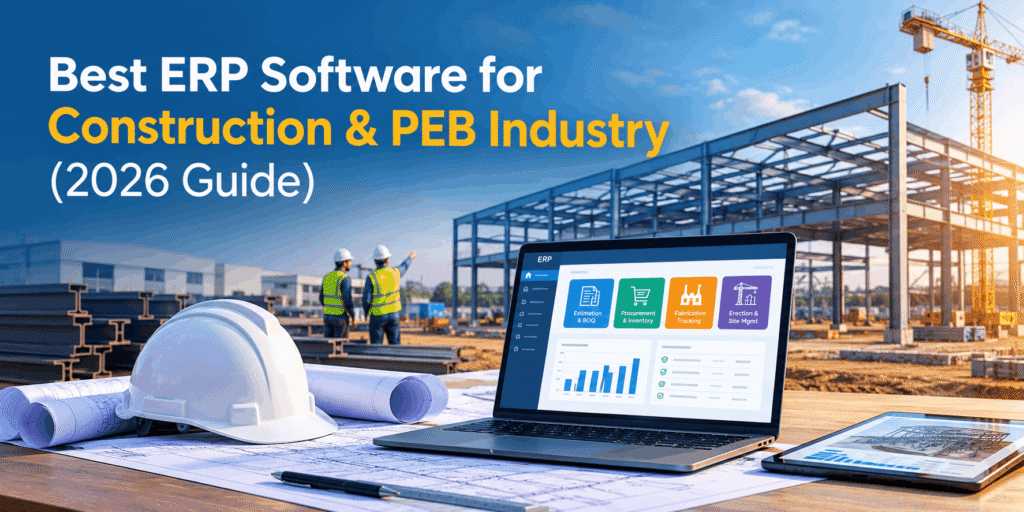
Modern construction firms and Pre-Engineered Building (PEB) manufacturers face unprecedented operational pressures. Balancing volatile raw material costs, tight project deadlines, decentralized field operations, and strict compliance standards requires absolute precision. Consequently, implementing a robust erp software for construction industry operations has transformed from a competitive advantage into an absolute operational necessity. In the fast-evolving infrastructure market, relying on legacy accounting software or disconnected spreadsheets leads to cost overruns and material leakage. Furthermore, general-purpose software fails to address the unique complexities of structural engineering, shop floor fabrication, bill of quantities (BOQ) estimation, and site-level labor deployment. This comprehensive guide breaks down everything you need to know about selecting, implementing, and maximizing the ROI of a specialized erp system for construction industry and PEB manufacturing operations. Why General Enterprise Software Fails the Construction and PEB Sectors Generic ERP solutions work exceptionally well for traditional retail or simple discrete manufacturing. However, when applied to structural steel fabrication or large-scale civil engineering, they quickly break down. The reason is simple: construction projects are dynamic, location-agnostic, and prone to unpredictable field variables. The Complexity of PEB Engineering and Manufacturing Pre-Engineered Buildings require tight integration between design engineering (CAD/BIM software) and shop-floor fabrication. A standard enterprise platform cannot track structural steel plates, cold-formed section roll-forming, built-up beam assembly, or paint shed staging at a granular level. Without specialized tracking, structural components arrive late at the site, stalling erection schedules. Decentralized Project Workflows vs. Centralized Manufacturing Civil construction happens across dozens of remote project sites, whereas PEB manufacturing takes place in controlled plant environments. A tailored erp for construction industry workflows must bridge this gap seamlessly. It must synchronize factory dispatch schedules with site-readiness metrics, preventing costly logistics bottlenecks. “In EPC and PEB projects, a single missing bolt assembly or delayed anchor plan can halt an entire project site. General ERPs track accounting; specialized construction ERPs track operational velocity.” To learn more about tailored digital transformation strategies for industrial frameworks, explore custom solutions on Nucleosys Tech. Essential Core Modules in an Advanced Construction & PEB ERP System When evaluating enterprise software, decision-makers must ensure the platform includes modules specifically engineered for EPC (Engineering, Procurement, Construction) and PEB demands. Dynamic Estimation & Bill of Quantities (BOQ) Management An effective platform allows estimators to upload BOQ files directly, auto-calculating material requirements, structural weights, labor hours, and sub-contracting expenses. Automated Material Take-off (MTO): Converts engineering drawings into actionable bills of materials instantly. Revision Tracking: Handles design changes without corrupting original cost baselines. Profitability Modeling: Predicts gross margins before submitting tenders. 2. Multi-Level Procurement & Inventory Control Material costs represent up to 60-70% of a PEB project’s total budget. Therefore, controlling raw material acquisition is critical. Raw Material Batch Tracking: Tracks steel coils, plates, and fasteners by grade and heat number. Just-In-Time (JIT) Dispatch: Aligns raw steel procurement with production schedules to reduce carrying costs. Store & Yard Management: Monitors stock across central warehouses, plant yards, and remote project sites. For a broader perspective on corporate IT strategies and structural software integration, read detailed insights from McKinsey & Company Capital Projects. 3. Integrated Construction Project Management Software Project tracking capabilities must go beyond basic Gantt charts. Modern construction project management software built inside an ERP offers real-time milestone monitoring, earned value analysis (EVA), and resource leveling. WBS (Work Breakdown Structure): Divides massive EPC projects into manageable, billable work packages. Sub-Contractor Billing (RA Bills): Automates Running Account (RA) bill verification against site progress, eliminating overbilling risks. Equipment & Fleet Tracking: Monitors heavy machinery utilization, maintenance cycles, and fuel consumption across active sites. 4. PEB Plant Production & Structural Assembly Specifically for PEB manufacturers, this module manages cut-to-length processes, shearing, fitting, welding, shot blasting, and painting stages. Raw Coil / Plate ──> Cutting / Shearing ──> Assembly & Welding ──> Shot Blasting & Paint ──> Site Erection By maintaining real-time visibility across these manufacturing stages, plant managers eliminate idle shop-floor hours and increase overall structural steel throughput. Technical Comparison: Generic ERP vs. Specialized PEB & Construction ERP Choosing the right platform requires understanding structural differences in software architecture. Functional Feature Generic ERP (Off-the-shelf) Tailored Construction & PEB ERP BOQ / BOM Management Basic single-level Bill of Materials Multi-level, design-integrated BOQ & MTO Site Billing & Progress Basic invoicing; manual tracking Automated Running Account (RA) bills with retention checks Field Accessibility Limited to desktop web applications Mobile app with offline sync for site engineers PEB Production Control Fits standard discrete products Tracks weight-based steel cutting, scrap, & painting Sub-Contractor Work Standard vendor purchase orders Piece-rate labor contracts, joint measurements, & holdbacks Integration Capability Standard REST APIs Direct CAD/BIM, Primavera, and MS Project connectors Key Benefits of Digital Transformation in Construction Adopting a tailored construction industry digital transformation strategy delivers measurable operational benefits across every level of the organization. Real-Time Financial Visibility & Cost Control Without centralized data, project managers only learn about cost overruns weeks after the budget is breached. An integrated erp system for construction industry tracks real-time commitment vs. actual spend, alerting project controllers before budget deviations occur. Streamlined Communication Between Site & Head Office Historically, field updates arrived via fragmented emails or messaging apps. Modern solutions offer dedicated mobile interfaces where site engineers record daily progress reports (DPRs), log safety incidents, and request material requisitions on-site. Scrap & Off-Cut Optimization in PEB Plants Steel scrap generation directly eats into gross profit margins. Advanced ERP solutions feature nesting algorithm integration that calculates optimal steel plate cutting patterns, dramatically reducing raw material waste. Step-by-Step Vendor Selection Checklist for Decision Makers Selecting the right enterprise system requires careful planning. Follow this step-by-step checklist to ensure a seamless vendor evaluation process. 1.Define Technical & Operational Requirements:Focus on domain-specific capabilities rather than generic feature lists. Identify specific pain points in your current operations. Determine whether your greatest friction lies in BOQ estimation errors, shop-floor steel tracking, sub-contractor measurement discrepancies, or delayed customer billing. 2.Evaluate Domain Expertise & Industry Footprint:Verify that vendors understand structural steel and civil engineering nuances. Filter out vendors that primarily serve retail,
AI Search in 2026: How Google AI Mode Is Changing SEO
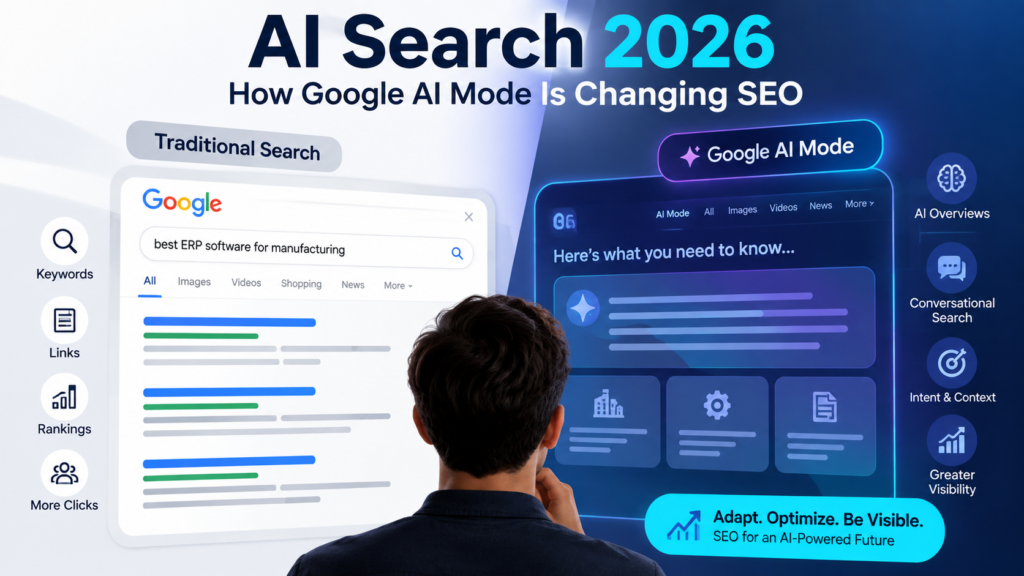
AI Search 2026 is changing how people discover information, compare solutions, research businesses, and make decisions online. Google Search is moving beyond the traditional model of entering keywords, scanning blue links, and opening individual websites. With Google AI Mode, AI Overviews, conversational follow-up questions, multimodal search, and new AI-powered experiences, users can ask longer and more complex questions and receive synthesized answers with links to supporting websites. For businesses and SEO professionals, this creates a major shift: ranking for a keyword is no longer the only visibility goal. Brands increasingly need to become visible across traditional search results, AI-generated answers, related queries, conversational search journeys, and other Google discovery surfaces. Google’s 2026 Search announcements show how quickly this transformation is developing. Google says AI Mode has surpassed one billion monthly users, while AI Overviews have more than 2.5 billion monthly active users. Google has also expanded AI-powered Search with conversational experiences, richer links, multimodal inputs, and AI agents. So what does this mean for SEO? Let’s explore how AI Search in 2026 is changing search optimization and what businesses should do to improve their AI visibility. Table of Contents What Is AI Search in 2026? What Is Google AI Mode? AI Mode vs Traditional Google Search How AI Search Is Changing User Search Behavior Why AI Search Changes SEO AI SEO vs Traditional SEO How Google AI Mode Finds and Uses Content 10 Ways to Optimize for AI Search in 2026 The Role of AI Overviews and AI Visibility Does AEO or GEO Replace SEO? How to Create AI-Search-Friendly Content Technical SEO for AI Search How to Measure AI Search Performance Common AI SEO Mistakes The Future of SEO in 2026 and Beyond Final Takeaway FAQs What Is AI Search in 2026? AI Search 2026 refers to the growing use of artificial intelligence within search engines to understand queries, connect information from multiple sources, generate responses, and help users explore a topic conversationally. Traditional search generally works around a query and a set of ranked results. AI-powered search can go further. A user might search: “What is the best digital marketing strategy for a manufacturing company that wants more B2B leads?” Instead of simply returning pages optimized around the exact phrase, an AI-powered search system can understand multiple concepts within the question: digital marketing manufacturing B2B marketing lead generation buyer intent SEO paid advertising industrial decision-makers Google’s AI Search systems can use related searches and multiple sources to develop a broader understanding of a complex query. Google describes query fan-out as a process in which AI generates related searches to explore different aspects of a user’s question before producing a response. This means content strategy needs to move from simply targeting individual keywords toward covering topics, entities, questions, search intent, and related subtopics comprehensively. What Is Google AI Mode? Google AI Mode is an AI-powered Search experience designed for more complex and conversational searches. Instead of requiring users to perform several separate searches, AI Mode allows them to ask a longer question, receive an AI-generated response, and continue with follow-up questions. Google introduced AI Mode as a way to handle searches that require deeper reasoning and exploration. In 2026, Google expanded the experience with additional AI capabilities and more conversational interactions. For example, a traditional search journey might look like: Search 1: Best SEO strategies for manufacturers Search 2: Manufacturing SEO keywords Search 3: How to generate B2B leads Search 4: Industrial SEO case studies A conversational AI search journey could combine much of this research into one broader interaction. That changes the SEO opportunity. The goal is not only to rank for: “manufacturing SEO” but to create authoritative content capable of answering the connected questions a potential buyer may ask next. AI Mode vs Traditional Google Search The fundamental purpose of Search remains helping users find useful information, but the interaction is changing. Traditional Search AI-Powered Search Short keyword queries Longer conversational questions Individual search results Synthesized responses with supporting links Multiple searches for complex topics Follow-up conversational searches Primarily text-based Increasingly multimodal Keyword-focused optimization Topic and intent-focused optimization SERP ranking Visibility across AI-generated experiences One query at a time Related queries and query fan-out Google has emphasized that AI Overviews and AI Mode continue to surface links to websites and are designed to help users explore information across the web. Google has also increased the use of links and website previews within AI experiences. For publishers and businesses, that means organic visibility is not disappearing—it is becoming more distributed across the search experience. How AI Search Is Changing User Search Behavior One of the most important changes in AI Search 2026 is the way users formulate questions. People can now ask more detailed questions without worrying about constructing the perfect keyword phrase. For example: Old-style search: “SEO agency Pune” More conversational search: “What should a manufacturing company in Pune look for when choosing an SEO agency to generate qualified B2B leads?” The second query contains significantly more context. AI-powered search can interpret: location industry service business objective audience purchase intent desired outcome Google reported that users of AI Mode ask longer questions and use the experience for more complex exploratory searches. For SEO professionals, this reinforces the importance of search intent and semantic relevance. Why AI Search Changes SEO The biggest mistake businesses can make in 2026 is assuming that AI Search means traditional SEO is no longer important. Google’s own guidance says the opposite. Google states that existing SEO fundamentals remain relevant for AI features such as AI Overviews and AI Mode. Pages need to be technically eligible for Search, indexable, crawlable, useful, and supported by strong content and page experience. The change is therefore not: SEO → AI SEO It is closer to: Traditional SEO + stronger topical relevance + useful original content + broader search visibility. This creates a new optimization objective: From keyword rankings to search visibility. A brand may be discovered through: traditional organic results AI Overviews Google AI Mode featured snippets
How to Choose the Right Custom AI Software Development Company for Your Business
In an era defined by rapid technological acceleration, adopting artificial intelligence is no longer an option—it is a strategic necessity. However, off-the-shelf AI tools often fail to solve complex, enterprise-specific challenges. To gain a true competitive edge, organizations require tailored solutions designed for their unique workflows. Selecting the right custom AI development company is the single most critical decision you will make on your digital transformation journey. Partnering with an experienced custom AI software development company ensures that your technology roadmap aligns perfectly with your long-term business goals. Whether you want to automate complex operations, enhance customer engagement, or leverage predictive analytics, the right team turns high-level concepts into scalable software. In this comprehensive guide, we will walk you through the entire selection process. You will learn how to evaluate technical expertise, analyze case studies, ask the right questions, and secure high-ROI custom AI solutions built to scale. The Rising Need for Custom AI Development Services The modern business environment generates massive amounts of data every second. Standard software application suites can organize this data, but they cannot extract actionable intelligence or automate decision-making. This gap is precisely why demand for custom AI development services has surged across every major industry, from healthcare and finance to manufacturing and logistics. Off-the-shelf AI platforms offer quick deployment, but they come with severe limitations: Rigid Architecture: Pre-built solutions cannot adapt easily to proprietary workflows or complex internal legacy systems. Data Security Risks: Sharing sensitive enterprise data with public or shared AI models can create severe compliance vulnerabilities. Lack of Competitive Differentiation: If your competitors use the exact same off-the-shelf tools, you lose the opportunity to innovate or establish a distinct operational advantage. By contrast, an experienced AI development company builds systems tailored to your exact data structures, security requirements, and operational goals. Custom solutions allow you to maintain full ownership of your intellectual property while creating AI-powered business solutions that grow alongside your enterprise. Core Benefits of Partnering with an AI Application Development Company Investing in custom artificial intelligence delivers benefits far beyond simple task automation. When you collaborate with a dedicated AI application development company, you gain access to end-to-end expertise that transforms raw data into a revenue driver. 1. Tailored Integration with Existing Systems Legacy infrastructure often presents a significant barrier to modernizing IT operations. A specialized custom AI software development company designs middleware and custom APIs that seamlessly connect modern machine learning models with your existing ERP, CRM, and database architectures. 2. Enhanced Data Privacy and Regulatory Compliance Data governance is a top priority for modern enterprises. Custom development allows you to deploy models within private cloud environments or on-premise servers. This architecture ensures strict adherence to international standards like GDPR, HIPAA, and ISO 27001. 3. Scalability and Future-Proofing As your enterprise expands, your data volume grows exponentially. A bespoke AI system features a scalable architecture designed to handle increased computational loads without requiring complete system overhauls. Key Steps to Select the Ideal Custom AI Software Development Company Selecting a technology partner requires a structured evaluation process. Rushing into a contract without thorough vetting often leads to missed deadlines, budget overruns, and unusable software models. Follow this step-by-step framework to identify the right partner for your project. Step 1: Define Your Internal AI Objectives and Scope Before reaching out to external vendors, establish a clear internal scope. Identify the exact business problems you intend to solve. Are you looking to implement predictive maintenance in your supply chain? Do you require generative AI models to handle customer support? Do you need advanced image recognition for quality control? Defining your requirements allows prospective vendors to provide accurate project estimates and realistic timelines. Step 2: Evaluate Technical Expertise and Core Competencies Artificial intelligence is a vast field containing numerous specialized domains. A reliable AI application development company should possess deep, hands-on experience across multiple technical disciplines, including: Machine Learning (ML): Supervised, unsupervised, and reinforcement learning models. Natural Language Processing (NLP): Large Language Model (LLM) fine-tuning, sentiment analysis, and intelligent document processing. Computer Vision: Object detection, facial recognition, and automated visual inspection. Predictive Analytics: Forecasting algorithms, anomaly detection, and risk scoring engines. Ensure that the vendor’s engineers are proficient in industry-standard frameworks like TensorFlow, PyTorch, Scikit-learn, and OpenCV. Step 3: Review Portfolios, Case Studies, and Industry Experience Theoretical knowledge alone is insufficient. Look for an AI development company with a proven track record of delivering production-ready applications. Request case studies that demonstrate: Problem Formulation: How the company approached the client’s initial challenges. Model Performance: Metrics such as accuracy, precision, latency, and computational efficiency. Business Impact: Quantifiable results, such as reduced operational costs, increased processing speed, or higher conversion rates. Step 4: Assess Data Engineering and Management Capabilities An AI model is only as effective as the data used to train it. High-performing artificial intelligence software development relies heavily on robust data engineering. Your ideal vendor must be highly skilled in: Data Cleaning and Preprocessing: Removing noise, handling missing values, and standardizing disparate data sets. Data Labeling and Annotation: Building accurate training datasets for supervised learning models. Pipeline Architecture: Constructing automated ETL (Extract, Transform, Load) pipelines for continuous model training. Ask prospective partners how they handle data quality issues and dirty data during initial development stages. Step 5: Understand Development Methodologies and Communication Clear communication prevents project misalignment. The vendor should follow Agile or DevOps development methodologies, providing weekly sprints, continuous demonstration sessions, and transparent progress tracking through tools like Jira, Trello, or Azure DevOps. Red Flags to Watch Out For During Vendor Evaluation Knowing what to avoid is just as important as knowing what to look for. Watch out for these common red flags during preliminary discussions: Red Flag Potential Risk How to Avoid Over-Promising 100% Accuracy AI models are probabilistic, not deterministic. No legitimate company promises absolute perfection. Choose vendors who talk in terms of precision, recall, and iterative optimization. Lack of Data Security Protocols Risk of sensitive corporate data leaks and regulatory non-compliance. Demand clear NDA agreements and verify ISO/SOC2 security
Why Your Business Needs a Professional WordPress Development Company

In today’s digital-first economy, your website serves as the virtual front door to your brand. When potential customers search for your products or services, your digital footprint determines whether they stay and engage or click away to a competitor. While modern site builders allow almost anyone to throw together a basic webpage, growing businesses require far more than off-the-shelf templates. Partnering with an expert wordpress development company ensures your platform delivers high speed, bulletproof security, seamless usability, and consistent revenue growth. Building an enterprise-grade digital presence demands specialized knowledge. A generic layout cannot handle complex database queries, heavy eCommerce traffic, or aggressive search engine optimization strategies. As a result, forward-thinking organizations choose custom wordpress web development over quick DIY fixes. By leveraging experienced engineering teams, companies gain tailored architectures designed specifically around their unique sales funnels, operational bottlenecks, and long-term scaling objectives. The Limitations of DIY and Pre-Made Themes Many business owners start their online journey using off-the-shelf themes purchased from digital marketplaces. Although these pre-designed templates look appealing in demo previews, they quickly present major challenges under real-world operating conditions: Bloated Codebases: Marketplace themes often bundle dozens of unnecessary features, scripts, and layout options. Consequently, this excess code slows down load speeds, increases server response times, and hurts Google search rankings. Security Vulnerabilities: Popular commercial themes and unverified plugins are frequent targets for malicious automated bots. Lacking continuous updates and secure code reviews, your site becomes exposed to malware, data breaches, and severe downtime. Design Rigidness: Pre-built layouts offer minimal flex. When your marketing team wants to implement a specific custom conversion workflow, generic themes force you into rigid boundaries. Plugin Conflict Nightmare: Relying on twenty different third-party plugins to add basic site functions regularly leads to software updates breaking your entire site interface. Working alongside an established wordpress website development company eliminates these structural bottlenecks. Instead of patching together mismatched plugins, developers craft streamlined codebases tailored precisely to your operational workflow. Core Advantages of Hiring a Professional WordPress Development Company Investing in expert wordpress development services transforms your online platform from a static brochure into a lead-generation machine. Below is an overview comparing a generic DIY approach against custom engineering from an established partner: Key Feature DIY / Pre-made Theme Approach Professional WordPress Development Site Speed & Performance Heavy asset bloat, slow page load speeds Optimized database queries, fast loading times Code Architecture Generic, bloated, prone to conflicts Clean, modular, tailored to exact business logic Search Engine Optimization Basic metadata capabilities Built-in technical SEO, clean schema, fast indexing Data & Site Security Vulnerable to generic, automated malware Hardened architecture, regular audits, firewall setup Scalability Struggles under sudden traffic surges Built on scalable infrastructure ready for enterprise growth Ongoing Maintenance Time-consuming manual updates and troubleshooting Proactive monitoring, automated backups, priority fixes Key Pillars of Custom WordPress Solutions Custom WordPress Solutions and Tailored Architecture Every business operates with distinct sales pipelines and customer touchpoints. Off-the-shelf tools force your business operations into pre-set templates. In contrast, specialized engineers deliver custom WordPress solutions that fit your specific operational needs. Whether you require custom API integrations with your existing CRM, tailored membership portals, or complex calculation engine calculators, dedicated teams build the exact features you need. Furthermore, custom architecture ensures that every backend control is easy for your internal marketing staff to update without touching a single line of code. Precision WordPress Theme Development First impressions matter. When visitors land on your site, they form an opinion about your brand’s credibility within milliseconds. Standard pre-made layouts make your business blend in with hundreds of competitors using the exact same styling. Through bespoke WordPress theme development, web architects design unique, brand-aligned interfaces centered entirely around user experience (UX) and conversion rate optimization (CRO). Additionally, custom themes ensure lightweight, semantic HTML5 markup that search engines love to crawl and index quickly. Specialized WordPress Plugin Development Plugins expand what your website can accomplish. However, overloading your installation with dozens of third-party plugins creates severe performance lags and security risks. By utilizing targeted WordPress plugin development, developers replace multiple heavy third-party add-ons with a single, highly efficient, custom-coded plugin. This custom plugin performs your exact required functions without injecting unnecessary tracking scripts, promotional bloat, or security vulnerabilities into your server environment. Technical Performance, Speed, and SEO Optimization Site speed directly dictates your digital revenue. According to research from Google PageSpeed Insights, as page load times increase from 1 second to 3 seconds, the probability of a mobile visitor bouncing increases by 32%. If your pages take longer than five seconds to load, over half your potential traffic leaves before seeing your offer. SEO-Friendly WordPress Websites That Rank High Search engines prioritize platforms that provide fast, stable, and seamless user experiences. Professional engineering teams design SEO-friendly WordPress websites built on rock-solid technical foundations: Optimized Core Web Vitals: Clean layout rendering prevents sudden layout shifts (CLS), minimizes interaction latency (INP), and accelerates main content paints (LCP). Advanced Caching Mechanisms: Implementing server-side caching, object caching (Redis/Memcached), and Content Delivery Network (CDN) integration ensures pages load globally within milliseconds. Clean Code and Schema Markup: Structured data implementation allows search engine crawlers to understand your offerings, service areas, and reviews for rich snippet displays. Mobile-First Responsive Engineering: Ensuring fluid layout adaptations across smartphones, tablets, and desktop displays. The End-to-End Development Process of a Specialized WordPress Agency Building a resilient digital platform requires a structured methodology. A full-service WordPress agency follows a meticulous engineering lifecycle to guarantee that your software release is bug-free, secure, and ready to convert visitors. 1.Discovery & Business Analysis:Aligning business goals with web architecture. Before writing a single line of code, developers analyze your industry landscape, user personas, sales funnels, and technical requirements to create a blueprint for success. 2.UI/UX Prototyping & Wireframing:Designing high-converting user journeys. UX designers craft interactive prototypes to test visual hierarchy, navigation flow, and call-to-action placement before backend development begins. 3.Custom Development & System Integration:Building clean, modular PHP & React codebases. Engineers develop custom themes, blocks, and plugins while integrating external APIs, CRMs, and
How to Run ChatGPT Ads in India: The Ultimate Step-by-Step Guide for 2026

Artificial intelligence has permanently transformed the global marketing ecosystem. With OpenAI integrating sponsored placements into conversational workflows, conversational AI is now one of the highest-converting digital channels available to Indian businesses. If you want to master how to run chatgpt ads in india, you are positioning your business at the absolute forefront of modern customer acquisition. Unlike static display banners or traditional search engine text links, ChatGPT advertising places your brand directly inside real-time, contextually rich, problem-solving conversations. Users across India are no longer just entering short keyword fragments into search engines; they are asking AI assistants for deep software evaluations, local service recommendations, architectural advice, and enterprise strategies. Learning how to construct a high-converting chatgpt ads campaign gives your business direct access to millions of tech-savvy decision-makers at the exact moment their commercial intent is highest. This comprehensive guide breaks down the technical setup, audience targeting, landing page infrastructure, compliance requirements, and bidding strategies required to create chatgpt ads that scale leads and revenue cost-effectively. What Are ChatGPT Ads and Why Do They Matter in India? ChatGPT ads are sponsored placements, product recommendation modules, and native media cards that appear naturally within user conversations on OpenAI’s ChatGPT platform. When a user asks the AI assistant for product suggestions, business solutions, tool recommendations, or local service providers, OpenAI displays relevant, clearly labeled “Sponsored” solutions right alongside or directly beneath the generated response. India represents one of OpenAI’s largest global user bases. With hundreds of millions of professionals, students, engineers, and enterprise leaders turning to conversational AI daily, launching chatgpt ads creates a powerful blue-ocean opportunity for forward-thinking Indian brands. Key Advantages of Conversational AI Advertising Ultra-High Intent Targeting: Users consult conversational AI when actively solving problems, driving click-through rates (CTR) and conversion rates significantly higher than traditional display networks. Zero Ad-Blindness: Rendered within natural text streams or dynamic post-response visual cards, these placements completely bypass standard user banner fatigue. Early-Adopter Bidding Advantage: Competition on OpenAI’s ad platform is far less saturated than Google Ads or Meta Ads in high-ticket Indian verticals, keeping initial Cost-Per-Click (CPC) rates low. Seamless Rupee Billing: Campaigns support direct payment methods in Indian Rupees (INR) with full GST compliance, making daily budget allocation and invoicing seamless. Understanding OpenAI Ad Formats for ChatGPT Ads Before launching your first campaign, you must select the appropriate format aligned with your commercial goals. OpenAI provides distinct ad formats designed to preserve conversational flow while maximizing advertiser performance. Ad Format Visual Placement Primary Use Case Core Pricing Metric Post-Response Sponsored Cards Displayed immediately beneath the AI answer E-commerce items, SaaS trials, local services Cost Per Click (CPC) / Leads Conversational Contextual Links Embedded natively inside relevant recommendation streams High-ticket B2B services, Enterprise consults Cost Per Action (CPA) / Sales Dynamic Product Showcases Multi-item horizontal carousels below product queries Retail, consumer tech, online marketplaces Cost Per Impression (CPM) / Clicks 1. Post-Response Sponsored Cards These native media modules render immediately after ChatGPT finishes generating an answer. They include your brand logo, headline, concise body copy, and a direct Call-to-Action (CTA) button driving traffic directly to your website. 2. Conversational Contextual Links When users ask open-ended comparative questions (e.g., “What are the top enterprise CRM solutions for Indian manufacturing companies?”), OpenAI permits verified advertisers to show highlighted context links directly inside the recommendation framework. Technical Prerequisites Before You Launch Your ChatGPT Ads Campaign OpenAI enforces rigorous destination quality and web infrastructure requirements. If your website isn’t technically optimized before submission, your campaigns will be automatically rejected. 1. Unblock the OAI-AdsBot Web Crawler OpenAI verifies every destination URL prior to ad approval using a dedicated security crawler named OAI-AdsBot. If your web host, Cloudflare firewall, or security plugin blocks this bot, your campaign will be rejected instantly. 2. Optimize Landing Page Speed and Mobile Performance OpenAI scores destination pages on speed, security, and mobile responsiveness. Your landing page must return a clean HTTP 200 status code, load in under two seconds on 4G/5G mobile networks, and contain explicit privacy and licensing details. Partnering with established engineering teams is critical for these setups. You can leverage custom eCommerce Website Development systems or specialized Website Design Company in Pune solutions to ensure your conversion funnels pass automated scans effortlessly. Step-by-Step Guide: How to Run ChatGPT Ads in India Executing a successful campaign requires a deliberate, step-by-step approach inside the OpenAI Ads portal. 1.Set Up Your ChatGPT Ads Manager Account:Required: Indian GSTIN & Verified Business Details. Navigate to the official OpenAI Advertising platform portal and register your business entity. Input your legally registered business name, Indian corporate address, and valid GSTIN for tax invoicing. Set your primary billing account currency to Indian Rupees (INR). 2.Define Audience Categories & Prompt Intent:Target conversational queries rather than simple keywords. Select relevant commercial topic categories (such as SaaS Software, Financial Planning, Real Estate, Digital Marketing, or Higher Education). Map your campaign to high-intent prompt categories and intent clusters used by your prospective clients across India. 3.Craft Native AI Ad Copy and Creative Assets:Focus on clarity, accuracy, and helpful solutions. Write ad copy that directly resolves the user’s underlying query. Keep messaging transparent, avoid hyperbolic clickbait, and ensure the offer in your ad headline perfectly mirrors the headline of your landing page. 4.Set Budgets, Bidding Models, and Geo-Targeting:Initial daily testing starts around ₹725–₹1,500/day. Select your target regions within India (e.g., pan-India or specific hubs like Mumbai, Pune, Bengaluru, or Delhi NCR). Define your daily spending limits and begin with Cost-Per-Click (CPC) bidding to establish performance baselines before transitioning to target CPA. 5.Submit Campaign for Compliance Verification:Automated review completes within 12 to 24 hours. Submit your ad creative and destination URLs for automated compliance scanning by OAI-AdsBot. Once validated against safety guidelines, policies, and local Indian advertising standards, your ads will go live across active sessions. Advanced Strategies to Create ChatGPT Ads That Deliver Maximum ROI Simply launching a chatgpt ads campaign isn’t enough to capture top-tier market share. To beat competitors and scale cost-effectively across India, apply these advanced performance optimization
How to Set Up Meta Ads in 2026: A Step-by-Step Guide with Real Campaign Insights
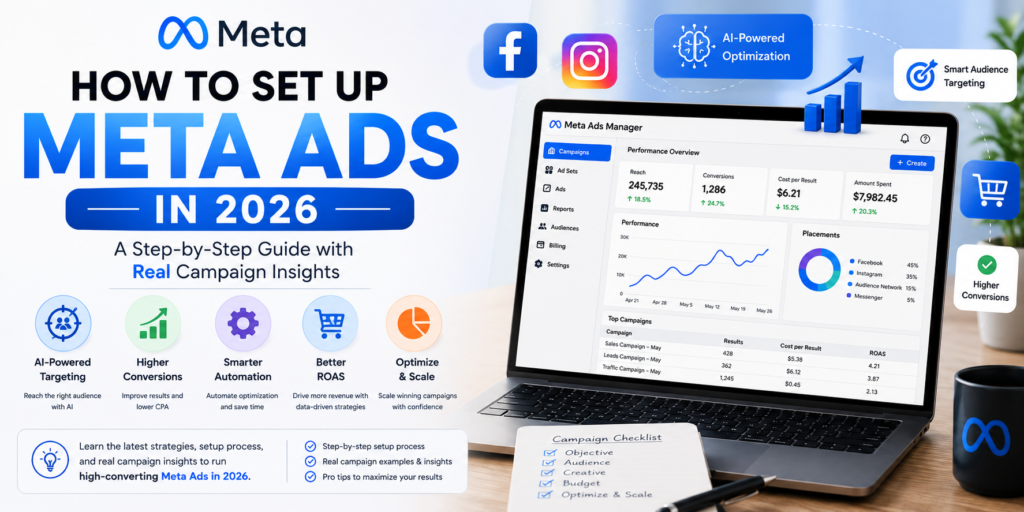
Introduction Running digital ad campaigns on Facebook and Instagram has changed dramatically over the last few years. If you are trying to figure out How to Set Up Meta Ads in 2026: A Step-by-Step Guide with Real Campaign Insights, you have likely realized that the old strategies of manual micro-targeting and static image ads no longer deliver high return on ad spend (ROAS). In 2026, Meta’s ecosystem is powered by artificial intelligence, automated machine learning, real-time creative optimization, and Advantage+ shopping campaigns. Advertisers who adapt to these updates achieve significantly lower cost-per-acquisition (CPA) and higher conversion rates. Conversely, brands relying on outdated frameworks bleed ad budget quickly. Whether you are an eCommerce business owner, a B2B marketer, or an entrepreneur, this long-form guide walks you through every single phase of building high-converting Meta advertising campaigns. You will learn how to configure your business foundation, launch campaigns with precision, and scale winning creatives using actionable data from real campaigns. 1. What Has Changed in Meta Advertising for 2026? To maximize paid traffic performance, it is crucial to understand how Meta Ads Manager has evolved. In 2026, Meta prioritizes algorithmic automation over manual lever-pulling. The Shift to Meta Advantage+ and AI Targeting Previously, media buyers spent hours tweaking age brackets, interest combinations, and geographic radius. In 2026, Meta Advantage+ Audiences handle audience discovery by using machine learning models that analyze user intent, messaging interaction, and dynamic behavior. Rather than constraining Meta with narrow interest targeting, top advertisers set broad parameter controls and let AI identify high-intent buyers based on ad interaction patterns. First-Party Data & Meta Conversions API (CAPI) With third-party tracking restrictions standard across all major browsers and mobile operating systems, browser-based Meta Pixels are no longer sufficient on their own. Server-side tracking via Meta Conversions API (CAPI) is essential for data collection accuracy. When implemented properly alongside website server logs, CAPI routes user actions directly to Meta’s servers, restoring signals that ad blockers or browser privacy tools normally strip out. 2. Essential Prerequisites Before Launching Your Meta Campaign Before creating your first campaign inside Meta Ads Manager, ensure your backend setup is fully verified and connected. Step 1: Secure Your Meta Business Manager Create or audit your account via Meta Business Suite. Connect your official Facebook Page and Instagram Business Account. Assign appropriate role-based permissions (Admin, Finance, Employee). Set up Two-Factor Authentication (2FA) for all users to protect asset security. Step 2: Implement Meta Pixel and Conversions API (CAPI) Installing backend tracking ensures proper event attribution: Navigate to Meta Events Manager and choose Connect Data Sources. Select Web and generate your Meta Pixel snippet. Integrate CAPI directly via your website’s CMS (such as WordPress or Shopify) or use custom server-side Google Tag Manager (GTM) setups. Verify server-to-browser event deduplication to avoid counting conversions twice. If you want your website infrastructure to seamlessly pass tracking data to ad platforms, working with professional Website Development Services in Mumbai ensures clean code execution and seamless API server scripts. Step 3: Domain Verification and Aggregated Event Measurement Verify your web domain directly under Business Settings > Brand Safety > Domains. Add the generated TXT record to your DNS configuration. Once verified, configure your top eight conversion events in Aggregated Event Measurement, prioritizing high-value actions like Purchase, Initiate Checkout, and Lead Generation. 3. Mastering the Setup of Meta Ads in 2026: Step-by-Step Execution Once your pixel, domain, and Business Suite are configured, follow this step-by-step breakdown to launch your campaign. Step 1: Select the Proper Campaign Objective Click the green + Create button inside Meta Ads Manager. Meta groups objectives into six distinct categories: Campaign Objective Ideal Use Case Primary Metric Sales eCommerce, direct purchases, catalog promotion ROAS, Cost Per Purchase Leads Contact forms, consult calls, CRM capture Cost Per Lead (CPL) Engagement Video views, messaging, page interactions Cost Per Engagement Traffic Content views, blog readership Cost Per Outbound Click Awareness Top-of-funnel reach, brand recall CPM, Reach App Promotion Mobile application downloads and events Cost Per Install (CPI) Pro Tip: Avoid using “Traffic” campaigns when seeking leads or purchases. Meta delivers traffic campaigns primarily to users who click links often, not necessarily users who convert. Step 2: Configure Campaign Budget Optimization (CBO) vs. ABO Advantage Campaign Budget (CBO): Meta distributes a single pool of money across all ad sets dynamically based on real-time opportunities. Ideal for scaling proven creatives. Ad Set Budget Optimization (ABO): Sets specific daily budgets for each ad set. Ideal for isolated audience testing and creative variations. Step 3: Define Target Audience and Placements at the Ad Set Level Inside the Ad Set setup: Locations & Demographics: Set target countries or local postal codes. Keep demographic filters flexible unless your product is explicitly age-restricted. Advantage+ Placements: Allow Meta to serve your ads dynamically across Facebook Feeds, Instagram Reels, Stories, Audience Network, and Messenger. In 2026, machine learning allocates delivery where impression costs are lowest and conversion likelihood is highest. Step 4: Craft Winning Creative and Copy at the Ad Level Ad creatives do heavy targeting work in modern ad ecosystems. Use a mix of: Vertical Video (9:16): Short-form UGC (User-Generated Content), customer unboxings, and problem-solution reels. Carousel Formats: Highlight individual product features, customer testimonials, or multi-step service benefits. Direct Copy Frameworks: Implement the PAS (Problem-Agitate-Solution) or AIDA (Attention-Interest-Desire-Action) writing structures. Ensure your core value proposition is featured prominently within the first 3 seconds of video or first 2 lines of text. 4. Real Campaign Insights: What Data Teaches Us in 2026 To understand how to succeed with Meta Ads in 2026, let us analyze real performance data gathered from active e-commerce and lead-generation ad accounts. Case Study A: E-Commerce Brand (Advantage+ Shopping vs. Manual Campaigns) A apparel brand split $20,000 across two distinct strategies over 30 days: Strategy A (Manual Audiences): Utilized 5 Interest Ad Sets with ABO Budgeting and static product creatives. This setup yielded a 2.1x ROAS with a $42 CPA. Strategy B (Advantage+ Shopping): Implemented 1 Broad Advantage+ Campaign with CBO Budgeting alongside dynamic UGC and catalog visuals.
Unlocking Business Growth with the Best Custom Software Development Company in India
In today’s hyper-competitive digital economy, off-the-shelf software applications often fall short of meeting unique business requirements. Organizations are increasingly searching for the Best Custom Software Development Company in India to build scalable, high-performance systems that align precisely with their operational workflows. Whether you operate a nimble startup or manage a sprawling global enterprise, generic applications introduce operational bottlenecks, security vulnerabilities, and integration challenges. Partnering with a specialized software engineering firm allows businesses to harness bespoke software development methodologies, transforming complex challenges into streamlined digital assets. India has evolved into the world’s premier tech hub, housing elite engineering talent capable of delivering cutting-edge digital products. From automated enterprise architectures to immersive web and mobile platforms, Indian engineering firms deliver exceptional value without compromising on code quality or global security standards. Why Modern Enterprises Need Tailor-Made Solutions Generic software products are designed to appeal to a broad audience, meaning they are packed with unnecessary features while lacking the specific workflows your organization demands. When companies rely on rigid frameworks, productivity often dips. This is where specialized tailor-made software solutions make a profound difference. By investing in custom engineering, businesses retain absolute ownership of their digital infrastructure. Furthermore, custom applications scale effortlessly alongside corporate growth. As user bases expand and transaction volumes multiply, your software adapts dynamically, ensuring zero downtime and continuous operational excellence. Core Capabilities of a Top Software Development Company in India A premier technology partner does not merely write code; they architect comprehensive digital ecosystems. When evaluating a competent software development company in India, it is vital to review their technical breadth across multiple modern domains: 1. End-to-End Software Development Comprehensive product engineering covers everything from initial discovery, UI/UX wireframing, and database architecture to rigorous QA testing and post-launch deployment. Opting for end-to-end software development guarantees that every component of your application syncs harmoniously. 2. Web Application Development and Mobile Solutions Digital presence extends across multiple screens. Engaging a proficient partner ensures seamless web application development utilizing progressive frameworks like React, Angular, and Node.js. Additionally, native and cross-platform mobile app development company competencies ensure your enterprise engages customers effectively on iOS and Android devices. 3. Scalable Enterprise and SaaS Products Modern companies demand flexibility. Leading providers excel in SaaS application development and robust cloud-based software development, leveraging serverless architectures, microservices, and platforms like AWS, Microsoft Azure, and Google Cloud. Furthermore, integrating a specialized CRM software development strategy allows sales and support teams to nurture leads and elevate customer satisfaction metrics effortlessly. Navigating the Software Engineering Lifecycle Understanding how technical partners execute complex projects helps decision-makers prepare for a seamless transition. A transparent development lifecycle minimizes risks and ensures timely delivery. Discovery and Requirement Analysis: Engineers map business goals, analyze target audiences, and define technical scopes. Architecture and Prototyping: Designers craft interactive wireframes and establish database schemas. Agile Development: Developers write modular, clean code utilizing continuous integration and continuous deployment (CI/CD) pipelines. Comprehensive Quality Assurance: Automated and manual testing phases eliminate bugs, latency issues, and vulnerabilities. Deployment and Maintenance: Smooth transitions to live environments accompanied by ongoing server monitoring and security patching. To explore how these structures are implemented in real-world scenarios, review insights from industry authorities on Software Engineering Institute Standards and benchmark your technical requirements against global frameworks detailed by IEEE Computer Society. Evaluating the Top Custom Software Development Company in India Selecting the ideal technology vendor requires careful analysis of multiple qualitative and quantitative metrics. Business leaders must look beyond marketing claims and evaluate foundational criteria: Technical Competence & Stack Diversity: Ensure the team possesses deep expertise in modern programming paradigms, API integrations, and database management. Industry Experience: A portfolio spanning fintech, healthcare, retail, and manufacturing demonstrates adaptability to diverse regulatory and operational environments. Transparent Communication: Time-zone flexibility, agile sprint reviews, and dedicated project management channels are indispensable for cross-border collaboration. For instance, companies seeking robust enterprise integrations often explore specialized offerings like those found at Nucleosys Tech Custom Application Development to bridFge technical gaps efficiently. Partnering with Nucleosys Tech for Scalable Innovation Finding a reliable technology ally can determine the trajectory of your digital venture. Organizations aiming for high performance, modular architecture, and rapid time-to-market often look toward trusted industry players. A strategic engagement with a seasoned firm guarantees that your software investments yield measurable dividends. Whether you need a complex customer relationship management tool, a secure cloud infrastructure, or an intuitive mobile application, working with industry veterans ensures future-proof outcomes. To understand how structured web solutions and marketing synergy drive business growth, you can read more about comprehensive strategies at the Nucleosys Tech Digital Marketing Blog. Furthermore, exploring the core offerings available at Nucleosys Tech provides clear visibility into custom product engineering. Transform Your Digital Vision Into Reality In an era where software dictates market leadership, standing still is equivalent to moving backward. Building custom applications empowers your organization to automate redundant tasks, protect sensitive data, and deliver exceptional experiences to your end-users. Don’t let rigid, out-of-the-box software constrain your business potential. Collaborate with industry experts who understand your unique vision and possess the technical discipline to bring it to life. Ready to scale your business with robust, tailor-made technology? Contact Nucleosys Tech today to schedule your consultation with the Best Custom Software Development Company in India! Frequently Asked Questions (AEO & SEO) What is custom software development? Custom software development is the process of designing, building, deploying, and maintaining software applications tailored specifically for a distinct set of users, functions, or organizations, unlike commercial off-the-shelf software (COTS) packaged for a mass market. Why choose a custom software development company in India? Choosing an Indian software development partner grants you access to top-tier engineering talent, cost-effective project execution, robust technical versatility across emerging tech stacks, and adherence to international quality and data security standards. How much does custom software development cost in India? The cost of custom software development in India varies depending on project complexity, feature sets, technology stack, and timeline. However, Indian firms generally offer competitive hourly or project-based rates that provide
AI-Powered CRM: Future of Sales Automation
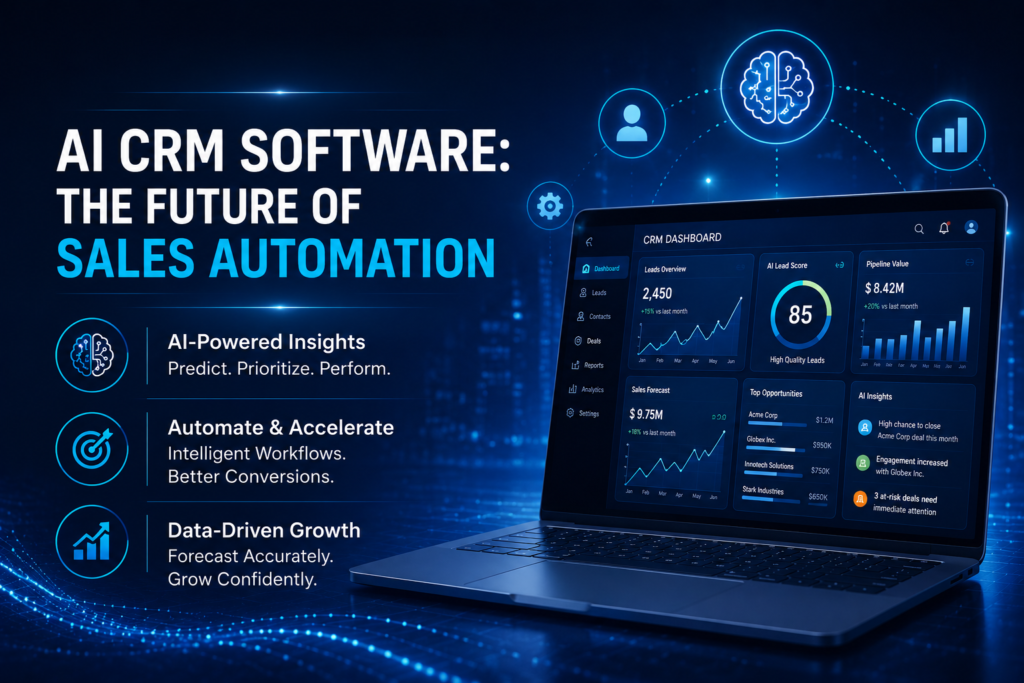
In the hyper-competitive digital landscape, data dictates the success of corporate operations. Modern sales teams no longer struggle with a lack of lead information; instead, they face structural bottlenecks in filtering actionable opportunities. Traditional systems act as digital ledger books, requiring manual tracking, tedious entry protocols, and fragmented communication setups. However, the introduction of specialized AI CRM Software has initiated a paradigm shift in data management. By unifying scattered metrics with self-learning models, modern platforms turn passive data collection into proactive, intelligent operations. Implementing advanced AI CRM Software allows enterprises to transcend standard operational boundaries, unlocking real-time data visibility, automated pipelines, and accelerated pipeline conversion velocities. For high-growth organizations aiming to scale effectively, manual lead filtering is no longer sustainable. The integration of an intelligent pipeline infrastructure shifts your team’s focus from administrative management to closing high-value deals. Across global markets, business leaders are realizing that manual tracking cannot match the execution speed of modern, automated ecosystems. The transition to an AI-powered CRM: The Future of Sales Automation represents a fundamental structural upgrade. It turns historical records into predictable revenue channels while freeing up internal human capital. The Genesis of Sales Transformation: Embracing AI CRM Software Legacy customer relationship management solutions were designed as systems of record. Sales professionals spent hours logging phone calls, archiving emails, and updating status fields manually. This operational lag frequently resulted in outdated metrics and missed deal conversions. Today, selecting an advanced AI CRM Software suite changes the dynamic from manual tracking to automated execution. Integrating artificial intelligence directly into your core enterprise applications creates a continuous cycle of process optimization. An enterprise-grade, AI Powered CRM works quietly in the background, analyzing operational history, interpreting client text patterns, and predicting buying signals before your sales reps even pick up the phone. This shift gives organizations a distinct competitive advantage, replacing guesswork with data-driven strategic decisions. Core Pillars of a Modern Intelligent CRM Building a highly productive modern enterprise requires deploying tools that go beyond basic contact storage. True CRM Automation leverages interconnected models to manage complex administrative workflows seamlessly. An Intelligent CRM operates across three main functional pillars: 1. Advanced Automated Data Architecture Instead of relying on reps to copy-paste information, an advanced AI CRM Software platform pulls context directly from emails, calendars, financial records, and historical communication trails. This eliminates blind spots and ensures account records remain accurate and up-to-date without human intervention. 2. Deep Customer Insights and Predictive Text Analysis By using Natural Language Processing (NLP), the software analyzes client emails and voice interactions to measure customer sentiment. These real-time Customer Insights help teams adjust their communication strategies on the fly, tailoring pitches to align perfectly with the client’s current sentiment. 3. Dynamic Workflow Automation When a prospect views a pricing page or downloads a whitepaper, the platform immediately triggers context-aware follow-up sequences. This level of CRM Automation guarantees that high-intent accounts receive immediate attention, keeping hot leads from slipping through the cracks. Maximizing Conversion Rates with AI-Driven Lead Scoring One of the biggest drivers of sales inefficiency is time spent chasing cold prospects. Standard platforms organize prospects based on rigid, manual rules that fail to capture shifting purchasing behaviors. In contrast, an AI Powered CRM processes historical buyer profiles to establish an accurate, automated model for Lead Scoring. This intelligent engine calculates conversion probabilities based on hundreds of data points, including: Specific corporate roles and operational sizes. Exact engagement frequencies across digital assets and content downloads. Intent signals, such as pricing page views and feature comparisons. Historic sales velocity patterns for similar market sectors. This automated prioritization ensures account executives focus their energy on prospects with the highest statistical probability of conversion. As a result, companies experience shorter sales cycles and significantly higher average contract values. Strategic Precision with Predictive Sales Forecasting Accurate financial projection is a cornerstone of sustainable business scaling. Yet, traditional forecasting models often rely on subjective updates from individual reps. Embracing comprehensive Sales Automation Software removes this human bias from revenue tracking. By continuously analyzing the current deal pipeline alongside historic closed-won records, the system generates accurate models for Sales Forecasting. This deep analytical approach allows leadership teams to predict quarterly revenues, balance inventory demands, and allocate budgets with precision. Furthermore, these predictive systems help flag at-risk accounts early. If an active opportunity shows a sudden drop in communication frequency or prolonged pipeline stagnation, the platform alerts managers immediately. This allows teams to step in with targeted retention campaigns before the deal stalls completely. Architectural Growth: Custom AI CRM Development Off-the-shelf software solutions often force scaling businesses to alter their internal workflows to fit the tool’s limitations. For enterprises managing proprietary workflows or complex cross-functional operations, investing in custom AI CRM Development is the ideal path forward. Building a custom system allows you to embed targeted algorithmic logic directly into your unique workflow setup. Whether you need to connect with legacy supply chain tools, integrate custom enterprise resource databases, or build proprietary compliance guardrails, dedicated development ensures complete structural alignment. Developing a tailored application turns your operational software into a proprietary asset that drives long-term market differentiation. Driving Revenue Velocities via CRM for Lead Generation Top-of-the-funnel growth requires constant, contextual communication across multiple channels. Deploying a dedicated CRM for Lead Generation transforms how organizations locate, nurture, and convert potential customers. Instead of executing broad blast marketing campaigns, an Intelligent CRM builds distinct customer personas based on actual engagement patterns. It identifies which target groups engage most with specific content, allowing your marketing teams to refine their campaigns for maximum ROI. Once new leads enter the pipeline, automated nurturing flows handle introductory outreach. By using historical data to determine optimal delivery times and messaging structures, the software delivers hyper-personalized content that keeps prospects engaged until they are ready to talk to a sales representative. Engineering Seamless Workflows: The Power of Sales Automation Software When enterprises combine predictive capabilities with robust Sales Automation Software, they eliminate the friction that typically slows down growing sales teams. Administrative tasks—like routing leads,
CRM vs ERP: Complete Comparison for Modern Businesses
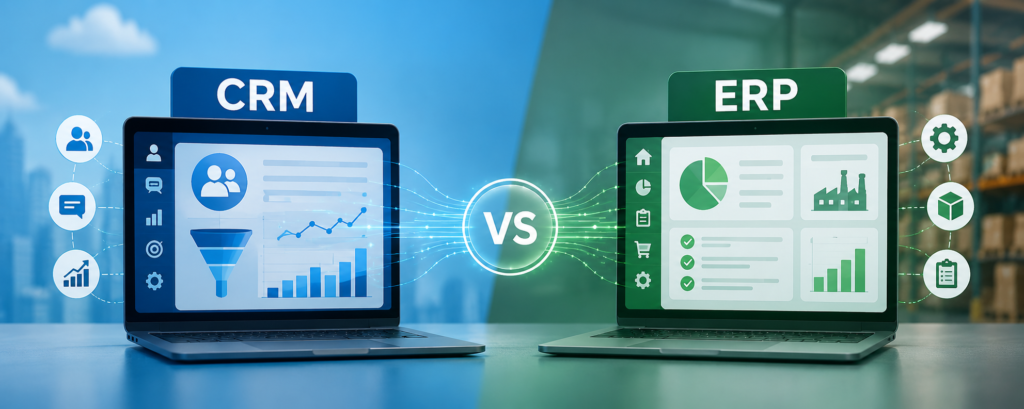
In the modern competitive corporate environment, scaling an enterprise requires maximum operational efficiency and structured client management. To achieve this, companies constantly invest in high-performance digital infrastructure. However, choosing the right corporate framework often sparks a common debate: CRM vs ERP: Complete Comparison. Organizations frequently find themselves evaluating CRM Software and ERP Software to determine which system will best optimize their daily workflows. While both platforms serve as the technological backbone for growing companies, they approach business optimization from entirely different angles. One system focuses on accelerating revenue and managing external client relations. Conversely, the other system manages internal back-end resources, financial supply chains, and manufacturing pipelines. Choosing blindly between these systems can result in redundant expenditures and fragmented data silos. Therefore, understanding the distinct operational scopes, core features, and overlapping functionalities of these systems is crucial. This detailed analysis explores the architectural CRM vs ERP Differences. Additionally, we will discuss how a strategic CRM ERP Integration can transform your enterprise into a highly synchronized, data-driven machine. Understanding the Core Frameworks: What is CRM and ERP? To accurately evaluate a CRM vs ERP: Complete Comparison, we must first dissect each system individually. These platforms form the cornerstone of modern corporate architecture. However, they cater to separate operational departments within an organization. What is CRM Software? CRM stands for Customer Relationship Management. This specialized system is engineered to manage every stage of a customer’s lifecycle. The primary goal of a CRM is to streamline customer acquisition, boost retention, and accelerate direct sales revenue. It functions as a central repository for all front-office activities. This allows your sales, marketing, and customer support departments to access real-time client histories instantly. By leveraging automated customer tracking, companies can eliminate manual documentation. This allows teams to focus entirely on closing deals. For organizations seeking custom applications tailored to unique sales funnels, exploring specialized CRM Software Development provides customized dashboards that align perfectly with specific growth metrics. What is ERP Software? ERP stands for Enterprise Resource Planning. While a CRM focuses entirely on the front-office client experience, ERP systems focus heavily on back-office operational mechanics. This architecture is built to manage, automate, and integrate core internal business processes across multiple departments. These departments include finance, human resources, procurement, inventory tracking, and distribution. An ERP platform establishes a single, unified database for the entire company. This setup ensures that your accounting team, supply chain managers, and warehouse supervisors all operate using the exact same data. For specialized industrial operations, implementing a robust Manufacturing Custom ERP system is vital to synchronize raw material procurement with floor production schedules. CRM vs ERP Differences: The Ultimate Breakdown Understanding the fundamental distinctions between these systems requires a deep dive into their daily operational objectives. Below is a detailed comparison of how these tools manage data, workflows, and operational scaling. Comparative Parameter CRM Software ERP Software Primary Operational Focus Front-Office Operations (Sales, Marketing, Customer Support) Back-Office Operations (Finance, Supply Chain, HR, Logistics) Core Objective Driving revenue growth, maximizing sales, and increasing customer retention Lowering operational costs, enhancing process efficiency, and ensuring financial accuracy Primary Target Users Sales Reps, Marketing Executives, Customer Success Agents Accountants, Inventory Managers, HR Professionals, Operations Leads Data Management Scope Customer interaction history, lead pipelines, support tickets, marketing campaigns General ledgers, payroll records, manufacturing schedules, supply chains Financial Tracking Sales pipelines, individual deal values, customer lifetime value (LTV) Profit margins, corporate balance sheets, operational overhead, billing Core Features of Modern CRM Software A comprehensive CRM vs ERP: Complete Comparison requires a close look at the specific features that drive front-office growth. A modern CRM system is far more than just a digital address book. It serves as a comprehensive engine for sales and marketing automation. 1. Advanced Sales Automation Managing pipelines manually can lead to missed follow-ups and lost revenue. Modern CRMs utilize Sales Automation to instantly route inbound leads to the appropriate sales representatives. They automatically trigger personalized email drip campaigns and send real-time reminders for follow-up calls. This ensures no high-value opportunity slips through the cracks. 2. Comprehensive Contact and Lead Management A CRM records every digital interaction a prospect has with your brand. From the initial website form submission to email clicks and support conversations, your sales team gains full visibility into the prospect’s journey. This deep context allows for highly personalized sales pitches that significantly boost conversion rates. 3. Automated Customer Support Pipelines Retaining existing clients is often more cost-effective than acquiring new ones. CRM platforms include built-in ticketing frameworks that organize, prioritize, and track customer issues. This ensures that support agents can resolve customer inquiries quickly and accurately. Core Features of Enterprise ERP Systems On the other side of our CRM vs ERP: Complete Comparison are the robust, back-office optimization capabilities found within modern enterprise ERP systems. These tools focus on resource maximization and cross-departmental alignment. 1. Unified Financial and Accounting Control The foundational module of any ERP system is its centralized accounting ledger. It automates complex corporate financial management processes, such as tracking accounts payable and receivable, managing payroll, and generating real-time balance sheets. This eliminates manual data entry errors and ensures strict compliance with tax regulations. 2. Comprehensive Supply Chain and Inventory Tracking For businesses that handle physical inventory, an ERP provides real-time visibility into stock levels across multiple warehouses. It tracks items from raw material procurement to final customer delivery. This comprehensive tracking helps prevent costly stockouts and minimizes excessive warehouse storage fees. 3. Integrated Workflow Automation An enterprise cannot scale efficiently when departments operate in silos. ERP frameworks introduce comprehensive Workflow Automation across the entire organization. For example, when a sales order is officially placed, the ERP can automatically update inventory logs, generate a warehouse packing slip, and create a financial invoice without requiring human intervention. ERP for Manufacturing: Driving Industrial Efficiency While service-oriented businesses often rely on lightweight accounting tools, an ERP for Manufacturing is absolutely essential for industrial, production-heavy organizations. Manufacturing workflows involve complex variables, including fluctuating raw material costs, equipment upkeep schedules, and intricate labor management.